By Staff Reporter
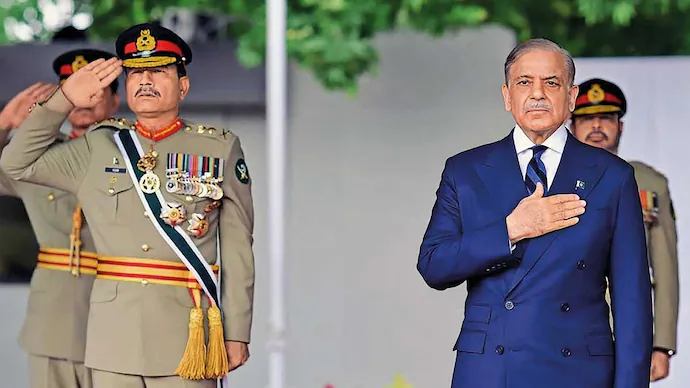
ISLAMABAD: Prime Minister Shehbaz Sharif and army chief Asim Munir have shared first place with the leaders of Saudi Arabia and Turkey in the annual ranking of the world’s 500 most influential Muslims, the first time the list has had joint leaders.
Sharif and Field Marshal Munir, who is Chief of Defence Forces and Chief of the Army Staff, appear at the top alongside the Saudi king, Salman bin Abdulaziz, Crown Prince Mohammed bin Salman and the Turkish president, Recep Tayyip Erdogan.
The list is compiled by the Royal Islamic Strategic Studies Centre (RISSC), a research institute in Amman, Jordan. It has published ‘The 500 Most Influential Muslims’ every year since 2009. This year’s is the 18th edition and is labelled 2027.
The centre said the unusual top ranking, which covers five people in three shared entries, reflects the Makkah Joint Defence Agreement between the three countries.
“The main reason for this historic decision is the Makkah Joint Defence Agreement,” the edition said. It described the unified top spot as representing “a massive shift in how Muslim nations are working together to protect one another”.
The report said the pact “unites the immense wealth of Saudi Arabia, the advanced tech and manufacturing of Turkiye, and the powerful military strength of Pakistan into a collective alliance”. Modelled on a “one for all, all for one” approach to security, it added, the agreement has “completely reshaped regional politics”.
The agreement, signed in Makkah on 7 August, allows each member state to treat an attack on one of them as an attack on all. It links Pakistan, the only nuclear-armed Muslim country, with Saudi Arabia, home to Islam’s holiest sites, and Turkey, which has Nato’s second-largest military. It builds on a bilateral defence accord between Riyadh and Islamabad signed in September 2025. Ankara said at the time that the arrangement did not conflict with its Nato commitments.
The report also acknowledged Pakistan’s difficult year. It said the country had “navigated an intricate set of economic stabilisation challenges, regional security pressures, and major-power diplomatic balancing acts”. It noted that Islamabad pursued “regional shuttle diplomacy” in the Middle East to press for de-escalation, “even as domestic energy markets faced immediate pressures via elevated import costs and emergency fuel conservation measures”.
Pakistan’s information minister, Attaullah Tarar, welcomed the ranking on X. “A moment of gratitude for every Pakistani,” he wrote. “From Marka-i-Haq to global diplomacy, they walked this journey together. This honour is a tribute to the sacrifices of our martyrs and the unity of our nation.” Marka-i-Haq is Pakistan’s name for its conflict with India in May 2025.
Behind the joint leaders, Iran’s Supreme Leader, Ayatollah Mojtaba Khamenei, is placed fourth and King Abdullah II of Jordan fifth. Qatar’s emir, Sheikh Tamim bin Hamad Al-Thani, is sixth.
The Pakistani scholar Sheikh Muhammad Taqi Usmani is seventh. The UAE president, Sheikh Mohamed bin Zayed Al-Nahyan, is 12th and Egypt’s president, Abdel Fattah El-Sisi, is 22nd. Another Pakistani scholar, Maulana Tariq Jamil, is 32nd.
The Liverpool footballer Mohamed Salah is 39th. The Palestinian president, Mahmoud Abbas, is 45th and Syria’s interim president, Ahmed Al-Sharaa, is 46th. New York City’s mayor, Zohran Mamdani, is 49th.
The honourable mentions in politics include the Hamas leader Khalil Al-Hayya, the jailed former Pakistani prime minister Imran Khan, the London mayor, Sadiq Khan, and the US senator-elect Abdul El-Sayed.
In the category covering social issues, science, arts and culture, media and sport, honourable mentions went to Jordan’s Queen Rania, the British composer Sami Yusuf, the Palestinian journalist Bisan Owda, the British-American broadcaster Mehdi Hasan and the Egyptian comedian Bassem Youssef.
The centre also names a Man and Woman of the Year. The man is Dr Hussam Abu Safiya, a Palestinian paediatrician. He was director of Kamal Adwan Hospital in northern Gaza and was detained by Israeli forces during a military operation there on 27 December 2024.
The report describes him as “a doctor who refused to abandon his patients, buried his son and returned to the wards”, who has now spent more than 600 days in Israeli custody without charge or trial. It says he documented attacks on medical facilities during the war and appealed for the protection of Gaza’s health infrastructure.
“A man with no army, no office and no freedom has done more than most governments to remind the world what courage and integrity look like,” it says.
The Woman of the Year is Fatemeh Zahra Sheikhabadi, a survivor of the attack on a girls’ elementary school in Minab, Iran. The report says a US missile hit the school on 28 February, killing more than 150 people, including over 100 children.
Sheikhabadi later travelled to Geneva to address the UN Human Rights Council, where she urged world leaders to “hear the voices of the children of Minab”.
“She is honoured not as a symbol of a war, but as herself,” the report says, “a girl who lost her friends and her teachers on an ordinary morning, and who lived to tell their story so that it would not be lost with them.”
Copyright © 2021 Independent Pakistan | All rights reserved