By Staff Reporter
ISLAMABAD: Pakistan’s army chief has called for sustained engagement and mutual trust with Iran after meeting Tehran’s foreign minister in Rawalpindi, while Washington continues to withhold its response to an Iranian offer to reopen the Strait of Hormuz within two days.
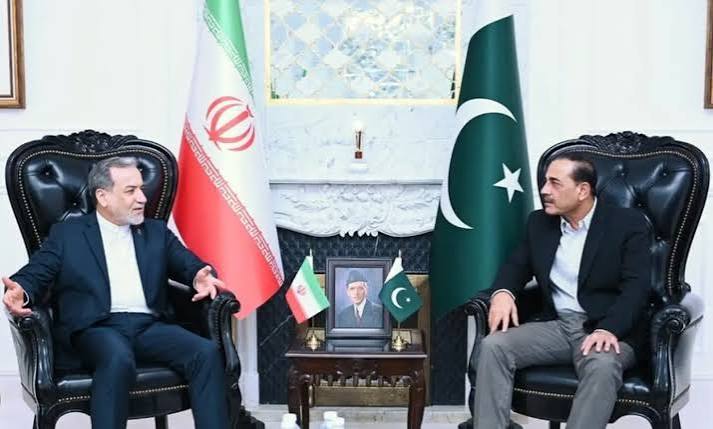
Field Marshal Asim Munir, who is both army chief and chief of defence forces, received Abbas Araghchi on Monday evening, at the General Headquarters, the military’s media wing said on Tuesday.
The Inter-Services Public Relations (ISPR) said the two men discussed “matters of mutual interest, regional security dynamics and evolving geopolitical developments” and exchanged views on ways to address common security challenges.
Field Marshal Munir “underscored the importance of sustained engagement, mutual trust and close coordination between the two brotherly countries for promoting regional peace and stability”, the statement said. Araghchi, it added, praised Pakistan’s “constructive role” and said Iran wished to strengthen bilateral relations.
The meeting capped a visit to Islamabad for the 30th meeting of the Economic Cooperation Organisation (ECO) Council of Foreign Ministers. Speaking to reporters, Araghchi was unambiguous about where Tehran stands on Pakistan’s mediation. “We trust Pakistan as a good friend, as someone that is trying its best, and we are satisfied of working with them,” he said.
Ishaq Dar, Pakistan’s deputy prime minister and foreign minister, said he had held “very candid, very frank, very brotherly, very comprehensive discussions” with Araghchi on the sidelines of the gathering. Iran, he said, had “fast-tracked” its seven-day proposal to reopen the Strait of Hormuz into a two-day plan.
“So, the response from the United States is pending. We have not given up hope or efforts. We are still doing our best [so] that the situation gets sorted out,” Dar said. He added that, with Washington no longer occupied by its midterm elections, he hoped it would reply “very soon”. He said both the seven-day and two-day plans were drawn from the Islamabad memorandum of understanding signed by Iran and the US in June.
Addressing the ECO ministers, Araghchi accused Washington of abandoning diplomacy. “Unfortunately, the United States chose a completely different path,” he said, citing aggression, threats, targeted assassinations, economic pressure and a blockade that he described as “blatant violations” of international law and the UN Charter.
He also had a message for his neighbours. “The territory, airspace and facilities of countries in the region must not become a platform for attacks against one another,” he said. Iranian media reported that the ECO’s final declaration backed Tehran’s two-day plan. Mr Araghchi invited ECO foreign ministers to the group’s 18th summit in Tehran.
The war began on 28 February, when the US and Israel launched a joint offensive that killed members of Iran’s leadership and demanded an end to nuclear-related activity. Tehran retaliated against Israel and Gulf states hosting American forces, sending global energy prices sharply higher.
Pakistan moved quickly to position itself as go-between. It brokered a ceasefire on 8 April and hosted direct US-Iran talks in Islamabad on 11 and 12 April, the highest-level contact between the two countries since the 1979 Islamic Revolution. Those talks ended without agreement, but the truce held and was later extended at Islamabad’s request.
The Islamabad memorandum, signed in June, set a framework for a permanent end to the war, for reopening the strait and for negotiations on Iran’s nuclear programme. The truce then collapsed, with each side accusing the other of violating it, and months of shuttle diplomacy led mainly by Pakistan and Qatar have failed to revive it.
Tehran says it will reopen the strait only if Washington meets its conditions, including the release of frozen assets abroad, sanctions relief and an end to the US naval blockade of Iranian ports.
Field Marshal Munir has been central to Pakistan’s effort. He visited Tehran on 24 August, where he met President Masoud Pezeshkian, Parliament Speaker Mohammad Bagher Ghalibaf and Araghchi. During a second visit on 21 October, Iranian leaders told him Washington must take the first steps to rebuild trust, and that US acceptance of Tehran’s seven-point proposal could provide a starting point for renewed negotiations.
Last month he was in the Iranian capital again, with officials from the other members of the Makkah defence pact, a grouping that also includes Saudi Arabia and Turkey. The talks took place amid concern over the conflict between Yemen’s Ansar Allah rebels and Saudi Arabia, the security of the Strait of Hormuz and the prospect of fresh US and Israeli strikes on Iran.
The public positions in Washington and Tehran remain far apart. Mohsen Rezaei, a senior Iranian security official, said last week that the strait would stay shut until the US met Tehran’s seven conditions. President Donald Trump has said the war is effectively over militarily, but that the US is ready to strike again.
Pakistan, for now, is waiting. Islamabad is due to host the apex committee of the Makkah alliance later this month.
Copyright © 2021 Independent Pakistan | All rights reserved