By Staff Reporter
ISLAMABAD: Pakistan has urged the Association of Southeast Asian Nations (Asean) to turn existing goodwill into concrete economic partnerships during the first visit to Islamabad by the bloc’s secretary general in more than two decades.
Prime Minister Shehbaz Sharif made the appeal to Dr Kao Kim Hourn on Thursday, a day after the Foreign Office described the trip as the “first high-level visit” to Pakistan by a delegation from the Asean Secretariat in over twenty years.
Behind the courtesies sits a request still awaiting an answer. Pakistan has sought to upgrade its standing with the grouping to full dialogue partner status, though a moratorium remains on new partnerships. Dr Kao acknowledged the request and said it was under consideration in line with Asean’s established procedures.
Asean, founded in 1967, has grown into one of the world’s fastest-growing markets, and Islamabad is eager for a larger share of it.
According to the Prime Minister’s Office, Sharif stressed the need to translate the “existing goodwill into concrete economic and development partnerships”. The two men discussed trade, investment and economic cooperation, along with food security, climate change, information technology and education.
Sharif also pitched Pakistan as a gateway to the wider region, pointing to its position at the crossroads of Central Asia, the Middle East and West Asia, and its potential to promote connectivity, trade and economic integration. Dr Kao thanked him for the hospitality, welcomed Islamabad’s interest in closer relations and expressed confidence that the visit would help advance the partnership.
At the Foreign Ministry, Deputy Prime Minister and Foreign Minister Ishaq Dar made the same case to the delegation, with more detail on how. He said Islamabad wanted to give its ties “greater practical substance” by drawing in businesses, universities and research institutions. He added that Asean’s nearly six decades of experience in bringing together countries of very different histories and economies offered lessons in integration and connectivity.
“In an increasingly fragmented world, Asean’s commitment to dialogue has particular significance,” Dar said.
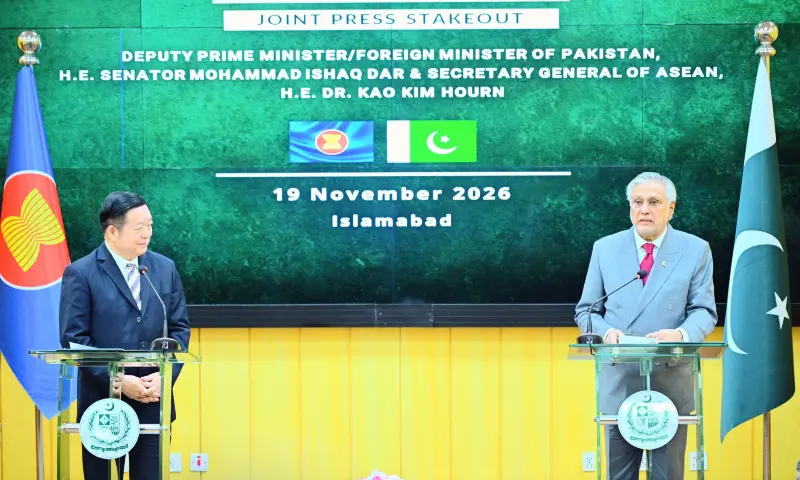
Speaking at a joint press stakeout after the talks, he said the two sides had agreed to work together on what he called non-traditional security threats.
“We agreed to enhance cooperation in addressing non-traditional security challenges, including climate change, food insecurity, disruptions to energy supplies and cyber threats,” he said. “Our ability to respond to these challenges together is vital to the security of our people and the sustainability of our development.”
Trade was central to the discussions, he said, including easing the movement of goods, improving connectivity and deepening digital integration. “Building on the Asean-Pakistan business conferences, we look forward to partnerships that connect businesses, open new markets and create more jobs,” he said. The talks also covered links between universities and research bodies, particularly in digital technologies and artificial intelligence, and more cultural, academic and youth exchanges.
The Gulf conflict took up a large part of the conversation. Dar voiced deep concern about its effect on energy security, maritime trade and global supply chains. Attacks on ships and critical infrastructure, and disruption to shipping through the Strait of Hormuz and the Bab al-Mandeb Strait, were driving up transport and energy costs, feeding inflation and squeezing households and businesses well beyond the region, he told the delegation.
He recalled that Pakistan had persuaded both Washington and Tehran to show restraint and bring their delegations to Islamabad, where they held a 21-hour session on 10 and 11 April. No final memorandum of understanding could be agreed then, he said, but further diplomacy led to its signing in June as the Islamabad Memorandum of Understanding. He also noted that during Pakistan’s presidency of the UN Security Council, Resolution 2788 was adopted unanimously after 12 years in which resolutions were often vetoed or passed only by majority.
Dr Kao praised Pakistan’s role in facilitating dialogue between the United States and Iran and in promoting de-escalation. He pointed to Asean leaders’ statement of 8 May, which welcomed the ceasefire between the two countries, and to a foreign ministers’ statement of 21 July. He said the Middle East crisis, with its geopolitical, economic and humanitarian implications, remained a key concern for the bloc.
The Asean chief described a global environment marked by intensifying geopolitical competition, economic uncertainty and erosion of the multilateral, rules-based order. He said the regional order was being recalibrated by the dynamics among major powers and the growing strategic agency of regional actors. He recalled that the 59th Asean Foreign Ministers’ Meeting in Manila in July had reaffirmed the bloc’s commitment to an open, inclusive, rules-based regional architecture, with Asean at its centre.
He also acknowledged Pakistan’s commitment to multilateralism during its 2025-26 term as an elected member of the Security Council.
Dr Kao urged Islamabad to use what Asean has to offer. “I would encourage Pakistan to make greater use of Asean’s various centres and institutions as a platform for capacity building, technical cooperation and knowledge sharing, drawing on experience and expertise available between our two sides,” he said.
He said the aim was to turn a long-standing relationship into “more substantive cooperation and tangible benefits”. He identified openings in renewable energy and in shared threats including terrorism, violent extremism, human trafficking and international crime. He also named digital transformation, maritime security, cybersecurity, tourism, small and medium-sized enterprises, smart cities and humanitarian cooperation as areas for expansion. He urged both sides to make full use of the existing Practical Cooperation Areas framework, which runs from 2024 to 2028, noting that the sectoral dialogue partnership would reach its 35th anniversary in 2028.
Dar used the meeting to set out Pakistan’s concerns closer to home. He called for “a just, durable and peaceful settlement of the longstanding Jammu and Kashmir dispute in accordance with relevant UN Security Council resolutions”. He criticised India’s unilateral decision to hold the Indus Waters Treaty in abeyance, which he said threatened water, food and energy security in Pakistan. He also raised Islamabad’s concern over the continued use of Afghan soil for terrorist attacks.
On the Middle East, he expressed concern over the expansion of illegal settlements in the West Bank, called for unhindered humanitarian aid to reach Gaza and reiterated Pakistan’s support for an independent Palestinian state.
“We look forward to giving fresh impetus to our partnership through practical cooperation that benefits our people,” Mr Dar said of the visit.
Pakistan has been a sectoral dialogue partner of Asean since 1993 and a member of the Asean Regional Forum since 2004. The bloc was founded on 8 August 1967, when Indonesia, Malaysia, the Philippines, Singapore and Thailand signed the Bangkok Declaration. It now has 11 members, including Brunei, Vietnam, Laos, Myanmar, Cambodia and East Timor.
Dr Kao is in Pakistan on a working visit from 18 to 20 November. The Foreign Office said the trip “underscores Pakistan and Asean’s shared commitment to deepening and diversifying cooperation”.
Pakistan has been courting the grouping for some time. Dar attended the 33rd Asean Regional Forum ministerial meeting in Manila earlier this year, where he listed the Kashmir dispute and India’s threats to Pakistan’s share of water among the challenges facing global stability. Last month, Sindh Chief Minister Murad Ali Shah urged Asean countries to look at investment in agriculture, food processing, pharmaceuticals, IT, energy, minerals, industry, logistics and tourism. Last year, seven Asean member states held a joint meeting with Investment Minister Qaiser Ahmed Sheikh to explore new avenues of investment and economic cooperation.
Copyright © 2021 Independent Pakistan | All rights reserved