By Staff Reporter
RISALPUR: Pakistan’s naval chief has warned India that it would be “unwise to need a second” lesson, 18 months after the nuclear-armed neighbours fought their most serious conflict in decades.
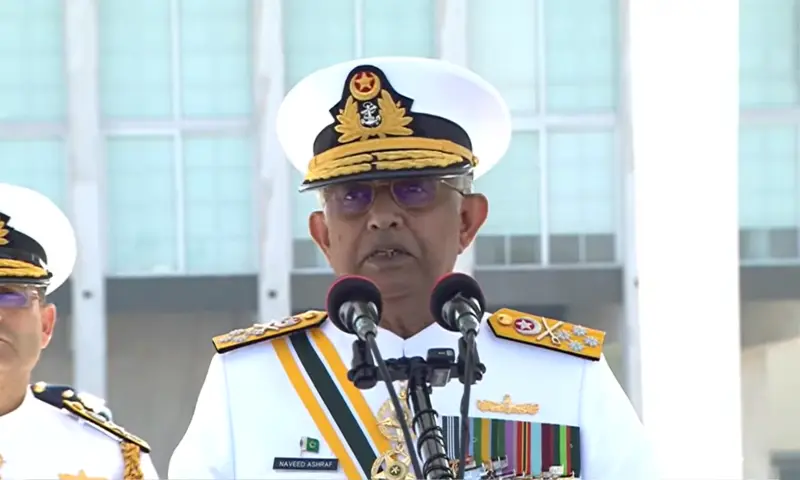
Admiral Naveed Ashraf, the Chief of the Naval Staff, told a graduation parade on Thursday that the armed forces were “invincible and capable to deter any aggression”. He said the navy’s combat capabilities “have recently undergone significant enhancement and transformation across all operational domains aligned with contemporary and future warfare demands”.
He was speaking at the Pakistan Air Force Academy Asghar Khan in Risalpur, in Khyber Pakhtunkhwa’s Nowshera district. It was his second appearance as chief guest at a graduation there this year. General Rafet Dalkiran, the Turkish air force chief, was also present.
Recalling the fighting of May 2025, Admiral Ashraf said: “I am sure our adversary has learned the lesson, and it would be unwise to need a second.”
The conflict followed the 22 April attack on tourists in Pahalgam, in Indian-occupied Kashmir, which India blamed on Pakistan and Islamabad denied. It ended on 10 May. Pakistan’s army calls the period Marka-i-Haq and its own military operation Bunyanum Marsoos, while India called its campaign Operation Sindoor. The US had mediated a ceasefire and since then relations between the nuclear-armed rivals remain frozen.
The admiral used the occasion to praise the host service. “For the first time in the history of warfare, the Pakistan Air Force conducted multi-domain operations chiefly comprising indigenous capabilities,” he said, singling out “the homegrown kill chain that was the highlight of the whole conflict”. He called it the outcome of “a very aggressive, innovative, and prudent strategy of modernisation and indigenisation in the past few years”.
The navy’s own role, he said, was to deter. It had “successfully deterred the Indian Navy from any hostilities at sea”, which “remained at bay throughout the conflict”.
Much of his address dealt with how war itself is changing. Its character, he said, had altered dramatically and was “evolving at an unprecedented pace”. “One of the key factors behind this transformation is the emergence of new technologies,” he said. “As such, warfare today is closely linked with technology, leading to revolutionary changes in concepts, doctrines and organisational restructuring.”
Conflicts, he added, were no longer confined to traditional battlefields and now spanned electronic warfare, cyber, space and cognitive domains. “More so, autonomous systems, artificial intelligence, and information warfare have reshaped the very texture of how battles are fought and won.”
He also pointed to a more dangerous regional picture, particularly the heightened tensions in the Middle East. “Geopolitical dynamics are shifting rapidly, presenting multifaceted security challenges that demand constant vigilance, strategic foresight, and remarkable operational readiness to deter conventional, as well as hybrid and asymmetric threats,” he said. The armed forces, he said, “are fully cognisant of such developments and have prepared accordingly”.
The most immediate test has been at sea. Operation Muhafizul Bahr, which means Protector of the Seas, was launched on 9 March after the war involving the United States, Israel and Iran disrupted shipping around the Strait of Hormuz, the route for much of Pakistan’s imported energy. The navy has said about 90 per \cent of the country’s trade moves by sea. Local media reported at the time that the escorts were limited to Pakistan-flagged vessels rather than convoys through the strait itself. Pakistan has since joined a Saudi-led coalition protecting shipping in the Red Sea and the Bab al-Mandab strait.
Admiral Ashraf said the operation was still “continuing successfully”.
He listed the hardware behind the navy’s claims of transformation: “The induction of state-of-the-art warships, Hangor-class submarines, indigenously developed long-range weapons, unmanned systems, and the establishment of Pakistan Maritime Science & Technology Park are some of the important developments taking place.”
The navy is due to receive eight Hangor-class submarines under a deal with China. The first arrived at Karachi in June and fired weapons live for the first time in the Arabian Sea in September. In mid-April the navy fired a locally developed anti-ship ballistic missile at an extended range, and days later tested an indigenous anti-ship weapon system called Taimoor. It had tested a ship-launched anti-ship ballistic missile in November last year. On Wednesday the army announced a successful test of the Fatah-3 supersonic cruise missile.
Admiral Ashraf described the navy and air force as “brothers in arms”, with the “maritime domain as our shared operational space”. “It is here we exercise together and shall fight alongside each other to defend our motherland,” he said. “God willing, together we shall prove equal to the task.”
His message was not only one of deterrence. Pakistan, he said, was a “peace-loving nation and always stands resolute to prioritise restraint, dialogue, diplomacy, regional stability and world peace”.
“But we know how to defend our motherland,” he continued. “In consistent pursuit of peace, our country and armed forces have rendered matchless sacrifices. We, as a nation, stand fully determined to continue our efforts until peace and stability are established in the region.”
Copyright © 2021 Independent Pakistan | All rights reserved