By Staff Reporter
ISLAMABAD: Pakistan’s economic recovery remains vulnerable to energy-price shocks, geopolitical tensions and tighter global financing, the International Monetary Fund said, projecting growth of 3.5% in fiscal 2027 and urging Islamabad to raise tax revenue and shift toward an export-led model.
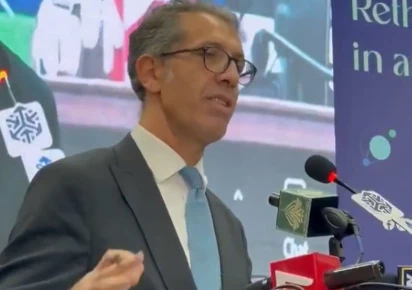
Mahir Binici, the Fund’s resident representative, told the 6th Pakistan Prosperity Forum on Thursday that the country has regained macroeconomic stability but that its weak growth is structural. Real per capita income is rising about 1.6% a year and investment is below 13% of gross domestic product. “Stabilisation is necessary, but not sufficient,” he said. The forum was organised by the Policy Research Institute of Market Economy under the theme “Growth in a Region of Crisis.”
The 3.5% projection is well short of the government’s 4% target for the year. In its October World Economic Outlook, the Fund kept growth unchanged and raised its fiscal 2027 inflation forecast to 9.9%. Binici said inflation should ease to about 8% by the end of the fiscal year, and that the current-account deficit is likely to widen slightly but stay under 1% of GDP.
The risks run through three channels, Binici said: a bigger energy import bill and a wider current-account gap; higher financing costs and tighter access to international markets; and weaker exports and remittances if protectionism and slower growth hit destination economies. He also pointed to higher sovereign yields, inflation pressures and cyber-related disruption. “Intensifying global economic shocks, including higher energy prices, geopolitical tensions, supply-chain disruptions and tighter international financial conditions, could undermine the country’s economic recovery and recently rebuilt external buffers,” he said.
Pakistan’s buffers are “still moderate,” Binici said, and the gains could be reversed if policy discipline weakens. He called for greater exchange-rate flexibility, monetary policy anchored to the medium-term inflation target, timely pass-through of energy prices with targeted support for vulnerable households, and continued fiscal consolidation and privatisation. External shocks are largely beyond Pakistan’s control, he said, but policy slippage is a risk the authorities can avoid.
Binici defended the State Bank of Pakistan’s tight stance, saying the central bank was among the first to respond to inflation after the Middle East conflict broke out. Inflation peaked above 11% and has since declined, he said, and the response helped keep expectations from de-anchoring. Official data show annual inflation eased to 9.6% in October from 10.3% in September, still well above the central bank’s 5%-7% target range. The SBP raised its policy rate by 50 basis points to 12% on Oct. 26. Binici said keeping market interest rates aligned with the policy rate remains one of the bank’s main liquidity-management tasks.
On the public finances, Binici said the improvement in the underlying primary surplus was not driven solely by central-bank profit transfers, because only part of those profits enters the calculation. First-quarter revenue targets were met, he said. Looking further out, he was more cautious. “To be candid on the medium-term outlook, we also project that the fiscal position over the medium term can weaken as imports rise and remittances moderate, so we have to continue building buffers,” he said.
Pakistan recently crossed 10% of GDP in tax revenue, Binici said, but needs to reach 15% to support stronger growth. He called for harmonising the general sales tax, broadening the base, rationalising withholding and minimum-tax regimes, and addressing exemptions and distortions. The IMF would like to see more salaried, retail and agricultural income brought into the net. Citing Fund research, he said a ratio of at least 10% can help countries escape a low-tax, low-growth trap, but only if governance and public spending also improve.
He also cited a 2023 IMF study of about 120 emerging and developing economies, which found that governance and external-sector reforms could raise output by up to 2.7% and 4.4% respectively over four years. For countries with larger starting gaps, the gains could reach 4% to 5%. Pakistan lags peers on governance and external-sector performance, while its business-regulation indicators are closer to the median. Preliminary Fund work calibrated to Pakistan suggests the payoff could be larger still.
Exports are the missing engine. Binici said they have slipped to about 10% of GDP, with many workers still in low-productivity agriculture. Trade data point the same way. The merchandise trade deficit widened almost 16% to $14.63 billion in the first four months of the fiscal year, as imports of about $26 billion outpaced 8.5% export growth to $11.34 billion. The current-account gap has been narrower than a year earlier, however, at $850 million for July-October, against $1.06 billion in the same period of fiscal 2026. The central bank’s reserves stood at $21.57 billion in the week ended Nov. 6.
Binici did not answer when asked whether Pakistan could avoid another IMF program after the current $7 billion Extended Fund Facility, which ends in September next year. Minister of State for Finance Bilal Azhar Kayani also did not address the question. The Fund and Pakistan reached a staff-level agreement in October that could unlock about $1.21 billion under the EFF and a climate-resilience facility, subject to Executive Board approval. That would bring total disbursements under the two programs to about $5.7 billion.
The talk of structural reform came alongside a debate over devolution. Kayani said the government fully supports devolving power, whether through local governments or new provinces, and that better education is not possible without it. “We have to achieve devolution one way or the other,” he said. He said cash grants do not solve the long-term problem and that the National Finance Commission formula needs a serious review, referring to the 1.035 trillion rupees ($) in cash grants the provinces have pledged this fiscal year to fund part of defence needs and large dams. Kayani also said the government has acted on exporters’ recommendations, including abolishing the Export Development Surcharge and cutting taxes.
Copyright © 2021 Independent Pakistan | All rights reserved