By Staff Reporter
ISLAMABAD: Pakistan’s large-scale manufacturing output grew 2.07% in the July-September quarter from a year earlier, but the gain rested on a handful of industries while food, textiles, pharmaceuticals and steel shrank.
The Pakistan Bureau of Statistics said Thursday that its provisional manufacturing quantum index averaged 116.38 points in the first quarter of fiscal 2026-27. The pace is well short of the 4.08% expansion recorded in the same period a year earlier, and below the 4.98% growth for the whole of fiscal 2025-26. Large-scale manufacturing accounts for about 8% of gross domestic product.
Of the 22 manufacturing sectors tracked, 12 expanded and 10 contracted. The figures show an industrial recovery concentrated in a few segments while several of the biggest industries keep losing ground.
September output rose 2.45% from a year earlier and 3.18% from August. The index stood at 116.79 that month, against 113.19 in August and 114.00 in September 2025. Production climbed 3.03% year-on-year in July and 0.65% in August, after a 3.48% contraction in June.
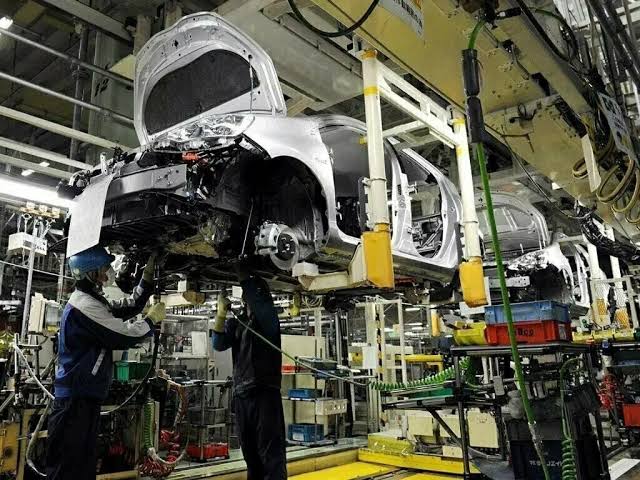
Garments led the quarter. Wearing apparel output rose 17.03% and added 2.91 percentage points to overall growth, the largest contribution of any sector. Automobiles added 1.26 points on a 32.67% gain, and petroleum products added 0.98 points on a 12.73% increase. Cement production rose 2.30%.
Car output is still growing at double digits, but far more slowly than before. Production rose 29.31% in September and 32.67% in the quarter, compared with 75.29% and 84.61% in the corresponding periods last year.
The statistics bureau also named wood products, other transport equipment, furniture and tobacco among the drivers of growth. Output rose 264.62% for wood products, 40.58% for other transport equipment, 27.73% for furniture and 22.38% for tobacco in the quarter.
The drags were larger in weight. Food production fell 9.43% in the quarter and 9.10% in September, reversing growth of 6.30% and 2.71% a year earlier, and almost all food products declined. The drop cut 1.26 percentage points from overall growth. Chemicals fell 9.55% and subtracted 0.77 points. Textiles fell 4.08% and subtracted 0.72 points. Pharmaceuticals fell 12.25%, extending last year’s contraction, and subtracted 0.71 points. Iron and steel products fell 11.77% and subtracted 0.49 points. Fertiliser output fell 7.81% in the quarter.
Textiles, the heaviest weight in the index at 18.16%, shrank 5.95% in September. Within the sector, cotton yarn rose 4.68% in September and 2.95% in the quarter, while cotton cloth was nearly flat. Garment output rose 17.69% in September, so the textile decline came from other parts of the sector.
The data arrive as policymakers confront a renewed inflation problem. The State Bank of Pakistan raised its policy rate by 50 basis points to 12% on Oct. 26, with nine of 10 committee members in favour. It cited the Middle East conflict, which is keeping global energy prices high, along with domestic wheat supply problems. Headline inflation eased to 9.6% in October from 10.3% in September, a third straight monthly decline but well above the central bank’s 5%-7% target. Average inflation for the first four months of the fiscal year reached 10.05%, compared with 4.79% a year earlier.
The central bank said in the same statement that economic activity is recovering gradually. It noted that large-scale manufacturing grew 1.9% in July-August, that private-sector credit was up 14.1% from a year earlier, and that reserves were stable at about $21.5 billion. It kept its fiscal 2026-27 growth forecast at 3.5% to 4.5%, after GDP grew 3.7% in fiscal 2025-26, and flagged risks from the Middle East conflict and adverse weather linked to El Niño. The bank also said a staff-level agreement had been reached with the International Monetary Fund.
Some analysts expect industry to broaden out. AL Habib Capital Markets said lower inflation, easing energy costs, better consumer demand, a revival in auto financing, improved cotton supply and anti-smuggling measures should support a wider recovery over the rest of the fiscal year. The central bank’s rate increase and its warning on energy prices point to risks on the other side.
Copyright © 2021 Independent Pakistan | All rights reserved