By Staff Reporter
ISLAMABAD: Pakistan has “unequivocally” condemned a Houthi strike on Riyadh’s tallest skyscraper, the headquarters of Saudi Arabia’s sovereign wealth fund, calling it a “grave violation” of the kingdom’s sovereignty.
In a statement on Friday that did not name the tower, the Foreign Office in Islamabad said: “This act of aggression constitutes a grave violation of the sovereignty of the Kingdom of Saudi Arabia.”
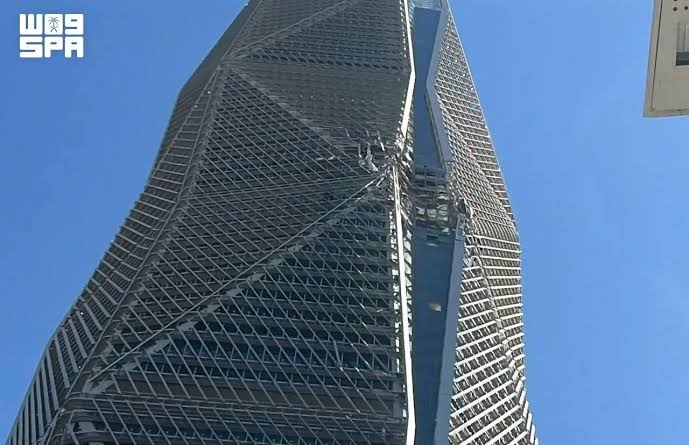
The attack on Thursday hit the Public Investment Fund (PIF) Tower in the King Abdullah Financial District. Saudi civil defence said it caused material damage to several floors and to neighbouring buildings. No injuries were reported. The state-run Saudi Press Agency did not identify the building in its statement, but a photograph published with it showed PIF Tower. Reuters reported that the strike blew out windows across seven to eight floors and bent parts of the metal facade.
The fund says it holds around $1tn in assets and owns EA and Newcastle United. It is central to Crown Prince Mohammed bin Salman’s drive to wean the kingdom off oil, and the strike landed on the symbol of that project.
Accounts of precisely what happened differ. Three sources familiar with the matter told Reuters that an incoming Houthi missile struck the building. The Saudi-led coalition said it had responded to a missile launched towards Riyadh and that debris had fallen. The Saudi foreign ministry said it reserved the right to take “all necessary measures” to defend its sovereignty and citizens.
In an early-morning statement, Houthi military spokesman Yahya Saree said the group had aimed cruise missiles at King Khalid International Airport and the financial centre in Riyadh.
It was the second time in less than two weeks that a Houthi attack damaged a landmark in the district, after Aramco’s building was hit on 8 November. Pakistan condemned that attack too, saying it stood firmly with Saudi Arabia and calling on the Houthis to halt their assaults immediately and unconditionally.
“The continued targeting of civilian infrastructure and economic facilities endangers innocent lives and poses a serious threat to regional peace and security,” the Foreign Office said. “Such reprehensible attacks must cease forthwith.”
Pakistan, it said, “stood firmly” with the Saudi government and people and supported the kingdom’s “legitimate right to defend its sovereignty and territorial integrity and to safeguard its citizens and residents”.
“Pakistan has been and will continue to make all efforts for achieving lasting peace and stability in the region,” the statement said.
Islamabad is a party to two defence agreements with Riyadh, the Makkah Joint Defence Agreement and the mutual defence pact signed in September 2025, under which an attack on one is treated as an attack on both. It has repeatedly voiced solidarity with the kingdom during the escalation.
Yemen’s frozen civil war reignited in July, during the US-Iran conflict, shattering a UN-brokered truce reached in 2022 that had largely halted cross-border attacks between the Saudi-led coalition, which backs Yemen’s internationally recognised government, and the Houthis, who control Sanaa.
Saudi airports and energy infrastructure have borne much of the pressure. October’s attacks on Saudi airports included a missile strike on Riyadh that killed 13 people. The Houthis have also claimed attacks on the East-West oil pipeline, which carries crude to Red Sea export terminals and offers an alternative to shipping through the Strait of Hormuz. The cost in Yemen is rising too: the International Organization for Migration said in October that more than 200,000 people had been displaced. Houthi authorities said Saudi airstrikes near Sanaa on 7 November killed at least 33 people, a claim Yemen’s government disputes by blaming a Houthi missile.
Copyright © 2021 Independent Pakistan | All rights reserved