By Staff Reporter
ISLAMABAD: Pakistan and 14 other countries, including Saudi Arabia, Egypt and Turkey, have urged the wider world to follow Britain and Australia in imposing sanctions over Israeli settlement expansion in the occupied West Bank.
The foreign ministers of Jordan, Somalia, Indonesia, Qatar, the United Arab Emirates, Kuwait, Algeria, Niger, Libya, the Maldives and Palestine also put their names to a joint statement, issued on Thursday by Pakistan’s foreign ministry. They said they hoped the two decisions “would encourage many in the international community to follow suit”.
Britain acted first, on Tuesday, sanctioning eight Israeli construction, property development and architecture firms it said had helped build or market housing and infrastructure in settlements. Those named included Har Hevron Development Company Ltd, Hemdat Shomron Ltd and SAG (Velvel) Construction and Development Ltd, and they face asset freezes and director disqualifications. The package came shortly before the final deadlines for the tender on the E1 project. London also sanctioned Tzav 9, an Israeli group it accused of blocking aid convoys bound for Gaza, in blockades as recent as October.
Australia followed on Wednesday with sanctions on three individuals and four organisations, among them, for the first time, a company involved in settlement construction. Daniella Weiss, leader of the settler organisation Nachala and an advocate for the expulsion of Palestinians from Gaza, is on the list, as is Eliav Libi, who has accelerated settlement growth through his construction company. Australians and Australian businesses are now barred from trading with, or supporting, any of them.
Foreign Minister Penny Wong said those sanctioned “have actively participated in the planning, coordination and establishment of new settlements, including raising funds, recruitment of volunteers and providing support to violent settlers”. She said violence at the E1 site in recent weeks had undermined the prospects of a two-state solution, and that she had told her Israeli counterpart, Gideon Saar, of the decision.
“I outlined our position … I said we do not agree with, we oppose the settlement activities,” Wong told ABC Radio. “We have had a long-standing position on this.”
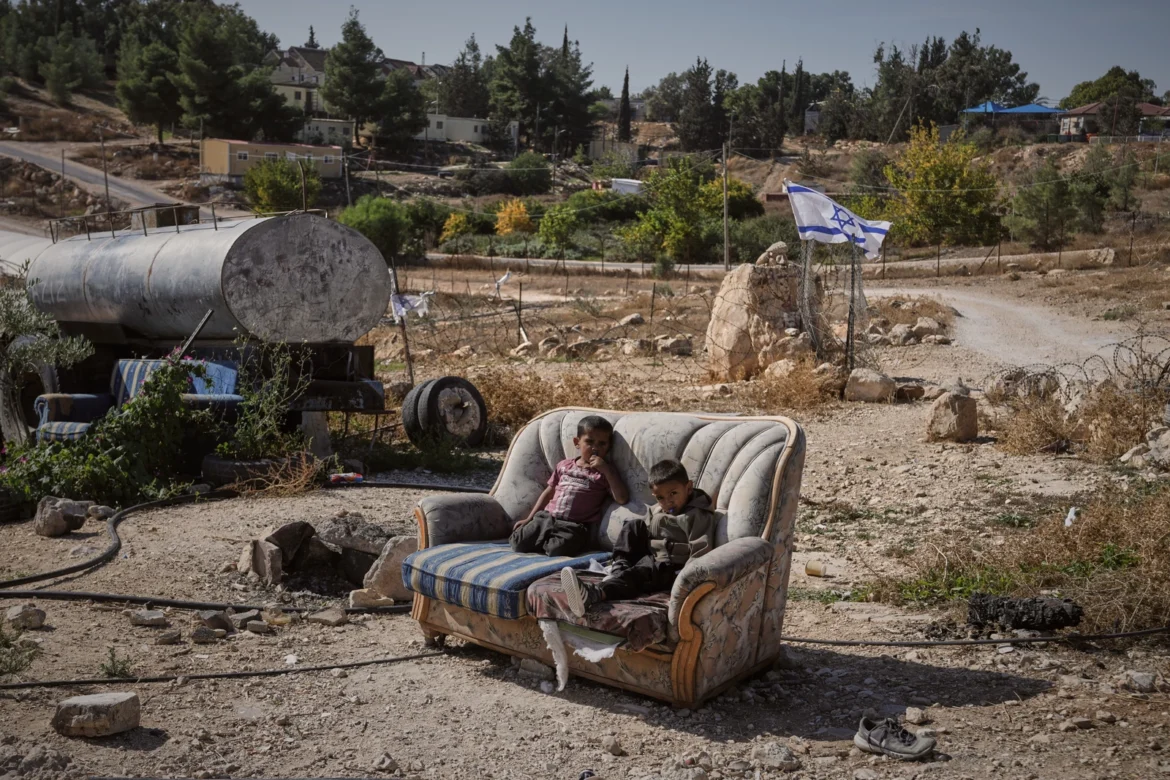
E1 would bisect the West Bank and cut it off from East Jerusalem, fragmenting the land Palestinians hope will form the heart of a state. Britain says the project risks undermining any future Palestinian state. Settlement building on territory captured in the 1967 war is widely regarded as illegal under international law, a view Israel rejects: its foreign ministry said last year that it refused “the attempt to impose foreign dictates upon it”. Israel’s foreign ministry also insisted at the time that it was acting within international law.
The 15 ministers renewed their “strongest condemnation of Israel’s continued settlement policies in the occupied Palestinian territory, particularly the ‘E1’ settlement plan and related settlement activities east of occupied East Jerusalem”. They described the British and Australian measures as consistent with international law and UN resolutions, including the “obligation of all states not to recognise as legal the situation arising from Israel’s unlawful occupation and not to render aid or assistance in maintaining the situation created by Israel’s occupation”.
They cited a 2016 UN Security Council resolution calling for an end to settlement activity, and a 2024 advisory opinion from the International Court of Justice on the occupation. They called on Israel to rescind every measure linked to settlement activity, and expressed support for accountability, including “appropriate international measures and the imposition of sanctions on entities and individuals responsible for settlement activities”.
The statement also turned to Gaza, condemning the “Israeli military escalation” there and demanding “the full and immediate implementation of President Trump’s Comprehensive Plan to End the Gaza Conflict, to ensure security and stability, address the humanitarian situation, facilitate reconstruction and recovery, and lay the foundations for lasting peace”. Gaza, the ministers said, was an integral part of the occupied Palestinian territory, and the only viable route to a lasting settlement was a two-state solution based on the “4 June 1967 lines, with East Jerusalem as its capital”.
A ceasefire in Gaza was agreed in October 2025, but Israeli strikes have continued. The ceasefire halted the heaviest fighting, though the territory’s health ministry put the Palestinian death toll above 74,000 by late September. The UN reported this month that civilians were still being killed and injured, and that restrictions on supplies were hampering efforts to shelter displaced families as winter approached.
Britain’s latest sanctions follow a sharp deterioration in its relations with Israel since the summer. Israel published tenders in August for more than 1,200 homes at E1, prompting London to summon its envoy and threaten sanctions, and Israel’s foreign minister rejected “patronising tone” of the British foreign secretary’s response. In September, Israel announced a further tender adding 2,167 homes to the plan, in defiance of Britain and other Western allies.
Britain and Australia have also joined other governments in pressing Israel to allow faster entry of food, shelter materials and other aid into Gaza.
Copyright © 2021 Independent Pakistan | All rights reserved