By Staff Reporter
PESHAWAR: Pakistan’s army chief has vowed to “decisively eliminate” militancy in Khyber Pakhtunkhwa during a visit to North Waziristan, weeks after the federal government took control of the province.
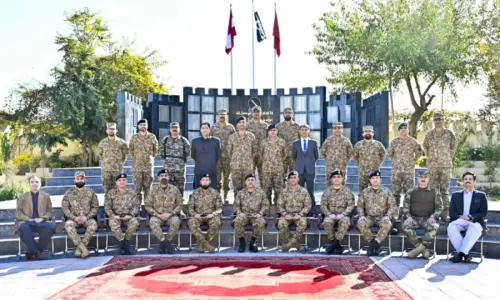
Field Marshal Asim Munir, who is both Chief of Defence Forces and chief of the army staff, travelled to Miranshah on Friday, the military’s media wing, the Inter-Services Public Relations (ISPR), said.
The ISPR said he reaffirmed the “unwavering resolve” of the security forces, working closely with law enforcement agencies, to end “the menace of terrorism” and preserve the province’s “hard-earned peace and stability”. He also praised the provincial police for their resilience and sacrifices in the fight against Fitna al-Khawarij, the term the state uses for the banned Tehreek-e-Taliban Pakistan (TTP).
The praise for the police has particular weight. Two security reports presented to the federal cabinet in October found that 73 percent of attacks recorded in the province during 2026 had targeted police and security personnel. They also identified drones and improvised explosive devices as growing threats.
The visit has a political edge. On 11 October, the federal government imposed an emergency and governor’s rule in Khyber Pakhtunkhwa after the president approved the cabinet’s recommendation. Ministers accused the provincial government of “deliberate disengagement from the fight against terrorism”. The army was deployed to assist the civil administration, and an 11-member advisory council was formed. The province’s chief minister, Sohail Afridi, was subsequently detained.
The province had been governed by the Pakistan Tehreek-e-Insaf (PTI) of the jailed former prime minister Imran Khan. Its spokesman called the suspension of the provincial government a “disguised coup”. Another party spokesman said the measures were intended to weaken PTI rather than address security.
In Miranshah, Field Marshal Munir was given a “comprehensive briefing” on the security situation, “ongoing intelligence-based operations” and measures to consolidate gains against militancy. He met officers and troops, whom he commended for their “high level of preparedness, professionalism and unwavering commitment”. He was received on arrival by the Peshawar Corps commander and laid a wreath at Yadgar-i-Shuhada, the memorial to soldiers killed in the line of duty.
The visit came a day after he travelled to Turbat in Balochistan, where he was briefed on operations against “externally sponsored terrorism” and on progress in socio-economic projects. Balochistan and Khyber Pakhtunkhwa have borne the brunt of militant violence in Pakistan.
Operations in both provinces have continued at pace. On Thursday, the ISPR said 22 militants were killed in operations on 16 and 17 November in South Waziristan, Bannu and Tank, 15 of them in South Waziristan. The military said 74 militants were killed in Khyber Pakhtunkhwa and Balochistan on 13 November, including 35 in Mir Ali and eight in Orakzai. The next day, 16 militants, two of them Afghan nationals, were killed in Mir Ali, Datta Khel and Ali Khel, along with two soldiers. The ISPR also reported that four soldiers, including a major, and 24 militants died in operations in Balochistan and North Waziristan on Saturday. Such figures cannot be independently verified.
The military’s account of progress finds some support in data from the Pakistan Institute for Conflict and Security Studies (PICSS), an Islamabad-based think tank, which reported a marked drop in violence in October. Attacks fell by 37 percent nationally, from 226 in September to 143. Deaths from attacks fell from 260 to 111. The report put injuries down by 71 percent.
The improvement was sharpest in Balochistan, where attacks fell from 132 to 71 and deaths from 136 to 44. In mainland Khyber Pakhtunkhwa, PICSS recorded 40 attacks, down from 58, with deaths falling from 90 to 38 and injuries from 165 to 19. The picture was less clear-cut in the province’s merged districts, formerly the tribal areas. Attacks there fell only from 34 to 30, and deaths from 33 to 25, while injuries rose from 11 to 13.
October’s fall offers limited comfort. It followed two consecutive months of rising violence. PICSS counted 1,376 attacks in the first ten months of 2026, a 53 percent increase on the same period last year. Kidnappings rose, with 88 people abducted in October against 72 in September.
The cabinet reports in October, which showed that terrorist incidents in Khyber Pakhtunkhwa had risen by 195 per cent between March 2024 and September 2026, set out the scale of the problem. On 4 November, a civil-military meeting chaired by Prime Minister Shehbaz Sharif agreed to expand intelligence-based operations and improve coordination between federal and provincial institutions.
Field Marshal Munir has visited Khyber Pakhtunkhwa several times since taking over as army chief in November 2022, including the former tribal districts. He visited Miranshah in December 2022, shortly after assuming command. In April 2024 he spent Eidul Fitr with troops in Miranshah and Spinwam. Friday’s visit is his third reported trip to North Waziristan as army chief.
Copyright © 2021 Independent Pakistan | All rights reserved