By Staff Reporter
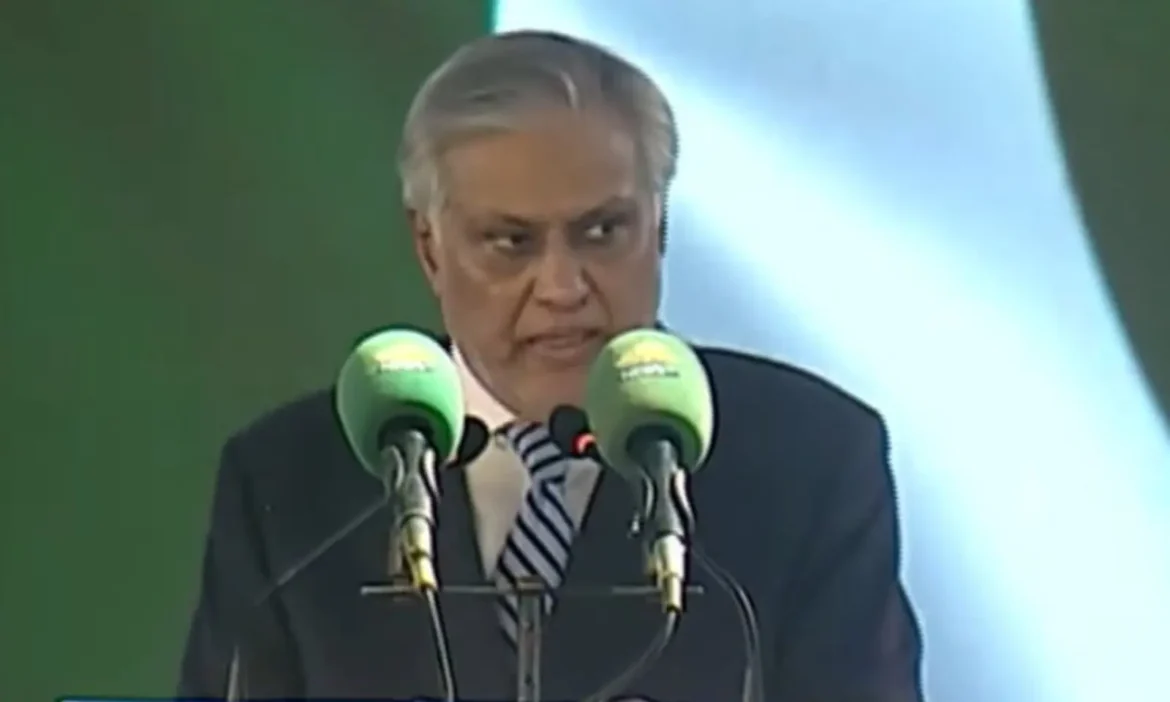
KARACHI: Pakistan’s minerals, hydrocarbons and gemstones are conservatively worth between $8 trillion and $10 trillion, Deputy Prime Minister and Foreign Minister Ishaq Dar said on Friday at a Karachi ceremony welcoming a Turkish seismic vessel that will help restart offshore oil and gas exploration after almost two decades.
Dar used the event to dismiss the idea that Pakistan is caught in a debt trap. “I always negate [that],” he said, putting government debt at about $100 billion, or $130 billion once the foreign-exchange liabilities of private companies and state-owned enterprises are counted. He called the $8 trillion to $10 trillion figure the “most conservative estimate” of the country’s mines, minerals, hydrocarbons, gemstones and other natural resources.
Dar has cited numbers of this size before. In August 2024 he described the country’s mineral reserves as having a proven worth of $10 trillion. A briefing to the federal cabinet the following year reportedly put the value at around $8 trillion. The industry’s current footprint is far smaller: a US Embassy official said in August that minerals contribute about 3% of gross domestic product, and that the Reko Diq copper-gold project could add roughly another half a point.
The Oruç Reis, operated by state-run Turkish Petroleum Corp., docked in Karachi on Thursday, Turkey’s energy ministry said, and will head to the survey areas after final preparations. It will first collect three-dimensional seismic data across 670 square kilometers of the Indus-C Block off Karachi, a job expected to take about 50 days from preparation through data collection once it reaches the area. The vessel will then return to Karachi before gathering two-dimensional data along 2,353 kilometers of survey lines in the Makran blocks, which the ministry expects to take 25 days.
Dar said the mission would run longer. He told Turkey’s energy minister it would take five to six months, and added, “You won’t be allowed to leave unless you give us good news of a real discovery.”
He was careful not to oversell the odds. “Offshore exploration is complex, capital-intensive and inherently uncertain,” Dar said. “A seismic survey cannot guarantee a commercial discovery, but no discovery can be made without seismic and exploration.”
The caution has history behind it. Only 18 offshore wells have been drilled in Pakistan since independence, and none produced commercially viable oil or gas. The most recent notable attempt, the Kekra-1 well drilled in 2019 by ExxonMobil with Eni and Pakistani partners, failed and led ExxonMobil to leave the country. Pakistan’s offshore zone covers about 300,000 square kilometers.
Turkish Energy and Natural Resources Minister Alparslan Bayraktar said the data would be used to assess the Indus and Makran basins, following agreements signed in Islamabad last year. “Based on the data that we are going to collect here, we aim to launch operations in the identified fields, Inshallah, next year in 2027,” he said. Turkish Petroleum has teamed up with Oil and Gas Development Co., Pakistan Petroleum Ltd. and Mari Energies, and licensing has been completed for five blocks, three offshore and two onshore, he said. He thanked Prime Minister Shehbaz Sharif, Field Marshal Asim Munir, who is chief of defence forces and army chief, and the Turkish and Pakistani navies, which escorted the vessel on its voyage.
Bayraktar pointed to Turkey’s own record, noting that it found a large natural gas deposit in the Black Sea in 2020, which he described as the largest offshore discovery in the global market that year. Turkey is producing about 10 million cubic meters of gas from those fields, enough for roughly four million households, and aims to reach 40 million cubic meters, enough for 14 million households, he said.
For Pakistan the stakes are tied to its fuel import bill. The country expects to spend about $1.29 billion on liquefied natural gas between November and February, as winter demand and disrupted Qatari supplies push it toward costlier spot cargoes. QatarEnergy extended a force majeure declared after an attack on its Ras Laffan LNG complex. “Security in the modern age is multidimensional,” Dar said. “It is also the security of energy supplies, trade routes and critical infrastructure.”
The survey follows Pakistan’s first offshore licensing round in nearly two decades. The Offshore Bid Round 2025, launched in January last year, offered 40 blocks in the Indus and Makran basins. The government awarded 23 of them, covering about 53,500 square kilometers, to four consortiums led by local energy companies. Turkish Petroleum took a 25% stake and operatorship in Offshore Block-C. A basin study by US consultancy DeGolyer and MacNaughton pointed to substantial unexplored hydrocarbon potential, and companies have committed 4,427 work units for the first phase of the initial three-year licence period, with planned spending of about $80 million. If early findings are encouraging and drilling goes ahead, total investment could reach $750 million to $1 billion, according to the Petroleum Division.
The Oruç Reis has done this kind of work before. Turkey’s energy ministry said it completed a 234-day mission off Somalia in June 2025, collecting 3D data across 4,464 square kilometers in three blocks. Turkey began drilling the Curad-1 well there in April 2026, at a location identified from that campaign.
Dar said Pakistan was open to long-term investment and offered “transparency and policy continuity” in return, and that Islamabad was pursuing economic reforms and talks with major international institutions to strengthen investor confidence. He said Sharif had directed federal ministries to coordinate on a fast-track basis so that “projects of strategic importance will not suffer from institutional fragmentation or unnecessary delay.” Three memorandums of understanding between Pakistani and Turkish agencies were signed at the event, and Dar said he wanted Pakistani geologists, engineers and universities to work closely with Turkish counterparts. He added that all offshore activity must meet the highest standards of maritime safety and environmental protection: “Our seas are an economic asset, but they are also a national trust.”
Debt measures vary by definition. Pakistan’s external public debt was $98.08 billion at the end of June, according to the Ministry of Economic Affairs. The World Bank’s International Debt Report 2026 put total external debt, including private borrowing and short-term obligations, at $135.1 billion in 2025. Foreign-exchange reserves have risen to about $17 billion, and Moody’s has said Pakistan met all its external obligations in the fiscal year that ended in June.
Dar said he hoped the mission would deliver the country’s first successful offshore drilling. “That day is not too far when Pakistan will be having its first successful offshore drilling and exploration,” he said.
Copyright © 2021 Independent Pakistan | All rights reserved