By Staff Reporter
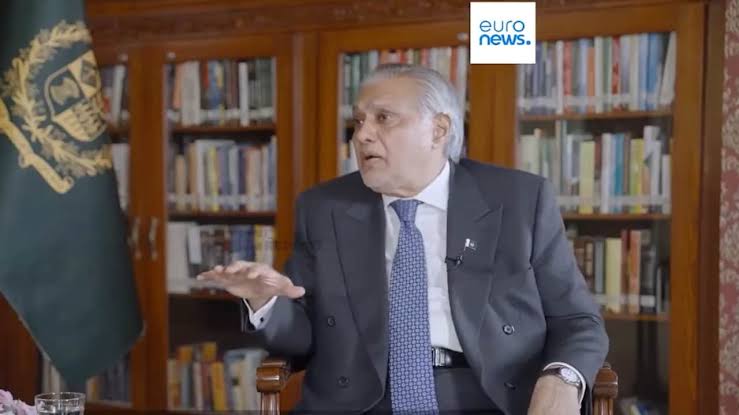
ISLAMABAD: Pakistan’s foreign minister has called for a new security architecture for the Middle East and insisted that Islamabad has not given up on a US-Iran peace deal that unravelled within weeks of being signed.
Ishaq Dar, who is also deputy prime minister, told Euronews’ World Conversation programme that it was “high time” regional peace was secured through an agreed mechanism. “We all have to see the new security architecture,” he said, adding that the consequences for the global economy reached well beyond the Gulf.
Dar described the Makkah defence agreement, signed by Pakistan, Saudi Arabia and Turkey in August, as a possible starting point. He said the pact was not directed against any country. The UK, France and Germany are already engaging with the emerging framework, he said, and Italy has also expressed interest in joining the dialogue. Germany plans to host a meeting in December of the R4 (Pakistan, Saudi Arabia, Turkey and Egypt) alongside the E4 group of European countries.
The proposal comes as the diplomacy Pakistan helped lead is under severe strain. The Islamabad memorandum of understanding, which Dar said was signed on 18 June, was meant to end the Iran war and reopen the Strait of Hormuz. One of its key principles, he said, was free navigation without tolls, fees, permits or other restrictions. He regretted that violations followed and that the arrangement later collapsed.
“Pakistan hasn’t given up. We are still working hard. We continue to persuade both parties to respect and honour what they signed on June 18,” he said.
The truce broke down on 8 July after Iran struck several commercial vessels in the strait, and the US responded with strikes on Iranian territory. Tehran has said it was Washington that breached its commitments, less than two weeks after the deal was signed. Indirect talks, with mediators led by Qatar, have continued since. In early November Iran said exchanges with Washington were “intensive” and offered to reopen the strait under strict conditions. President Donald Trump said renewed US attacks were “highly unlikely” if the talks made progress, but by 8 November the two sides had failed to agree on reopening Hormuz or on Iran’s nuclear capabilities.
Dar said Pakistan and China had proposed a five-point peace initiative that won broad backing, including from the European Union and the UK. A core point, he said, was that there should be no tolls, permits, fees or permissions in the strait, an idea he said almost every country supported. He called the free movement of vessels through all sea routes a “must”.
“Sooner or later – I hope sooner – we will achieve that objective because the world cannot afford [continued disruption],” he said. “See the price hikes, see the people suffering.” People in Pakistan were also suffering, he added, though he praised the government for providing fuel subsidies to low-income groups.
He gave a detailed account of Pakistan’s role since the war began on 28 February. Pakistan, he said, was the first country to condemn the strikes on Iran. At the outset of the conflict he called his Iranian counterpart, Abbas Araghchi, and urged him not to retaliate. Dar said his message was that Gulf and other Middle Eastern countries should not be targeted, and he expressed regret that they were attacked. Iranian officials, he said, had told Pakistan they were hitting only American military bases.
Dar also welcomed the direct US-Iran talks in Islamabad in April, the first of their kind in 47 years. He said it had been agreed during an earlier round of indirect talks in Oman that Pakistan must be present if direct talks followed.
Dar was combative on India. He said the revocation of Kashmir’s special status on 5 August 2019, done with a “stroke of a pen”, was “certainly not acceptable”. He said New Delhi had wrongly blamed Pakistan for the Pahalgam attack as a pretext for the May 2025 conflict, and that Prime Minister Shehbaz Sharif had immediately offered an independent investigation, which India rejected.
He called India’s decision to place the Indus Waters Treaty in abeyance illegal. “It can’t be held in abeyance. How can you deprive 260 million people of water?” he said. “Weaponising water is not desirable. International treaties need to be respected, no matter how big or small a country is.”
On Afghanistan, he said “nobody wishes for Afghanistan to be a stable, economically viable and prosperous country more than Pakistan does”. He said Pakistan had shared what he described as credible evidence with international institutions pointing to Afghanistan as the source of major terrorist attacks last October. The Afghan administration, he added, had offered no verifiable evidence of concrete action against militants.
“We are on the front line. We have lost 100,000 people and Rs150bn from our economy,” he said. He said Pakistan was also trying to improve conditions in Afghanistan, including by proposing a regional electric grid.
Copyright © 2021 Independent Pakistan | All rights reserved