By Staff Reporter
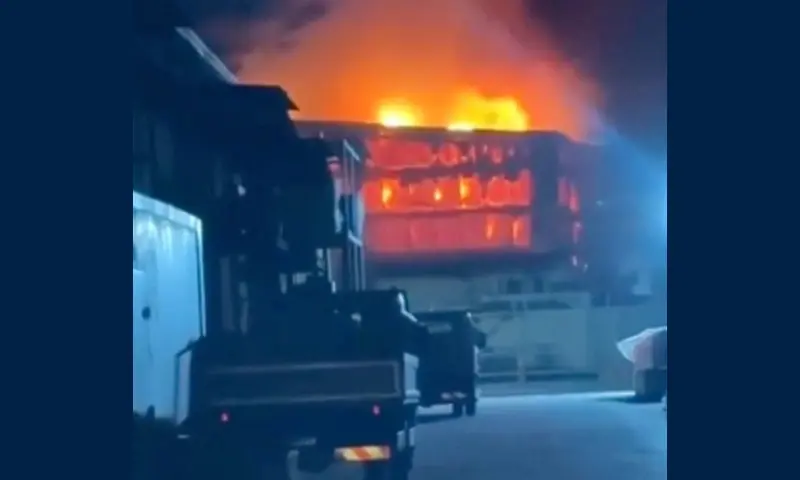
ISLAMABAD: A Pakistani resident is in a critical condition after an Iranian strike on a civilian industrial site in Bahrain, the kingdom’s authorities said on Sunday.
A Bahraini citizen with disabilities was also injured in Saturday night’s attacks and is stable, the interior ministry said.
“As a result of the heinous Iranian attacks on Bahrain yesterday, a Bahraini citizen with disabilities sustained injuries and is in stable condition, while a Pakistani resident was also injured and is in critical condition,” the ministry said. “Both are receiving treatment in the hospital.”
The casualties emerged only after an earlier statement, issued late on Saturday, which said the strike had caused fire and material damage but no injuries. The ministry did not name the site. Residents told AFP they saw smoke rising over Sitra Island on the east coast, home to several industrial facilities including a refinery run by the state oil company Bapco. Civil Defence crews worked to contain the blaze.
The ministry issued alerts about a “potential threat” through the night, giving an all-clear after midnight local time. Bahrain’s Defence Force said its air defences had intercepted a number of Iranian aerial attacks, with shrapnel causing material damage but no casualties. It accused Tehran of a “systematic hostile approach” towards the kingdom.
Iran’s Islamic Revolutionary Guards Corps (IRGC) said it had attacked US military positions at the Al-Riffa and Awali bases with missiles and drones, in retaliation for what it called “ongoing aggression and repeated violations of Iranian airspace”. “Two radars belonging to the US Army’s Patriot air defence systems… were struck,” it said.
A US official told CBS News that American forces and military assets were unaffected by the latest Iranian attempts.
Bahrain’s foreign ministry rejected Tehran’s justification, insisting the facility was civilian. It accused Iran of using disputes with other countries as a pretext to attack Bahrain, endanger civilians and violate its sovereignty. It called on the UN Security Council to take firm action and demanded Iran pay full compensation. Bahrain, it said, reserves the right to defend itself, alone or with allies.
Saudi Arabia, Kuwait and Qatar all issued statements on Sunday condemning the attack.
Bahrain is home to the US Navy’s Fifth Fleet. Iranian strikes on the kingdom resumed on 13 November after a lull that began in early September. That ended a weeks-long pause in a conflict that began with US-Israeli strikes on Iran in late February.
The attack came as the Strait of Hormuz remained the focus of the stalemate. Two tankers were hit there on Saturday, according to the British maritime agency UKMTO. One was struck by an “unknown projectile” and the other in its engine room. “There are no reported casualties at this time,” UKMTO said. Tehran has repeatedly reported ships catching fire in the strait in recent weeks, often claiming they struck mines.
Iran continues to blockade the waterway, which carried about a fifth of the world’s oil before the war. The US military is escorting ships through it and maintains its own counterblockade of Iranian ports.
PressTV reported on Sunday that the IRGC had shot down a US MQ-1C ER drone over the eastern strait, the fourth in 24 hours and the 20th overall. Tehran also said on Saturday it had intercepted a US drone targeting Qeshm Island. Iran’s deputy parliament speaker, Hamidreza Hajibabaei, accused Donald Trump of fabricating figures on Iranian drones to conceal American losses. None of Iran’s claims could be independently verified.
‘Clear red lines’
Diplomacy has not moved. Deputy foreign minister Kazem Gharibabadi said a Qatari delegation visited Tehran on Friday evening and “held two hours of talks”, giving no details.
Foreign Minister Abbas Araghchi said the talks “must be given a chance, and the blockade must be lifted rationally”. But he added, as quoted by state TV: “Our position is clear: as long as Iran’s demands are not met, the discussion on the Strait of Hormuz and its opening is pointless.”
Those demands include ending the war on all fronts, unfreezing Iranian assets, lifting oil sanctions and ending the US counter-blockade. Washington announced what it called an “economic asphyxiation” campaign in August, aimed at curbing Iran’s trade and financial flows. Gharibabadi, speaking to the Tasnim news agency, said: “We consider the economic blockade an act of war and we will take all necessary measures to lift it.” He said Iran had made this known to the mediators and that “the United States was aware of this”.
On the nuclear question, Araghchi told the state-run Iran Daily that Tehran would not let its stockpiles of enriched uranium leave the country. Western nations accuse Iran of seeking a bomb, which Tehran denies. “I believe a solution can be found, but we have clear red lines: the material will not be taken out of the country,” Araghchi said.
The rhetoric was no softer. Major General Rezaei, secretary of Iran’s Supreme National Security Council, said Iran in 2026 was not the country that attended the 1943 Tehran Conference or the 1945 Yalta Conference, and described the US as a “defeated nation, not a victorious one”. “You cannot restore the old world order with outdated photographs!” he said, according to PressTV. IRGC commander Major General Ahmad Vahidi said any violation of Iranian airspace would meet a “firm and decisive response”.
Iran is also feeling the strain at home. President Masoud Pezeshkian said US and Israeli strikes on energy infrastructure had worsened shortages, “and we should therefore expect difficulties this winter”. He has also described a “silent economic war” that he called harder than a military one, Al Jazeera reported. Mohammad Allahdad, head of the national electricity company, told state TV that rolling power cuts would begin on Sunday. “Given the country’s fuel supply conditions, the electricity sector will be forced to impose distribution restrictions,” he said.
Agriculture minister Gholamreza Nouri said food reserves remained higher than in previous years and ruled out bread rationing and price rises for now.
Turkey’s foreign minister, Hakan Fidan, warned that the costs reach well beyond the region. “The economic burden brought by this war and lack of resolution is getting harder every day for many countries,” he told TGRT Haber. “It is heading toward having very destructive effects.” He said messages were still passing between the parties, though the process looked deadlocked, and argued that nuclear questions belong in US and UN frameworks while other regional disputes should be settled by regional states.
Adm Brad Cooper, head of US Central Command, met Qatar’s defence minister, Sheikh Saoud bin Abdulrahman Al Thani, in Doha on Saturday. Qatar gave no details. He had earlier held talks in Riyadh with Crown Prince Mohammed bin Salman. Saudi Arabia, meanwhile, intercepted Houthi missiles and drones. Hostilities between the kingdom and the Yemeni group have escalated, with attacks targeting Saudi energy facilities.
Copyright © 2021 Independent Pakistan | All rights reserved