By Staff Reporter
ISLAMABAD: Pakistan and China agreed to pursue government-to-government arrangements for gasoline imports and a new liquefied petroleum gas plant, giving Islamabad a potential second channel for fuel supply after the US-Iran war exposed its dependence on Gulf cargoes, according to a Petroleum Division statement.
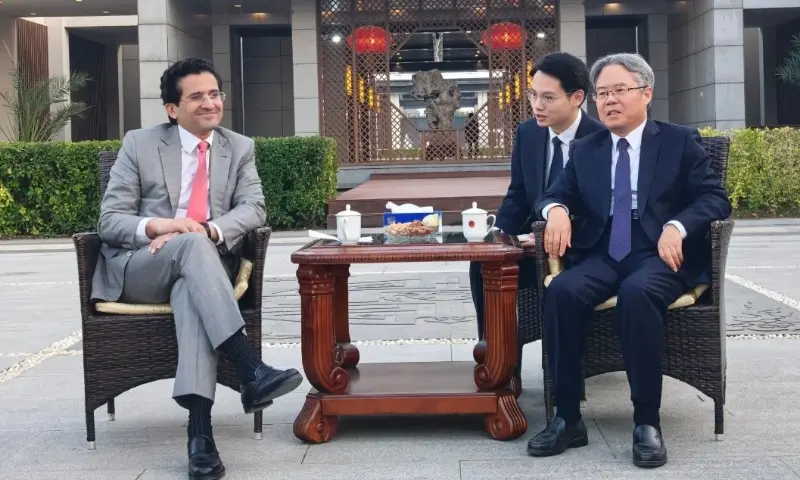
Petroleum Minister Ali Pervaiz Malik and Pakistan State Oil Co. Chief Executive Officer Jawwad Ahmed Cheema met Chinese Ambassador Jiang Zaidong and his commercial team in Islamabad on Wednesday. The two sides named two priorities for early action: an LPG plant with storage and terminal facilities, and imports of motor gasoline, covering sourcing, storage and logistics.
The LPG project is meant to expand domestic supply, widen access to cleaner fuel and ease shortages in peak season, the ministry said. The gasoline arrangement is intended to strengthen fuel security and ensure reliable supply at competitive prices. Both initiatives are expected to deliver early results, the statement said.
The ministry gave no gasoline volumes or pricing terms. It also gave no location, capacity or construction schedule for the LPG plant.
The talks follow months of upheaval in Pakistan’s fuel market. The war disrupted shipping through the Strait of Hormuz, a key route for Pakistan’s energy imports. Islamabad secured emergency crude shipments through Saudi Arabia’s Red Sea port of Yanbu after crude stocks fell to about 11 days of supply. In March, Pakistan raised gasoline and diesel prices by 55 rupees a liter as global oil prices surged.
Pakistan sourced 81% of its fuel imports from the six Gulf Cooperation Council countries and was paying higher prices, particularly for refined products. The disruption has persisted. A US-Iran truce collapsed on July 8 and Iran closed the Strait of Hormuz again, and oil fell about 6% on Nov. 2 on hopes that Iranian and Qatari diplomacy could end the war and ease supply disruptions. Pakistan has also been working to build up LPG stocks for winter. A state-run importer, SSGC LPG Ltd., received a record 15,000-metric-ton cargo at Engro Vopak Terminal this month, which the ministry described as the largest shipment of its kind.
“We want to move decisively from discussions to implementation,” Malik said in the statement.
The two sides agreed to form a joint commercial team of Pakistani and Chinese representatives. It will assess the proposals, approach prospective companies, weigh investment and partnership models, and draw up a roadmap covering upstream, offshore and downstream projects as well as minerals and mining.
PSO was named as the key commercial partner for Chinese companies interested in storage, terminals and wider downstream infrastructure. The discussions also covered Chinese investment in exploration and mining, with particular emphasis on Balochistan and emerging offshore opportunities, including integrated offshore hubs. State-owned Oil & Gas Development Co. is among the national energy companies the ministry said would be brought together with Chinese upstream and downstream firms.
China’s existing energy investments in Pakistan, largely under the China-Pakistan Economic Corridor, include coal and hydropower projects. Fuel storage and distribution would be a new area of focus.
Malik pitched the government’s investment case, citing deregulation of the petroleum sector, investor-friendly policies, streamlined import and export procedures and improved security arrangements. He said the government would protect investors and provide an enabling environment for long-term operations.
“Pakistan offers immense untapped potential across its energy and natural resources sectors,” Malik said, according to the statement. “Our priority is to translate this potential into concrete investments, industrial growth and sustainable economic opportunities.”
The minister urged Chinese companies to build on priorities President Xi Jinping set out at the Asia-Pacific Economic Cooperation summit in Shenzhen on Nov. 18-19. Jiang reaffirmed Beijing’s support for Pakistan and said the Chinese Embassy and its commercial team would help coordinate follow-up. He welcomed the proposed framework and expressed interest in exploring investment and strengthening business-to-business links, the ministry said.
The talks also touched on more efficient import and export policies and closer institutional and commercial coordination to facilitate investment, technology transfer and cross-border business.
Copyright © 2021 Independent Pakistan | All rights reserved