By Staff Reporter
ISLAMABAD: Pakistan will host Saudi and Turkish ministers in Islamabad this week to try to turn the Makkah defence pact from a pledge into a working alliance, with Houthi attacks on Saudi Arabia on the agenda, its defence minister has said.
Khawaja Asif told AFP that “continuous turmoil south of Saudi Arabia will obviously be one agenda point in the meeting and it is very important”. He confirmed that defence and foreign ministers from the three countries would attend.
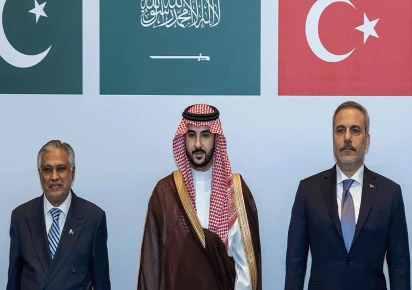
Saudi Arabia is expected to send Foreign Minister Prince Faisal bin Farhan and Defence Minister Prince Khalid bin Salman, while Turkey is likely to field Hakan Fidan and Yasar Guler in the same roles. Pakistan will be represented by Asif, Deputy Prime Minister and Foreign Minister Ishaq Dar, and senior military officials. Nauman Mahmood, the alliance’s secretary-general, has also arrived in the country.
The Houthis, who hold swathes of Yemen including the capital, Sanaa, have repeatedly struck Saudi cities, oil facilities and shipping since fighting in the country’s civil war intensified in July.
“Any threat to Saudi Arabia is a threat to Pakistan and Turkiye according to the pact, which is absolutely clear,” Asif said on Wednesday, praising Riyadh’s handling of the conflict.
The Makkah Joint Defence Agreement was signed in August by Saudi Crown Prince Mohammed bin Salman, Pakistan’s Prime Minister Shehbaz Sharif and Turkey’s President Recep Tayyip Erdogan as the US-Israeli war on Iran, which began in February, heightened security fears across the Gulf. It commits each country to treat an armed attack on any one of them as an attack on all three. It builds on a bilateral Saudi-Pakistani pledge made in September 2025.
Asif was frank about how far the arrangement has to go. It remained at a “nascent stage”, he said, and the immediate task was procedural. “Initially, we need to have frequent meetings to steer what is being formulated, in a way that in the next couple of months we have everything in place so that we can move forward.”
He declined to say how the pact would respond to a direct Iranian attack on Saudi Arabia, a question that goes to the heart of how the alliance would work in practice. He did name Israel as a possible threat to the region. “The possibility of some conflict, or aggression from the Israeli side exists, so we need to close our ranks, the countries of this region.”
The Foreign Office has described the pact as defensive and directed against no country. Its spokesman, Sajjad Haider Khan, said last week that the agreement was “defensive in nature”.
Pakistan’s own role in the wider conflict adds to the weight of the meeting. Islamabad brokered a June accord that briefly halted fighting between the US and Iran and set out a roadmap for reopening the Strait of Hormuz and for talks on Tehran’s nuclear programme. The truce later collapsed, with Washington and Tehran accusing each other of violations, and months of shuttle diplomacy, led mainly by Qatar and Pakistan, have followed.
Asif said Pakistan had played “a very, very constructive role” between the two sides, but the outcome of the mediation was “still fragile” and peace was “not yet embedded in a way people were expecting”.
Two Pakistani sources told Reuters that the Saudi and Turkish foreign ministers were due to arrive on Thursday for talks on Friday and Saturday, though some local outlets have reported different dates. It will be the third meeting of the pact’s Strategic Political and Defence Committee, after earlier sessions in Istanbul and Riyadh.
At the Istanbul meeting on 31 August, the three countries agreed to set up a permanent secretariat in Riyadh and to develop and produce defence technology jointly. They met again in Riyadh on 5 October for emergency talks on threats to Saudi Arabia, condemning attempts to target Makkah and Madinah and attacks on Saudi cities and on civilian and economic sites. Mahmood, a retired Pakistani lieutenant general, was confirmed as the alliance’s first secretary-general for a three-year term.
Islamabad has been reshaped for the visit and heavy vehicles are barred from entering the capital and neighbouring Rawalpindi by motorway and the Grand Trunk Road from 6pm on Thursday until 12.30am on Saturday, and the Faizabad Bus Terminal is closed for the same period. Metrobus and electric bus services between 7th Avenue station and the Pak Secretariat are suspended, and two Margalla Hills hiking trails will shut on Friday.
The government has also declared Friday a local holiday in the Islamabad Capital Territory, with essential services such as hospitals, police and utilities running as normal. The notification gave no reason. Police asked residents to avoid unnecessary travel, and a separate notice cited expected “VIP movement” in warning of a possible closure of parts of the Rawalpindi-Islamabad metro.
The three members bring unusual combined weight. Turkey has Nato’s second-largest military, Saudi Arabia is home to Islam’s holiest sites and is one of the world’s top oil exporters, and Pakistan is the only nuclear-armed Muslim-majority country.
Copyright © 2021 Independent Pakistan | All rights reserved