
By Staff Reporter
ISLAMABAD: Pakistan’s military said Sunday it is sending troops to Saudi Arabia to reinforce the kingdom’s defenses against Yemen’s Houthi rebels, whose missile and drone strikes have hit an oil refinery, a port and an office tower in Riyadh’s financial district.
The army did not say how many soldiers are going, what they will do, how long they will stay or where in the kingdom they will be based. A statement from its media wing, Inter-Services Public Relations, said only that they will “discharge their assigned responsibilities within Saudi territory, under agreed commitments and the established framework of defence cooperation.”
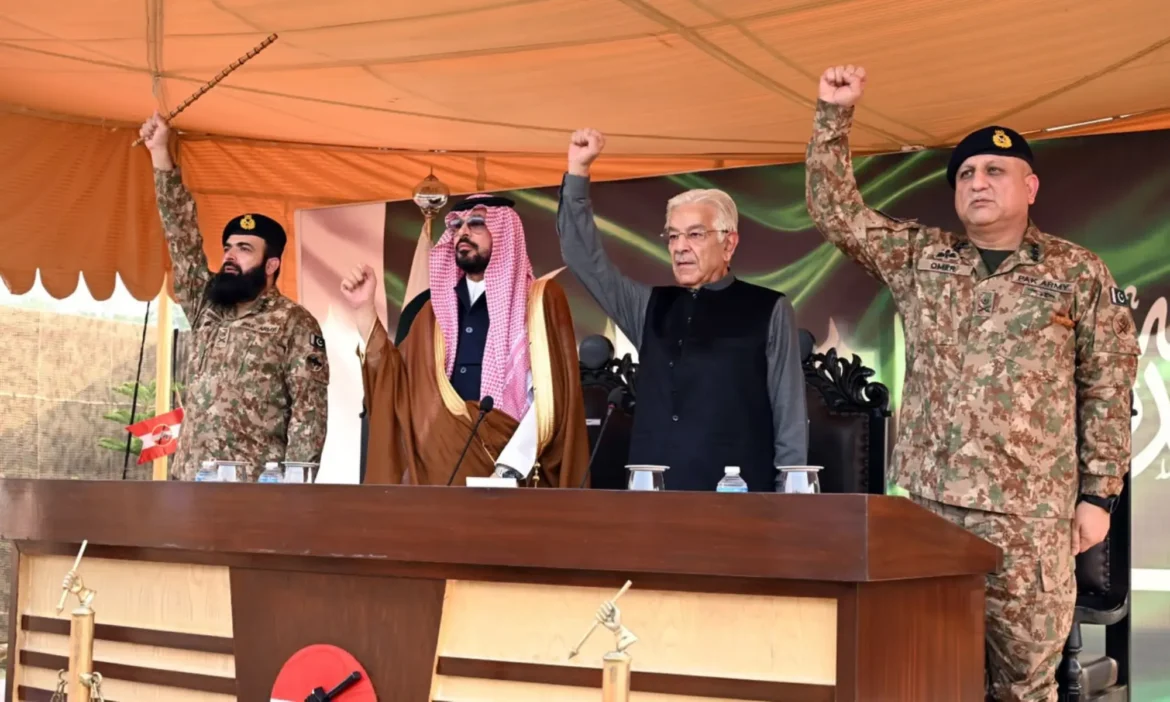
Defence Minister Khawaja Asif was chief guest at a send-off ceremony for the contingent on Saturday. Saudi Ambassador Rajeh Tami Albugamy attended, along with Lt. Gen. Omer Ahmed Bokhari, the army’s chief of general staff, and Lt. Gen. Muhammad Umer Bashir, commander of the Lahore Corps. The statement said the deployment would strengthen the kingdom against “emerging security concerns” and renewed Pakistan’s pledge to protect the “sanctity of Haramain Sharifain,” a reference to the holy mosques in Mecca and Medina.
The announcement came two days after Pakistan hosted the top decision-making body of the Mecca Defense Alliance, which also includes Turkey. The three countries denounced “persistent and heinous” Houthi attacks on civilians and civilian infrastructure in Saudi Arabia and pledged to speed up efforts to support the kingdom. They signed the Mecca Joint Defense Agreement on Aug. 7, agreeing that an armed attack on one would be treated as an attack on all. At an emergency meeting in Riyadh on Oct. 5, they had agreed to provide forces and capabilities and ensure their rapid deployment in the kingdom.
What those forces will look like has not been spelled out. The alliance has yet to publicly define its doctrine, the makeup of its forces, command arrangements or the procedures for a collective military response.
Pakistan has been careful about where its commitment ends. Foreign Office spokesman Sajjad Haider Khan said last month that troops stationed in Saudi Arabia under the alliance would not cross the border into Yemen. In October, Pakistan’s information ministry called a New York Times report that Pakistani air force jets had struck Houthi targets “fake and fabricated.” The Houthis claimed anyway that Pakistani jets hit rebel-held areas on Nov. 6.
Late Saturday, Mohamed Ali al-Houthi, a member of the Houthis’ Supreme Political Council, accused Turkey and Pakistan of ignoring Saudi “aggression” and the blockade of Yemen. On Sunday, Houthi military spokesman Yahya Saree declared Jeddah’s port and all other Saudi Red Sea ports military targets. He spoke after the Saudi-led coalition told civilians to leave Yemen’s Ras Isa port; Houthi-run al-Masirah then reported a Saudi attack there. The coalition had not confirmed a strike on the port at the time of the latest reporting.
Saudi air defences destroyed ballistic missiles fired toward Riyadh and the Eastern Province early Sunday, the coalition said, with no civilian casualties reported. A day earlier, it said it had downed four ballistic missiles and a cruise missile. On Thursday, a strike on the Jazan refinery killed a Nepali worker. The coalition has said Houthi attacks on King Khalid International Airport in Riyadh last month killed 17 people and wounded 333. Saudi Arabia has accused the Houthis of firing at Mecca and Medina; the group denies it.
Prime Minister Shehbaz Sharif, speaking Sunday at a National Security Workshop in Islamabad, said the alliance was “against no country at all; it has no aggressive design whatsoever.” He said the partnership would secure not only Pakistan’s security interests but its “progress and prosperity.” He also cited Pakistan’s role in bringing Iran and the United States to the negotiating table. Pakistan has said the pact is not aimed at Iran, the Houthis’ patron.
The Saudi side says it has no plans for a ground war. Coalition spokesman Maj. Gen. Turki al-Maliki told Reuters the conflict “can end … tomorrow” if the Houthis accept a UN-backed peace roadmap, but that the coalition will keep up military pressure until then. He ruled out sending Saudi ground troops into Yemen and said Riyadh has drawn a red line at Aden, the government’s interim capital, where Houthi forces are now about 37 miles away.
Pakistan has kept troops in the kingdom for decades. An unspecified number have been stationed there since the early 1980s to train and advise Saudi forces. Fighter jets arrived in April under the 2025 Strategic Mutual Defence Agreement between Islamabad and Riyadh. Yemen’s civil war reignited in July after a UN-brokered truce collapsed, months into a wider Middle East war. The Houthis have since seized the Bab el-Mandeb chokepoint from Saudi-backed government forces. The conflict began in 2015, when Saudi Arabia led an Arab coalition against the Houthis.
Copyright © 2021 Independent Pakistan | All rights reserved