By Staff Reporter
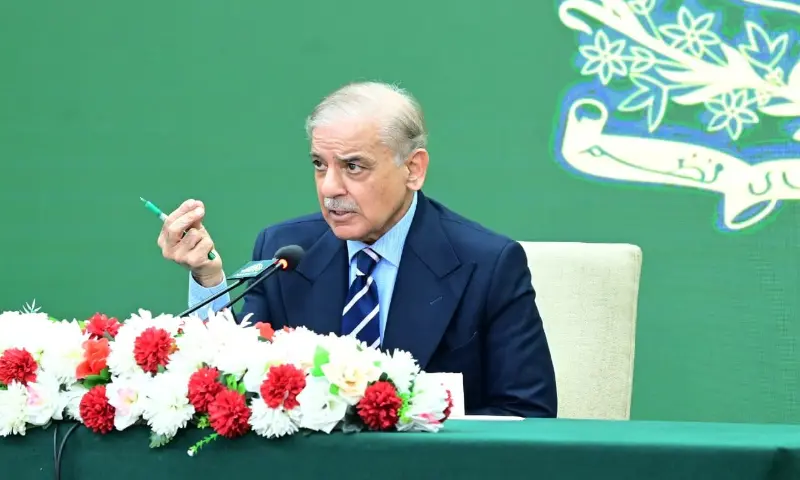
ISLAMABAD: Prime Minister Shehbaz Sharif called for a national consensus on “bitter decisions” to end Pakistan’s reliance on foreign loans, less than two weeks before the International Monetary Fund’s board is due to consider another $1.2 billion tranche.
“There are solutions to this, but we will have to take bitter decisions,” Sharif said Sunday at the National Security Workshop in Islamabad. If the nation, political parties and every segment of society decide together, he said, “I guarantee you without any fear of contradiction that we will rid Pakistan of this mountain of loans.”
Sharif blamed decades of subsidies for the debt. “These loans have been increasing for the past 80 years,” he said, adding that Pakistan “could have moved the engine without any crutches, without any tablet or subsidy.” Taxpayers footed the bill, he said: “the subsidy came from the people; it is tax revenue. This has made our nation impoverished.” He also cited “trillions pumped into” loss-making state-owned enterprises, and tax evasion, but said he wasn’t looking to assign blame. “I am not here to point fingers; the aim is to try to understand where the problem lies and solve it.”
He set a growth goal of at least 6% “as early as possible.” The economy is projected to expand 3.5% in the fiscal year through June, short of the 4% target the National Economic Council approved last June. Pakistan is trying to move from stabilization to sustained growth under a $7 billion IMF program. Sharif listed the country’s mediation between the US and Iran, its defense pacts with Saudi Arabia and Turkey, and the four-day conflict with India in May 2025, which he said gave New Delhi a “bloody nose.” It is time to convert those achievements into economic gains, he said, because “time and tide wait for none.”
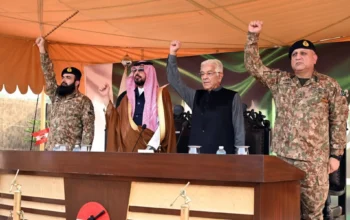
Pakistan’s military said Sunday it would deploy troops to Saudi Arabia to strengthen the kingdom’s defenses following attacks by Yemen’s Houthi rebels. It gave no numbers, assignments or arrival date. The announcement followed trilateral talks in Islamabad on Friday under the Makkah Joint Defense Agreement, which Pakistan, Saudi Arabia and Turkey signed Aug. 7 and which treats an attack on one as an attack on all three. Reuters reported in May that Pakistan had already sent about 8,000 troops, a fighter squadron and an air-defense system to the kingdom.
Sharif said the pact is not aimed at any country and will serve Pakistan’s economic as well as security interests. “With Saudi Arabia we have historic relations based on mutual trust and respect,” he said, adding that the partnership would secure “not only our security interest in the region but our progress and prosperity.” Riyadh has supported Pakistan’s finances in past crises.
Central bank reserves stood at about $21.6 billion on Nov. 20, with total liquid reserves, including those held by commercial lenders, at $26.75 billion. Sharif called the reserves the highest in the country’s history but said the figure settles little. “Do we want to live a life of asking for alms or do we want to live with honour and dignity, and the latter requires hard work and honesty,” he said.
He pointed to an overhaul of the Federal Board of Revenue as proof that change is possible. The agency recovered 900 billion rupees ($3.3 billion) through enforcement in the fiscal year that ended in June, Sharif said, crediting cooperation between the civilian and military leadership. “For the first time in the history of Pakistan, we were able to recover Rs900 billion through enforcement,” he said, and asked when the government had last recovered even 9 billion rupees “lost to these nefarious designs.” Most evasion, he said, comes from indirect taxes such as sales tax. He recalled that the IMF’s managing director told him in the US: “Pakistan is a changed country.”
Collections this fiscal year are trailing. The FBR took in about 4.06 trillion rupees in July-October, more than 100 billion rupees short of target, the Express Tribune reported. Growth of about 6% compares with the roughly 17% needed to reach the 15.26 trillion-rupee ($55.2 billion) annual goal in the IMF program, with income tax lagging by 165 billion rupees. The newspaper said the FBR’s own assessment points to 14.3 trillion to 14.6 trillion rupees by June, which would leave it as much as 960 billion rupees (about $3.5 billion) short.
The fuel subsidy is the other pressure point with the IMF. When staff reached agreement on the latest review on Oct. 7, mission chief Iva Petrova said the scheme should be phased out promptly because of its cost and broad targeting, and the Express Tribune reported that Islamabad agreed to do so. The government launched the program Sept. 18 with 75 billion rupees ($271 million) allocated for three months. On Sunday the prime minister’s office said more than 52 billion rupees had been distributed to over 18.4 million beneficiaries, that more than 100 million tokens had been used, and that about 150,000 new consumers register each day. Sharif asked for further facilities so more “deserving” people can benefit, the office said. Owners of motorcycles, Qingqi rickshaws and cars of up to 800cc qualify.
Energy is where the pressure comes from. Pakistan imports LNG, LPG, crude, refined products and gas at a cost of billions of dollars a year, Sharif said. “This is the biggest challenge we are facing,” he said. The government absorbed a hit of 28 billion rupees in the first weeks of the crisis, he said, with across-the-board subsidies that reached the richest and poorest alike before relief was narrowed. Brent crude traded around $95 a barrel Friday after its first weekly gain this month, with attacks on tankers in the Strait of Hormuz and on Saudi energy infrastructure stoking supply fears, Reuters reported. Inflation was 9.61% in October against 6.24% a year earlier, and the State Bank of Pakistan raised its benchmark rate by half a point to 12% on Oct. 26, its first increase since April.
Sharif defended the closures of the Utility Stores Corp. and the Pakistan Public Works Department, which drew criticism. Ending the public-works agency removed “Rs100bn in corruption,” he said. Of the subsidized-grocery chain, he said: “Every year, people lined up to receive substandard rice and flour, and there was massive corruption.” Payments now go to people through digital wallets. He cited the privatization of Pakistan International Airlines, which he said lost 30 billion rupees ($108 million) a year, as an example of the burden state companies place on the budget.
On minerals, Sharif repeated a policy of “mine in Pakistan, process in Pakistan, manufacture in Pakistan.” Raw material can be exported for a limited period, he said, but companies must meet contractual deadlines to build smelters and produce ingots at home. Illegal gold mining in Khyber-Pakhtunkhwa’s rivers has been stopped, he said, and the cartels involved curbed through legislation.
Exports rose 8% in the first quarter of the current fiscal year, Sharif said, and information-technology exports reached $4.6 billion in the last one, though he said “much more” is needed. Agriculture is the area where Pakistan has fallen shortest. “Let me say with a heavy heart that we have not been able to do what we needed in agriculture,” he said, adding that the sector could be reformed “within six months.” “The only thing lacking is hard work.”
Sharif returned several times to the need for consensus, saying the economy can’t be rebuilt by one person or institution. “It cannot be achieved through a solo flight,” he said. “It has to be teamwork.” He said ordinary Pakistanis, including laborers, shopkeepers and street vendors, have borne much of the cost of the past two and a half years of stabilization, and that the government must not slip back into the boom-and-bust cycles of the past. He also said he recently attended the funerals of a major and a havaldar killed in the fight against militants.
“Please mark my words: nothing succeeds like success,” Sharif said.
Copyright © 2021 Independent Pakistan | All rights reserved