By Staff Reporter
ISLAMABAD: Pakistan’s ruling party is pushing for its senior leader Ishaq Dar to become the interim prime minister ahead of a general election due by November, but faces resistance from its main coalition partner, the Pakistan People’s Party (PPP), Dawn newspaper reported on Monday.
Dar, who is currently the finance minister, is a loyalist of ousted Prime Minister Nawaz Sharif, and is seen by the Pakistan Muslim League-Nawaz (PML-N) as a trusted candidate to lead a caretaker government that will oversee the vote, party sources said.
But the PPP, part of the current coalition government, has objected to Dar’s nomination, saying he is “too close to the Sharif family and cannot be impartial”.
The two parties are trying to reach a consensus on the interim prime minister, who will replace Prime Minister Shahbaz Sharif when the parliament term ends in mid-August.
Both parties want a politician to head the caretaker setup, fearing that any delay or disruption in the election process could benefit the powerful military establishment, which has ruled Pakistan for nearly half of its 70-year history.
The ruling PML-N supremo Nawaz Sharif, who was disqualified by the Supreme Court in 2017 over corruption charges, is currently in Dubai, where he is expected to meet PPP leaders Asif Ali Zardari and Bilawal Bhutto-Zardari to discuss the caretaker issue, Dawn reported.
Sharif lives in London for medical treatment. He is facing corruption charges in Pakistan and has been declared a fugitive by an accountability court.
However, Dawn quoting political sources, reported that no meeting took place on Sunday and Sharif’s daughter Maryam Nawaz returned to Pakistan without any breakthrough.
“Sharif may try to persuade Zardari to accept Dar’s name by arguing that any disagreement between political parties would allow the establishment to take advantage of the situation,” a PML-N leader in Punjab province said.
PML-N Secretary General Ahsan Iqbal said Dar could be the interim prime minister if all parties agreed on his name.
“Dar or anyone else can be the caretaker prime minister provided there is an agreement,” Iqbal told reporters.
Meanwhile, the PML-N said it was introducing an amendment to the constitution to give more powers to the caretaker government.
The move supports speculation that the party may try to push a loyalist of the Sharif family as the interim prime minister.
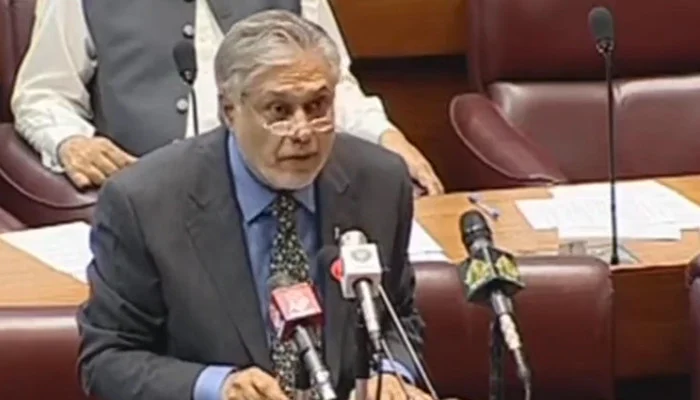
But Finance Minister Dar said the caretaker government should be able to take important decisions like an elected government does.
“I don’t think this is something to hide from the nation. They will find out and it should [indeed] be amended,” Dar said in a television interview.
He did not elaborate on what kind of decisions he had in mind, but some analysts have suggested that the PML-N may want to use the caretaker government to influence the accountability process against former prime minister Sharif.
The PPP said it wanted the interim prime minister to be a politician, but there should be consensus among all political players.
“Discussions on the caretaker setup are going on among the parties. Both (PPP co-chairman) Mr (Asif Ali) Zardari and (PPP chairman) Mr (Bilawal) Bhutto are in Dubai,” PPP spokesman Farhatullah Babar told reporters.
Another PPP leader, Faisal Kundi, said his party had not shared any name of a candidate with the PML-N.
“Both, the prime minister and the leader of the opposition will have to present three names each. Of which one will be chosen for the caretaker prime minister,” he said.
The constitution does not specify any criteria for the caretaker prime minister, but in the past two elections, non-partisan figures were chosen to head the interim governments.
However, if the caretaker government is led by any party loyalist, such as Dar, then it would undermine the credibility of polls, some experts say.
“Sadly, our constitution and law is not sufficiently explicit that caretaker prime minister and cabinet ministers should be ‘neutral’ and not affiliated to a political party,” Ahmad Bilal Mahboob, president of PILDAT, a think-tank that monitors democracy and governance, said on Twitter.
Copyright © 2021 Independent Pakistan | All rights reserved