By Staff Reporter
ISLAMABAD: Pakistan’s first lunar satellite, ICUBE-Q, successfully entered the moon’s orbit on Wednesday, a senior official at the country’s Institute of Space Technology (IST) said, hailing the development as a crucial step towards bigger space missions in the future.
The ICUBE-Qamar satellite, weighing around 7kg, carries two optical cameras to image the lunar surface, said Dr. Khurram Khurshid, head of the electrical engineering and computer science department at IST and co-lead on the satellite project.
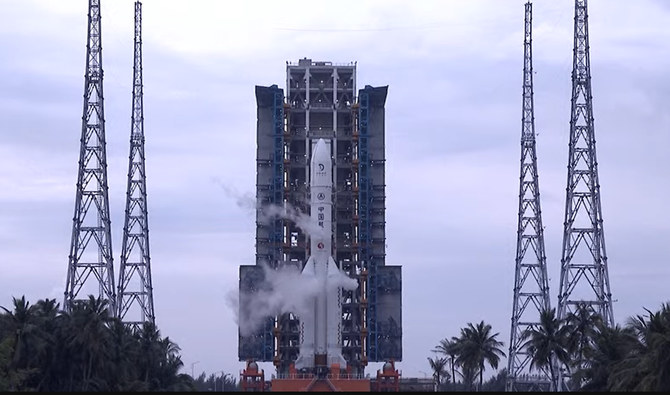
Pakistan’s first lunar satellite was launched aboard China’s Chang’e-6 probe on May 3, which aims to land on the far side of the moon and retrieve samples. China is the first country to attempt such a feat.
CubeSats, tiny box-shaped satellites, are mainly used for experimental and research purposes in low Earth orbits, but are now finding applications in higher orbits and deep space missions.
“Our ICUBE-Q was deployed successfully in its orbit at 1:14 p.m. Pakistan Standard Time,” Dr. Khurshid said, adding that Pakistani officials will conduct tests on the satellite’s system for the next three to four days.
Initial tests revealed no complications with the cubesat’s system, Dr. Khurshid said, noting that the development marks Pakistan’s entry into an exclusive club of countries that have conducted deep space missions.
“This is the first step, a step in the right direction,” Dr. Khurshid said. “It can lead to bigger space missions, such as landing on the moon or various other experiments.”
Dr. Khurshid said Pakistan would share images from the satellite by May 15. Around 100 students from IST contributed to developing the satellite, which was designed, developed, and qualified by faculty members and students of IST in collaboration with China’s Shanghai Jiao Tong University (SJTU) and supported by Pakistan’s National Space Agency, SUPARCO.
Copyright © 2021 Independent Pakistan | All rights reserved