By Staff Reporter
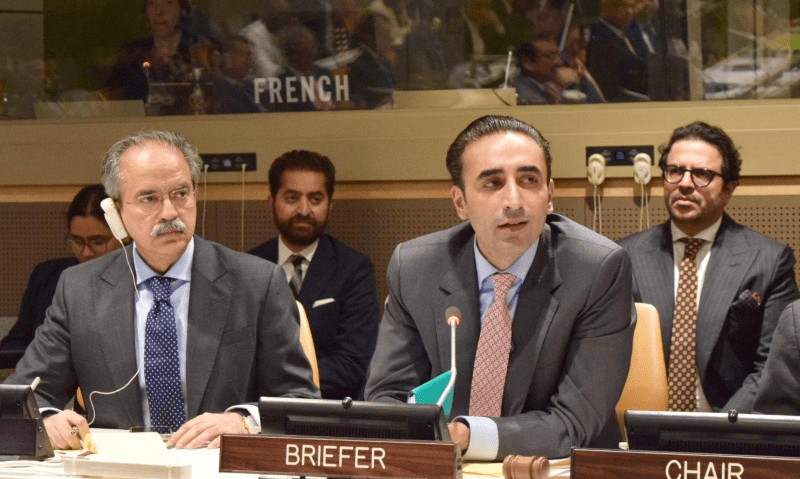
ISLAMABAD: A high-level delegation, spearheaded by former foreign minister Bilawal Bhutto-Zardari, met with officials from the Organisation of Islamic Cooperation (OIC) on Tuesday to present Pakistan’s position on the escalating conflict with India spike over the recent Pahalgam attack.
The clash, already sparking cross-border drone and missile strikes on civilian and military structures and the scrapping of a critical water treaty, has put South Asia on edge.
The delegation, packed with heavy hitters like three ex-foreign ministers, two former foreign secretaries, and two past U.S. ambassadors, touched down the New York last Sunday for United Nations talks.
Its members, Bilawal Bhutto-Zardari, chairman of the Pakistan Peoples Party, alongside ex-foreign ministers Hina Rabbani Khar and Khurram Dastgir, as well as seasoned diplomats like Jalil Abbas Jilani and Tehmina Janjua, signal the gravity with which Pakistan views the current crisis.
By Tuesday, they were briefing the OIC, laying out Pakistan’s side of the story.
Bhutto-Zardari “categorically rejected India’s attempt to link Pakistan to the Pahalgam incident without any credible investigation or evidence,” according to a press release from Pakistan’s Mission to the UN.
The former foreign minister said the accusation was “used as a pretext for unlawful military actions, including cross-border strikes, which targeted civilians and civilian infrastructure.”
Bhutto-Zardari voiced particular alarm over India’s decision to suspend the Indus Waters Treaty, calling it “a blatant act of weaponising water and a violation of international and treaty obligations.” “We cannot allow this to become a new normal.”
Bilawal warned that “due to India’s belligerent aggression, the world has become a less safe place, with real and present implications for peace and security in South Asia.” “The only path to peace is dialogue, engagement and diplomacy.”
He reaffirmed Pakistan’s commitment to restraint and called for “the restoration of the Indus Waters Treaty, full respect for the ceasefire, and the resumption of a comprehensive dialogue with India, with the resolution of the Jammu and Kashmir dispute at its core.”
The OIC envoys responded with support, expressing their “appreciation for Pakistan’s transparent and timely briefing and reaffirmed their solidarity with Pakistan and the people of Jammu and Kashmir,” the statement said.
They also “reiterated their concern over worsening security situation in South Asia and stressed the importance of upholding the principles of the UN Charter and international law and in this regard, the sanctity of treaties, including the Indus Water Treaty.”
Beyond the OIC, the delegation sought to rally broader international backing. On Tuesday, it met with Ambassador Carolyn Rodrigues-Birkett of Guyana, who holds the United Nations Security Council (UNSC) presidency for June.
The Pakistani team pressed the UNSC to take a proactive stance in “promoting de-escalation, ensuring respect for international law and treaties and facilitating peaceful resolution of the disputes, including the Jammu and Kashmir dispute, in line with the Council’s resolutions.”
Rodrigues-Birkett, in turn, “reaffirmed the UNSC’s commitment to upholding international peace and security in line with its mandate.”
The diplomatic push continued Monday with a flurry of meetings at UN Headquarters. The delegation briefed representatives from the UNSC’s elected members Algeria, Denmark, Greece, Guyana, Panama, Sierra Leone, Slovenia, Somalia, and South Korea, while also engaging envoys from the permanent five members China, Russia, France, the United Kingdom, and the United States.
In a meeting with China’s Ambassador Fu Cong, Bhutto-Zardari found common ground, with both sides agreeing that “aggressive posturing and unilateral actions threaten peace in the region and must be firmly opposed”.
With Russia’s Ambassador Vasily Nebenzya, the delegation dismissed India’s allegations as “premature and lacking any credible investigation.” And in talks with US Ambassador Dorothy Shea, Bhutto-Zardari urged Washington to “play its role in ensuring comprehensive dialogue between India and Pakistan to address all outstanding issues.”
The delegation’s next stop is Washington, where it arrives today, June 3, for a packed itinerary through June 6. Meetings are slated with Secretary of State Marco Rubio, senior officials, lawmakers, and think tank experts as Pakistan seeks to shape the narrative on Capitol Hill and beyond. The team is also scheduled to travel to London and Brussels in the coming days.
Copyright © 2021 Independent Pakistan | All rights reserved