By Staff Reporter
ISLAMABAD: Houthi rebels struck Riyadh’s main airport for a second consecutive day on Sunday, killing a Pakistani resident and injuring 11 others, a day after an attack there left 13 people dead.
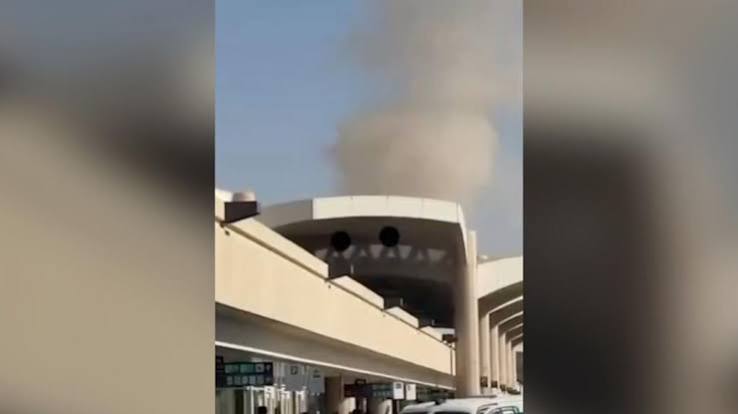
Saudi Arabia’s civil aviation authority said the latest strike on King Khalid International Airport was the fourth in five days. The Saudi-led coalition fighting the Yemeni group said a projectile hit the airport and started a fire, and that air defences intercepted a missile nearby. A cruise missile was also shot down close to the airport, the aviation authority said.
A witness on board a taxiing aircraft told Reuters that a projectile hit the tarmac beside several parked planes late evening, causing a fire. Saudi officials said the attack affected terminals 3 and 4, which serve domestic flights.
Saturday’s missile strike was the deadliest on Saudi soil in more than a decade, since a suicide bombing in 2015. It marked a sharp escalation in the Yemen war, in which Riyadh has long backed the country’s internationally recognised government against the Houthis.
The Houthis said on Sunday they had carried out multiple attacks over the previous 24 hours, including on the airport, and threatened to keep targeting the kingdom’s transit hubs. They described them as “a theatre of operations for our forces”. The group has also warned airlines and travellers against using Saudi airports, saying they remain vulnerable.
AFP journalists and residents reported hearing several blasts in the capital. “The birds went into a frenzy after the sound. The whole house shook,” said one resident of the Al-Aarid neighbourhood in the north of the city.
Wider attacks
The aviation authority also reported an attack on Dammam airport in the east, which the Houthis said they had targeted. The airport’s website showed many departures and arrivals delayed. The coalition said it shot down a drone in the east shortly afterwards, and early on Monday said it had “intercepted and destroyed” a Houthi ballistic missile heading for Khamis Mushait, a southern city that is home to a major military base.
Riyadh airport has been closed since Saturday’s strike. A senior aviation source said operations were suspended into Sunday, and a second source said they would remain halted “until further notice”. That source added that radar and communications equipment was damaged and runways needed to be assessed. Flightradar24 said the closure had been extended by a further 24 hours.
Riyadh airport was also hit on Thursday, when three Saudi citizens, including a pilot, were killed. The airport has no military facilities.
The civil aviation authority said Saturday’s strike killed four Saudis, two Bangladeshis and one each of American, Egyptian, Jordanian, Syrian, Palestinian and Sudanese nationality, and wounded 309 people. India’s embassy said one of its citizens died on Sunday from injuries sustained the day before, bringing the toll to 13.
A Riyadh-based Western diplomat told AFP the injury figure may understate the true picture because it did not appear to include people with minor wounds.
Witnesses described chaos. “People who were in Terminal 3 started running towards us,” a 32-year-old Riyadh resident told AFP. “Some had lost a hand or an arm. People were running while carrying injured people, covered in blood.”
Health officials activated a rare mass call-up of doctors, a medical source said. Schools across Riyadh were ordered to move to remote learning for a week.
On Monday, Saudi Arabia released security camera footage of Sunday’s strike. It shows people, many in the white robes of Umrah pilgrims, queuing in a busy hall while others scroll through their phones in a seating area. A fireball then erupts, and people throw themselves to the floor or run.
International reaction
The United Nations and world leaders condemned Saturday’s attack. UN Secretary-General António Guterres called it a violation of international law. Secretary of State Marco Rubio said the strike had taken the lives of “numerous innocent” people, including an American citizen. Israeli Prime Minister Benjamin Netanyahu, whose country has no diplomatic relations with Saudi Arabia, denounced a “horrific terrorist attack”.
The Saudi-led coalition called the attack a “full-fledged war crime” and vowed to “respond decisively”. Houthi media reported two Saudi strikes in the Sanaa governorate on Sunday.
Donald Trump said he was weighing whether the US should join Saudi strikes on the Houthis. “We may. We’re going to look at it,” he told reporters outside the White House on Saturday. He later said Saudi Arabia could defend itself against the group, described the airport attack as “terrible” and said he would speak soon to Crown Prince Mohammed bin Salman.
The US, Canadian, German and Spanish embassies have warned citizens to avoid Riyadh airport. Australia urged its nationals on Sunday to stay indoors and “shelter in place”.
Pakistan’s pledge
Pakistan, Egypt and Turkey condemned the Houthi attacks in a joint statement issued late on Sunday through Pakistan’s foreign ministry, along with Saudi Arabia, as members of the so-called R4 Group. It said the attacks violated international law and demanded their “immediate and unconditional halt”.
“The Group holds the Houthi militia fully accountable for the results of these attacks,” the statement said. It reaffirmed “full support for all legitimate measures” Riyadh takes to counter them.
Pakistan signed a bilateral defence agreement with Saudi Arabia in September 2025, and a trilateral pact that includes Turkey in August this year. Prime Minister Shehbaz Sharif told his cabinet in televised remarks on Sunday: “Pakistan will not tolerate any kind of aggression. Our agreements demand it, and so do our bonds of brotherhood.”
The timing is awkward for the kingdom. Saturday’s strike came on the eve of its high-profile convention and entertainment season, and Sunday’s attack took place while Riyadh hosted a major international energy conference, with an investment gathering to follow. October also usually marks the start of the peak Umrah season, when millions of Muslims travel to Makkah.
Thomas Juneau, a security analyst at the University of Ottawa, said Saudi air defences had intercepted some attacks. But he added: “Saudi Arabia is so large that it’s simply impossible for them to consistently defend themselves.”
He said the Houthis now “want to rewrite the rules of the game”. “They want to do to Saudi Arabia what Saudi Arabia does to them,” he said. “So if their airport in Sanaa has to be closed because of the Saudi air embargo, they want to do the same thing to Saudi Arabia.”
Saudi Arabia has led a coalition backing Yemen’s government since 2015, including by seeking to control Yemeni airspace and the airport in the Houthi-held capital, Sanaa.
The Houthis have stepped up attacks on the world’s top crude oil exporter this year, as the US-Iran conflict drags on. On the ground, Saudi-backed government forces said they were advancing around the Bab al-Mandab strait, a key shipping route, while the Houthis claimed to have repelled them. Neither side’s claims could be independently verified, with the front moving quickly and access for journalists difficult.
Copyright © 2021 Independent Pakistan | All rights reserved