By Staff Reporter
ISLAMABAD: The Judicial Commission of Pakistan (JCP) on Tuesday appointed new chief justices to four high courts, a move overshadowed by ongoing legal challenges over judicial transfers to the Islamabad High Court.
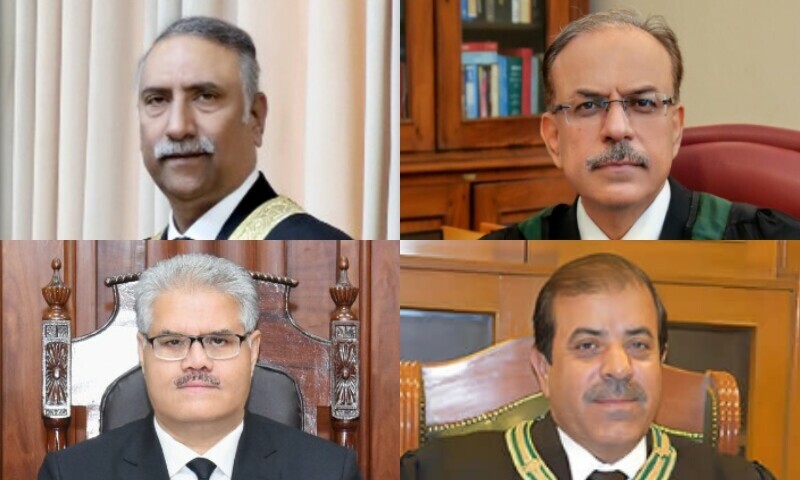
The JCP, after convening four consecutive meetings, voted by a majority of its members in each session to appoint Justice Sarfraz Dogar as the chief justice of the Islamabad High Court (IHC), Justice Rozi Khan Barrech for the Balochistan High Court (BHC), Justice Syed Muhammad Attique Shah for the Peshawar High Court (PHC), and Justice Junaid Ghaffar for the Sindh High Court (SHC).
The commission also permitted acting chief justices to remain in their roles during the transition. Letters detailing these nominations were dispatched to the prime minister’s principal secretary, urging the government to forward them to the president for formal appointment.
The decision to elevate Justice Atiq Shah, currently the second most senior judge at the PHC, to chief justice was supported by 11 of the JCP’s 16 members. However, the nomination faced opposition from Supreme Court Justices Mansoor Ali Shah and Muneeb Akhtar, as well as Khyber Pakhtunkhwa’s law minister and two members affiliated with the opposition Pakistan Tehreek-e-Insaf (PTI) party.
The appointments unfold against a broader controversy over judicial transfers. In February, five IHC judges, Justices Mohsin Akhtar Kiyani, Tariq Mehmood Jahangiri, Babar Sattar, Sardar Ejaz Ishaq Khan, and Saman Riffat Imtiaz, petitioned the Supreme Court to challenge Justice Dogar’s appointment as acting IHC chief justice and the transfer of three judges to their court: Justice Dogar from the Lahore High Court, Justice Khadim Hussain Soomro from the Sindh High Court, and Justice Muhammad Asif from the Balochistan High Court.
On June 19, the Supreme Court upheld the transfers’ constitutionality under Article 200, which governs inter-high court transfers, and allowed Dogar to continue as acting chief justice. The court referred the question of seniority to President Zardari, who on Saturday declared Dogar the IHC’s “senior-most judge” based on a revised seniority list from the Ministry of Law and Justice. Zardari also confirmed the permanent status of all three judges’ transfers.
On Friday, the five IHC judges, represented by senior lawyers Muneer A. Malik and Salahuddin Ahmed, appealed the ruling, urging its reversal “in the interest of justice.” They argue that the Supreme Court misinterpreted Article 200 by allowing permanent transfers, despite the provision’s text specifying only temporary reassignments.
“The June 19 order impermissibly reads in ‘permanent’ in Article 200(1) and (2) of the Constitution when no such language was contained in the provision,” the appeal states, criticizing the court for narrowly focusing on a single sub-article while ignoring the provision’s broader intent.
The judges also cite Article 175A, which grants the JCP authority over judicial appointments, warning that the ruling gives the executive undue influence over transfers. “The independence of judiciary does not allow bestowing onto the executive a much more expansive power than what the text of Article 200 and the foundational principles of constitutional law can bear,” the appeal asserts.
The judges further note that the Islamabad High Court Act of 2010 permits appointing judges from other provinces but omits any reference to transfers, supporting their claim that permanent reassignments to the IHC are unconstitutional. They have requested interim relief to prevent the three transferred judges from serving on the IHC until they take fresh oaths under Article 194, a pressing issue given Dogar’s current role.
In its June 19 decision, the Supreme Court defended the president’s authority under Article 200, stating that transfers, unlike appointments, do not require JCP approval. The court also dismissed arguments that vacant IHC posts should have triggered new JCP appointments rather than transfers.
The dispute has sparked concerns about judicial autonomy, with critics arguing that the executive’s role in determining seniority and transfers risks politicizing the judiciary.
Copyright © 2021 Independent Pakistan | All rights reserved