By Staff Reporter
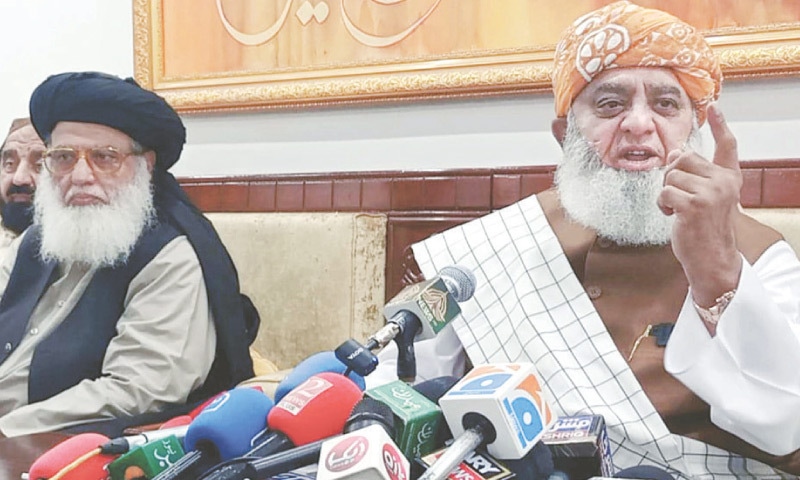
ISLAMABAD: The leader of a right-wing pro-Taliban opposition party called on Saturday for a shake-up in the government of Khyber Pakhtunkhwa province, pressing the ruling Pakistan Tehreek-e-Insaf (PTI) to initiate change from within the ruling party rather than through opposition manoeuvres.
Speaking at a news conference in Peshawar, Maulana Fazal ur Rehman emphasised the need for internal reform within PTI, which has governed the province for over a decade. “If PTI claims to have a majority, then change must come from within,” he said. “It should not appear as though the opposition is engineering the removal of the provincial government.”
His remarks come amid swirling reports of potential efforts to orchestrate a “regime change” in Khyber Pakhtunkhwa, a province already grappling with security challenges and political uncertainty.
The remarks follow a shifting political landscape following the Supreme Court’s June 27 verdict, which ruled PTI ineligible for reserved seats in the provincial assembly. This decision has left the opposition alliance just 20 members shy of a simple majority, intensifying speculation about the stability of Chief Minister Ali Amin Gandapur’s administration.
Prime Minister Shehbaz Sharif’s recent meetings with two key provincial leaders have only deepened suspicions of federal involvement, though senior Pakistan Muslim League-Nawaz (PML-N) leaders Khawaja Asif and Rana Sanaullah have publicly dismissed the prospect of a no-confidence motion against Gandapur.
Yet, Khyber Pakhtunkhwa Governor Faisal Karim Kundi, in a statement, left the door ajar for such a move.
“We are not plotting against the chief minister of Khyber Pakhtunkhwa,” he said. “However, the day we have even one more member in the assembly, it will be our democratic right to move a no-confidence motion.”
A July 2 meeting between Kundi and Sharif has further fueled rumors of a possible federal push to unseat Gandapur.
Rehman, however, advocated a different path. “My advice would be that there should be a change in the province, but if the PTI is in the majority, then the change should be from within the majority of the PTI,” he said. “If the same people come together to bring a change in the provincial government, then it will be better.”
He argued that this approach would preserve stability, warning that the province could not withstand the upheaval of a broader political struggle.
Rehman also cast doubt on PTI’s mandate, calling it “fake” and a product of electoral rigging, though he stopped short of endorsing an opposition-led ouster.
Beyond the political fray, Rehman turned his attention to the province’s worsening security situation, a concern that has plagued Khyber Pakhtunkhwa for years. “The common citizen’s life is insecure today,” he said. “The ordinary citizen no longer feels safe. People hesitate before leaving their homes.”
He called for an all-parties conference to devise a strategy to address the crisis, signaling JUI-F’s willingness to engage with other opposition parties on the issue. The JUI-F leader’s remarks underscore the dual challenges facing Khyber Pakhtunkhwa: political instability and a deteriorating law-and-order situation.
The province, which borders Afghanistan, has seen a resurgence of militant activity in recent years, particularly following the merger of the Federally Administered Tribal Areas (FATA) with Khyber Pakhtunkhwa, a policy Rehman has long opposed.
Rehman reiterated his party’s rejection of the FATA merger, a contentious reform enacted in 2018. “We strongly opposed the merger when it was being done,” he said, questioning the composition of a subsequent reform committee tasked with overseeing the integration.
“From all the parties, only we have been asked for representatives for the committee, but we haven’t given our representatives,” he noted, adding that JUI-F would finalise its stance after consultations at a grand tribal jirga scheduled for Sunday.
He raised pointed questions about the merger’s aftermath. “Is this decision an admission of the failure of the previous decision or another ploy to gain access to the minerals of the area?” Rehman asked, hinting at economic motives behind the policy.
Rehman’s critique extended to both the federal and provincial governments, which he accused of emerging from rigged elections. “Both the federal and the provincial governments were a result of electoral rigging,” he said. “When seats in the assemblies were for sale during the elections, how could I align myself with such a government?”
He distanced himself from Sharif’s administration, stating, “If I had agreed with the government’s decisions, I would have been part of it.” Despite his sharp rebukes, Rehman struck a note of national unity in the face of external threats. “Even with a thousand grievances, we will stand in one row if war is imposed on the country,” he said.
Adding another layer to the unfolding drama, JUI-F Senator Kamran Murtaza voiced the party’s unease with Chief Minister Gandapur. “We have had reservations against KP Chief Minister Ali Amin Gandapur,” Murtaza said, citing “inappropriate behavior and language” as reasons for the discontent. “He is not a well-liked personality for us.”
Murtaza clarified that JUI-F did not seek the government’s collapse but would support an internal PTI decision to replace Gandapur. “If PTI itself takes that decision that a certain individual will not continue and will be replaced by another, JUI-F would certainly welcome that decision,” he said.
He dismissed any personal ties influencing the stance, noting that Gandapur’s hailing from Dera Ismail Khan, the same district as Rehman, was irrelevant.
Copyright © 2021 Independent Pakistan | All rights reserved