By Staff Reporter
KARACHI: Pakistan unveiled plans on Saturday for a new aquaculture park in Karachi’s Korangi Fish Harbour, a move aimed at expanding the nation’s maritime sector and harnessing its blue economy.
The Rs3 billion initiative, led by Minister for Maritime Affairs Muhammad Junaid Anwar Chaudhry, targets transforming the sector into a $100 billion contributor by 2047.
The 120-acre aquaculture park is expected to produce between 360 and 1,200 tonnes of marine species annually, depending on the farming system and species cultivated. Its revenue potential is projected to range from $720,000 to $7.2 million a year, influenced by factors such as species selection, market prices, and production intensity. “
This project will boost the country’s blue economy through sustainable aquaculture,” Chaudhry said, directing the Korangi Fisheries Harbour Authority to submit a comprehensive execution report within 10 days.
He emphasized that the park would be developed under a public-private partnership framework, with land costs set according to an extensive farming model to provide an “affordable and efficient foundation” for private investors.
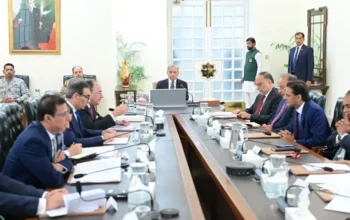
The meeting, attended by Gwadar Port Authority Chairman Noorul Haq Baloch and representatives from the Korangi Fisheries Harbour Authority, the Marine Fisheries Department, and the Balochistan Chamber of Commerce and Industry, highlighted the collaborative approach driving Pakistan’s maritime ambitions.
Experts at the session noted that the country’s coastal waters offer “highly conducive conditions” for aquaculture, providing an ideal environment for farming a variety of marine species.
Pakistan’s push for a robust blue economy is anchored in its recently launched “Maritime at 100” Vision, which seeks to unlock the economic potential of its coastal resources over the next two decades. Prime Minister Shehbaz Sharif has championed the effort, declaring in June that the blue economy represents “Pakistan’s new economic frontier.”
Speaking at the time, Sharif said, “Even tapping a fraction of this economy could be a real game-changer,” pointing out that coastal trade already contributes nearly $7 billion annually to the economy. “Just imagine the potential if we fully develop this sector.”
The Karachi aquaculture park is a cornerstone of this vision, but Chaudhry signaled that its success could pave the way for broader expansion. He proposed extending the aquaculture model to Balochistan, leveraging the province’s vast coastal belt for sustainable marine farming. “The series of meetings held by the maritime minister mark a significant step in the government’s broader maritime development strategy,” the ministry’s press release said
Beyond the aquaculture initiative, Chaudhry ordered the relocation of the Marine Fisheries Department’s sub-office to the premises of the Gwadar Port Authority. The administrative shift, the press release noted, is expected to “streamline inter-agency collaboration and expedite decision-making in blue economy initiatives.”
In a separate meeting, the minister reviewed progress on the land allotment and lease policy of the Port Qasim Authority, a key player in Pakistan’s maritime infrastructure. He was informed that the Survey of Pakistan has been tasked with identifying and demarcating authority-owned land, while revisions to the Port Qasim master plan are being aligned with a feasibility study for the National Ports Master Plan, currently underway.
Chaudhry reiterated the government’s commitment to sustainable marine development, asserting that investments in aquaculture and port infrastructure are “essential for ensuring food security, increasing exports, and generating employment across coastal regions.”
Stakeholders have also embraced Chaudhry’s proposal to establish a “maritime chamber of commerce and industry,” an initiative aimed at bringing all players in the sector onto a single platform. The idea has gained traction as a way to foster collaboration and drive growth in a sector long overshadowed by Pakistan’s land-based economy.
Copyright © 2021 Independent Pakistan | All rights reserved