By Staff Reporter
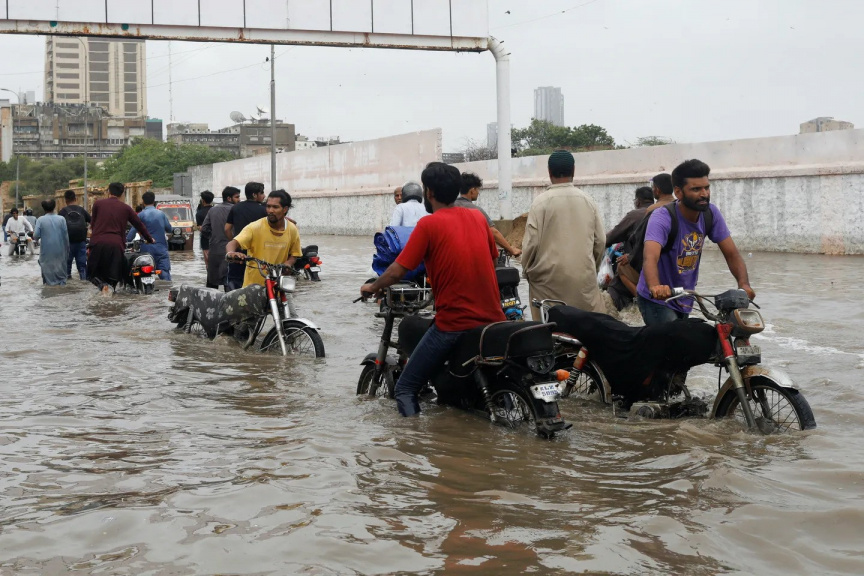
ISLAMABAD: Pakistan is bracing for another bout of heavy monsoon rain from Wednesday, weather officials have warned, as communities across the country continue to reel from flooding that has already killed at least 110 people and displaced thousands of families.
The Pakistan Meteorological Department (PMD) said on Tuesday that monsoon currents sweeping in from the Arabian Sea and the Bay of Bengal would begin penetrating the upper and central regions of the country from 29 July, with a westerly weather system expected to strengthen further from 1 August. The combination, forecasters said, is likely to bring scattered heavy to very heavy rainfall to large parts of the country over the following week.
Karachi and Lahore, Pakistan’s two largest cities, are among those expected to be affected, alongside Islamabad, Rawalpindi, Peshawar and Multan. The PMD cautioned that low-lying urban areas in Islamabad, Rawalpindi, Peshawar, Nowshera, Gujranwala, Gujrat, Sialkot, Lahore, Multan and Faisalabad face a heightened risk of urban flooding between 30 July and 4 August.
Officials also raised the alarm over the threat of landslides in the mountainous north, warning that Dir, Chitral, Swat, Kohistan, Buner, Battagram, Mansehra, Haripur and Abbottabad in Khyber Pakhtunkhwa, along with Gilgit-Baltistan, Murree, the Galliyat hills and Azad Kashmir, are all at risk between 30 July and 5 August. Flash floods could also strike streams and hill torrents across Kashmir, Murree, the Galliyat region, north-eastern Punjab, Islamabad, Khyber Pakhtunkhwa, Gilgit-Baltistan, Dera Ghazi Khan and north-eastern Balochistan, the department said, urging tourists to exercise caution throughout the forecast period.
Region-by-region warnings
In Punjab, the PMD forecast scattered heavy to very heavy showers across Islamabad, Rawalpindi, Murree and the Galliyat hills, along with Attock, Chakwal, Jhelum, Gujrat, Gujranwala, Sialkot, Lahore, Faisalabad, Sargodha and numerous other districts between 29 July and 4 August. The province’s south, including Bahawalpur, Multan, Rahim Yar Khan and Dera Ghazi Khan, is expected to see thundershowers and scattered heavy rain slightly later, from 31 July to 3 August.
Khyber Pakhtunkhwa faces rain, wind and thunderstorms across a wide swathe of the province, from Dir and Chitral in the north to Waziristan and Dera Ismail Khan in the south, running from 29 July through to 5 August. Gilgit-Baltistan is expected to see moderate to heavy rain and thunderstorms in Diamer, Astore, Hunza, Gilgit and Skardu from Tuesday evening until 6 August.
Sindh, including Karachi and Hyderabad, is forecast to receive rain and thundershowers with isolated moderate to heavy falls from the evening of 31 July to 2 August, with the PMD separately warning of urban flooding risk in Nawabshah, Sukkur, Hyderabad, Thatta, Badin, Mithi and several other towns during the same window. Eastern and southern Balochistan, including Zhob, Sibi, Kalat, Khuzdar and Gwadar, is expected to see rain, wind and isolated heavy falls between 31 July and 3 August.
Separately, the PMD’s Flood Forecasting Division said the Indus River remained at low-flood levels at Kalabagh, Taunsa and Guddu, and the Ravi River at Balloki and Sidhnai, but warned that the Indus at Guddu was expected to reach medium-flood level within 24 hours. A low-flood situation is expected to persist at Sukkur for a further 48 hours before it, too, rises to medium-flood level.
Rain to stay concentrated in the north, NDMA tells PM
Briefing Prime Minister Shehbaz Sharif and senior federal ministers earlier on Tuesday, an official from the National Disaster Management Authority (NDMA) said the current weather pattern remained heavily skewed towards the north of the country, with the most intense rainfall likely in the first ten days of August across eastern Punjab, Khyber Pakhtunkhwa, Gilgit-Baltistan and Azad Kashmir.
The official told the meeting that southern and central Balochistan had so far received no rain at all, and that no significant weather system had reached Sindh, pointing to what he described as a stark regional contrast in conditions across the country. A further major monsoon spell is expected over Azad Kashmir, Gilgit-Baltistan and southern Sindh within the next two days, with another significant spell forecast nationwide from the second week of September, according to a subsequent statement from the Prime Minister’s Office.
Chief secretaries from all four provinces, as well as from Gilgit-Baltistan and Azad Kashmir, also updated the meeting on the damage caused by recent rains and the state of ongoing rescue and rehabilitation work. The NDMA said it was continuing to funnel assistance and resources to provincial authorities dealing simultaneously with flooding in the north and a severe heatwave gripping Sindh and Balochistan.
Melting glaciers add to flood risk
According to figures shared during the briefing, 110 people have now died in rain-related incidents since the monsoon season began, with 360 injured, 796 houses damaged and 376 livestock killed.
Officials also warned that the global El Niño weather pattern has accelerated glacier melt in Pakistan’s northern mountains, raising the risk of glacial lake outburst floods (GLOFs) and flash flooding over the coming month. Vulnerable areas have been identified and precautionary steps are being put in place, the Prime Minister’s Office said.
The briefing was told that urban flooding in central Punjab, including Lahore, had been brought under control through immediate intervention, though agricultural land in some areas remains submerged after seasonal streams and drains overflowed, with drainage operations continuing. Flood conditions in Dera Ghazi Khan and the surrounding districts were also described as under control.
The National Highway Authority told the meeting that roads at 106 locations, closed by landslides, had already been reopened. Separately, the Ministry of Information Technology confirmed it had activated the National Emergency and Telecommunication Centre, allowing the Rescue 1122 service to take emergency calls from any mobile network regardless of the caller’s provider. Officials added that 700 sites had been identified nationwide to store rainwater during the monsoon season for later use in agriculture during drier months.
PM orders emergency footing
The prime minister directed all relevant authorities to remain on standby for emergencies, and instructed the NDMA to coordinate closely with provincial disaster management authorities and ensure rainfall forecasts and monsoon updates reach federal and provincial departments without delay.
He also asked Planning Minister Ahsan Iqbal to chair daily meetings of the flood committee to determine the appropriate response as the situation develops, and stressed that the early warning system for glacial lake outburst floods and flash flooding in the north must remain fully functional at all times.
Sharif noted that Pakistan’s contribution to global carbon emissions remained negligible, yet the country continued to bear the brunt of climate change, adding that his government was moving swiftly to implement short, medium and long-term measures in response. He instructed the NDMA to work with all relevant institutions to keep loss of life and property to a minimum during the current spell.
Ministers at the briefing struck a similar note, calling for a co-ordinated, whole-of-government response to the monsoon season. “We cannot stop floods or high temperatures, but we can take measures to protect lives, and this is why we have been focusing on strengthening our preparedness,” Ahsan Iqbal said.
Referring back to the floods of 2025, the planning minister said that despite their scale, comparatively few lives had been lost, which he credited to swift rescue and relief work. He said the government was also monitoring glacial melt and collaborating with China on developing weather-resistant crop varieties to safeguard food security. “With this whole of government approach, we are trying to minimise losses,” he added.
Finance Minister Muhammad Aurangzeb told the meeting that Pakistan had committed $700 million a year to climate-related spending for the next decade under a country partnership framework agreed with the World Bank, which pledged $20 billion in support for the country’s development in 2025. He said the ten-year, $2 billion-a-year programme was built around two central priorities — climate change and population growth — and called for more “investable, bankable projects” to make use of the funding. “We have the funds available; now let’s utilise them properly,” he said.
A recurring disaster
Separate figures released by the NDMA on Tuesday put the monsoon death toll at 109 since 26 June, with 362 people injured, 799 houses damaged, more than 23km of roads washed away, 25 bridges destroyed and 379 livestock killed. Khyber Pakhtunkhwa has recorded the highest number of fatalities, with 55 deaths, followed by Punjab with 36, while Punjab has reported the highest number of injuries, at 263. House collapses remain the single biggest cause of death this monsoon season, accounting for more than half of all fatalities recorded so far.
No deaths were reported in the most recent 24-hour period, though two people were injured and three houses damaged in Buner, in Khyber Pakhtunkhwa.
Pakistan endures destructive monsoon flooding most years, with homes, crops and infrastructure regularly damaged by the seasonal rains. The devastation pales, however, next to the floods of 2022, when unprecedented monsoon rainfall submerged a third of the country, killed more than 1,700 people and affected an estimated 33 million — among the deadliest natural disasters in the country’s history.
Copyright © 2021 Independent Pakistan | All rights reserved