By Staff Reporter
ISLAMABAD: Pakistan’s army chief, Field Marshal Asim Munir, on Sunday described his second US visit in six weeks as a “new dimension” in Islamabad-Washington ties, state-run PTV News reported.
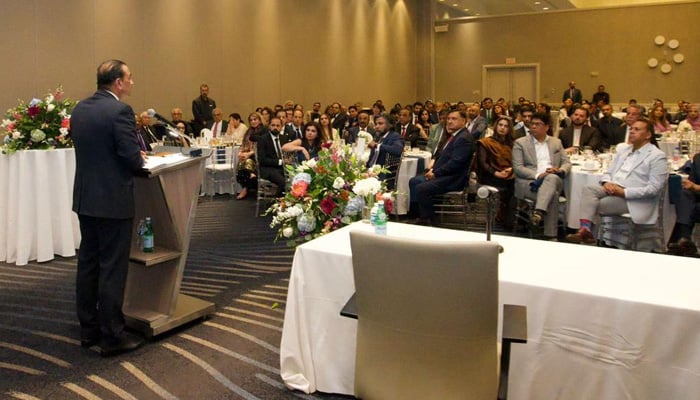
The remarks came during an address to members of the Pakistani diaspora in Florida, where Munir highlighted the strengthening of bilateral relations and Pakistan’s role in regional stability.
“My second visit after a gap of just one and a half months marks a new dimension in Pak-US relations,” Munir said, emphasising that the aim was to steer ties onto a “constructive, sustainable, and positive path.”
The visit follows Munir’s June trip, where he became the first serving Pakistani army chief to meet a sitting US president, holding talks with President Donald Trump over lunch. The military’s media wing said Munir’s current engagements include senior US political and military leaders and the diaspora.
“It is an honour to address Pakistanis living in the US,” Munir told the gathering, calling overseas Pakistanis “a source of pride and dignity” with enthusiasm matching those at home. “Pakistanis living abroad are not a case of ‘brain drain’ but rather a ‘brain gain.’”
Field Marshal accused India of projecting itself as a “Vishva Guru” (global teacher) while engaging in destabilising acts. “In practice, it is nothing like that,” he said, alleging India’s Research and Analysis Wing (RAW) was involved in “transnational terrorist activities.”
He cited the killing of a Sikh leader in Canada, the detention of eight Indian naval officers in Qatar, and the case of Kulbhushan Jadhav, an Indian convicted of espionage in Pakistan.
“Pakistan has fought a successful diplomatic war against India’s discriminatory and duplicitous policies,” Munir said, warning that recent Indian actions had brought the region “to the brink of a dangerously flaming war.”
He credited Trump’s “strategic leadership” for averting a Pakistan-India conflict and other global wars.
On Kashmir, Munir called it “an unfinished international agenda,” not India’s internal matter, echoing Quaid-e-Azam Muhammad Ali Jinnah’s description of it as Pakistan’s “jugular vein.” He reaffirmed support for UN Security Council resolutions on the disputed region.
Munir also addressed terrorism, pointing to groups like “Fitna al-Khawarij,” a term for the banned Tehreek-i-Taliban Pakistan (TTP), operating from Afghanistan. “Pakistan is currently the last bulwark against terrorism,” he said, vowing that terrorists “will have to face justice with all their might.”
Munir highlighted a potential US trade deal to boost investment and noted ongoing implementation of economic cooperation agreements with the US, Saudi Arabia, UAE, and China. “Pakistan has achieved remarkable successes on the international diplomatic front,” he said.
He praised the diaspora’s role. “Pakistan’s progress and prosperity are linked to Pakistanis living around the world.” However, he cautioned that “anti-state elements” were using social media to “create engineered chaos.”
Army chief Munir has engaged with senior American military and political leadership during his ongoing visit to the United States, the military’s media wing said on Sunday, as Islamabad seeks closer defence and security ties with Washington.
Munir’s visit comes at a time when both nations are working to rebuild relations that had been strained mainly over disagreements on counterterrorism policy. The army chief’s engagements reflect an evolving dynamic between Pakistan and the United States, as Islamabad seeks to expand military and economic collaborations with Washington under President Donald Trump’s administration.
“Field Marshal Syed Asim Munir, NI (M), Chief of Army Staff (COAS), is undertaking an official visit to the United States,” the Inter-Services Public Relations (ISPR), the military’s media wing, said in a statement. “During the visit, he has engaged in high-level interactions with senior political and military leadership, as well as members of the Pakistani diaspora.”
In Tampa, the Pakistan army chief attended the retirement ceremony of outgoing United States Central Command (CENTCOM) Commander General Michael E. Kurilla, and the change of command ceremony that marked the assumption of command by Admiral Brad Cooper, his successor, the military’s media wing said.
Munir lauded General Kurilla’s leadership and his contributions to strengthening bilateral military cooperation between Pakistan and the US. He extended his best wishes to Admiral Cooper, expressing confidence in continued collaboration to address shared security challenges, the ISPR added.
The Pakistani army chief also met US Chairman Joint Chiefs of Staff General Dan Caine, where matters of mutual professional interest were discussed. “On the sidelines, COAS interacted with Chiefs of Defence from friendly nations,” the statement added, without mentioning the names of the countries.
Munir’s engagements included an interaction with the Pakistani diaspora in the US, during which the army chief urged them to “remain confident in Pakistan’s bright future and to actively contribute to attracting investments.” “The diaspora reaffirmed their commitment to supporting Pakistan’s progress and development,” the ISPR said.
Munir’s visit to the US signifies growing closeness between Pakistan and the US. This is the Pakistan army chief’s second visit to the country since June, when Trump hosted him for an unprecedented lunch at the White House. Both leaders discussed the tensions in the Middle East, particularly the then Iran-Israel military conflict.
Under Trump’s renewed outreach, Washington has praised Pakistan’s leadership and reinstated military cooperation previously curtailed over Afghanistan-related concerns. Islamabad, in turn, seeks to balance its longstanding partnership with China, including arms supply and defence infrastructure, with growing engagement with the US.
Both countries last week finalised a trade deal according to which the US will charge a 19 percent tariff on imports from Pakistan, compared to a 29 percent reciprocal tariff announced in April that had raised alarm in Islamabad. Separately, Trump highlighted a partnership with Pakistan to develop the country’s oil reserves.
Pakistan’s powerful military, which has ruled the country directly for nearly half of its history and holds sway in political matters even when not in power, plays a central role in shaping its foreign and security policies.
Copyright © 2021 Independent Pakistan | All rights reserved