By Staff Reporter
KARACHI: Pakistan’s central bank anticipates economic growth accelerating to as much as 4.25% in fiscal year 2026, with inflation holding steady within target as the benefits of prior interest-rate reductions continue to ripple through the economy.
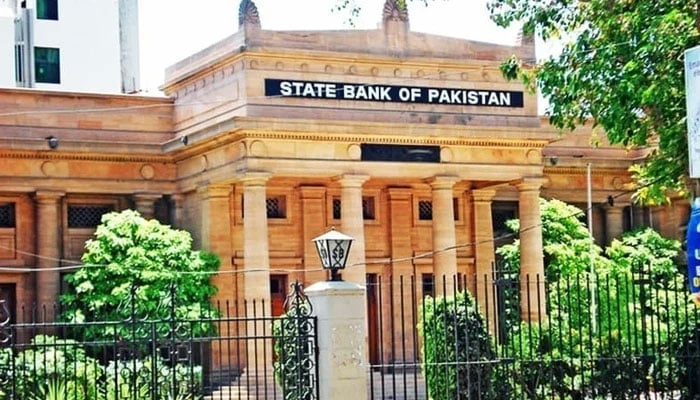
The State Bank of Pakistan (SBP), in its maiden Monetary Policy Report (MPR) released Wednesday, forecast real GDP expansion of 3.25% to 4.25% for FY26, up from 2.7% in the prior fiscal year, while expecting the current account deficit to widen modestly to 0% to 1% of GDP.
Foreign exchange reserves are projected to build to $15.5 billion by December 2025 and exceed $17 billion by June 2026, bolstered by planned official inflows and an expected uptick in foreign investment following a recent sovereign credit rating upgrade.
The SBP’s Monetary Policy Committee (MPC) maintained the policy rate at 11% during its June and July 2025 meetings, assessing the real policy rate as “adequately positive” to anchor inflation within the medium-term range of 5% to 7%. This follows a 1,100 basis point cut to the rate from June 2024 to May 2025, implemented amid a sharp slowdown in inflation. The MPR, the central bank’s inaugural such report, serves as a transparency tool to outline key economic developments and the macroeconomic outlook informing MPC decisions.
Pakistan’s economy has endured significant headwinds in recent years, including high inflation, elevated twin deficits, depleted foreign reserves, exchange rate volatility, and subdued growth stemming from adverse global and domestic shocks. Yet, through the SBP’s calibrated policy responses and the government’s sustained fiscal consolidation, stabilization has taken hold, positioning the country better to handle external shocks and domestic risks than two years ago.
Economic activity is gaining traction, with the lagged effects of earlier rate cuts still materializing. SBP-IBA business sentiment surveys signal a gradual revival in economic and investment activity, supporting the FY26 growth projection. On the external front, a widening trade deficit is anticipated due to rising import demand, though continued growth in workers’ remittances will help contain the current account gap. Projected financial inflows, combined with the SBP’s ongoing interbank FX purchases, are expected to drive reserve accumulation.
The MPC expects inflation to largely stay within 5% to 7% in FY26, conditional on the current policy stance, as illustrated in the report’s inflation fan chart. “On balance and conditional upon the current policy rate, the Committee expects inflation readings to mostly remain in the range of 5 – 7 percent during FY26,” the MPR stated.
While acknowledging recent macroeconomic improvements, the committee highlighted risks to the outlook. “The Committee acknowledged the recent improvement in macroeconomic dynamics, but also considered potential domestic and global risks to the macroeconomic outlook. These include volatile international commodity prices, global trade uncertainty, and unanticipated adjustments in domestic administered energy prices,” the report noted. Additional concerns include heightened global economic uncertainty from recent trade-related tariff developments, potential volatility in energy and food prices affecting the external account and domestic inflation, and domestic risks from heavy rainfalls and flooding that could elevate perishable food prices in the near term. Tight global financial conditions and the timing of energy price adjustments also pose implications for inflation and activity.
Based on these factors, the MPC deemed the real policy rate sufficient to stabilize inflation in the 5% to 7% target range. At the same time, the MPR emphasized pursuing structural reforms to complement monetary policy and foster sustainable higher growth. “The MPC stressed on the importance of pursuing structural reforms to supplement monetary policy efforts and to achieve higher growth on a sustainable basis,” the report said.
The MPR features five box items addressing theoretical aspects of monetary policy and current issues. The first contextualizes the 1,100 basis point rate reduction and its unfolding impact, linking it to transmission lags referenced in recent SBP statements. A second provides an overview of cautious policy decisions by major central banks in advanced and emerging economies. The third offers guidance on interpreting fan charts, a tool for conveying forecast uncertainty, particularly for inflation. The fourth and fifth detail the SBP’s application of alternative data and machine learning to overcome data lags and inconsistencies in the labor market and agriculture sectors, respectively.
The report underscores the SBP’s commitment to data-driven policymaking amid evolving challenges. By detailing these elements, the central bank aims to better inform stakeholders on the rationale behind maintaining a prudent stance.
Copyright © 2021 Independent Pakistan | All rights reserved