By Staff Reporter
MUZAFFARABAD: Elections in Azad Kashmir have been split into three separate phases, with polling now stretching into August, after officials said troops needed to be freed up from duties elsewhere in the country to secure the vote following weeks of deadly unrest.
The region’s chief election commissioner, Justice (retd) Ghulam Mustafa Mughal, said on Tuesday that voting in Azad Jammu and Kashmir (AJK), which had been due to take place in a single round on 27 July, would instead unfold in three stages running until 10 August. He said the change was made at the request of political parties, who wanted assurance that sufficient army personnel would be available to guard polling stations.
“You are aware of the overall situation in Pakistan. The army is engaged at various places, but we are grateful to all stakeholders who, at our request, made arrangements to provide an adequate number of troops. Their movement will begin over the next couple of days,” Mughal told reporters, pointing to the strain already placed on the military by unrest in Balochistan and Khyber Pakhtunkhwa.
Under the revised timetable, voters in Mirpur division will go to the polls as originally planned on 27 July. Muzaffarabad division will follow on 2 August, alongside polling for the 12 seats reserved for refugees from Indian-occupied Kashmir who settled in mainland Pakistan. The final stage, covering Poonch division, will take place on 10 August.
Mughal said the same contingent of troops would move between divisions as each stage of voting concluded, travelling from Mirpur to Muzaffarabad once polling closed there on 27 July.
The announcement comes after weeks of turmoil in the Himalayan territory, where protests led by the Joint Awami Action Committee (JAAC), a civil rights alliance banned by the authorities last month under anti-terrorism legislation, have left around 30 people dead in clashes with law enforcement. The unrest has closed businesses, disrupted campaigning and left internet and mobile data services suspended across large parts of the region, with security checkpoints still a common sight in the capital, Muzaffarabad, despite an easing of the shutter-down strikes that paralysed the city for weeks.
At the heart of the JAAC’s campaign is a demand to scrap the 12 assembly seats set aside for Kashmiri refugees, which the group says are used to manipulate the formation of government in AJK. The regional administration rejects that claim. The organisation was outlawed on 5 June, shortly before it called for mass demonstrations on 9 June, and confrontations between protesters and security forces have flared intermittently ever since, including clashes in Poonch as recently as last week.
Despite the violence, Mughal insisted the vote would go ahead regardless of whether conditions improved. “Hopefully, the situation will improve. Even if it does not, we are constitutionally bound to hold the elections,” he said, adding that participation in advance polling by government employees suggested public appetite for the vote remained strong. “The doubts were that elections might not be held at all or could be postponed. By adopting phased polling, we are reinforcing the electoral process so that elections remain peaceful, transparent, and voters can freely exercise their right to vote.”
He dismissed suggestions that staggering the vote across divisions could undermine its transparency, arguing the opposite was true, and rejected calls to exclude Poonch from the process altogether. Officials said polling agents would receive Form-24 results at the close of voting in each constituency, allowing unofficial results to be known on the day, though formal notification of winners may not be issued until voting has concluded in every division. Mughal also pledged that measures were in place to prevent internet disruption from hampering journalists’ ability to report results on polling day, while stressing that decisions on broader internet restrictions fell outside the commission’s remit. He confirmed that international observers and journalists would be granted full access to cover the elections, and that the invitation extended to domestic and foreign observers remained open.
The change to the schedule was made under Section 37 of the Jammu and Kashmir Elections Act 2020, which allows the Election Commission to amend the election programme after the official notification has been issued. The decision had been taken in consultation with political parties, though no formal meeting was held because election material for Mirpur division had already been dispatched; parties were instead consulted by phone and backed the change.
The revised timetable follows a call from Sardar Muhammad Yaqoob Khan, a former AJK president and prime minister, who wrote to Mughal on Monday urging that the vote be postponed altogether because of the security situation. Mughal had previously told local media that postponing the elections was not an option, describing the vote as a constitutional requirement.
Voters across 45 constituencies will elect the AJK Legislative Assembly, comprising 33 territorial seats and the 12 reserved refugee seats, with candidates drawn from Pakistan’s Punjab, Sindh and Khyber Pakhtunkhwa provinces standing for the latter.
Nawaz Sharif launches PML-N campaign
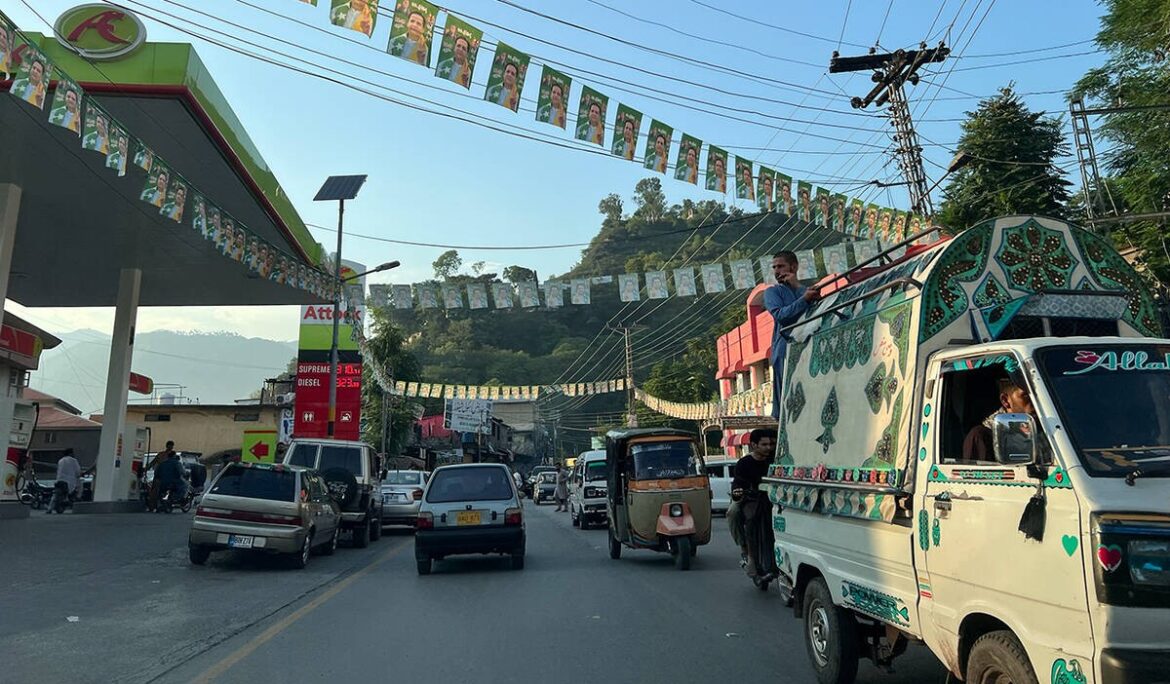
The announcement came as former prime minister Nawaz Sharif formally launched the campaign of his Pakistan Muslim League-Nawaz (PML-N) party in Muzaffarabad, telling supporters he would ask his brother, prime minister Shehbaz Sharif, to install him as AJK’s own prime minister should the party win.
Addressing a rally alongside Punjab chief minister Maryam Nawaz, his daughter, Sharif told the crowd it had been years since he had visited the region. “Today, we are meeting after a very long time. I have remained away from you,” he said, before questioning why a motorway had never been built connecting Kohala and Muzaffarabad. He suggested one should now run along the Jhelum River, linking Mansehra to Muzaffarabad and on to Mirpur.
“For me, Azad Kashmir is just as dear as Punjab,” he said. “Azad Kashmir is my second home.”
Sharif pledged to visit the region every three months if elected, personally inspecting development projects alongside the prime minister, and promised a tenfold increase in AJK’s budget, recalling that he had doubled it during his own tenure as Pakistan’s prime minister. He said 10 electric, air-conditioned buses would arrive in Muzaffarabad within days, alongside what he described as a fleet of mobile hospitals for the region — though he gave differing figures for the latter during the address, at one point saying 12 and at another 15.
He was also critical of the parties that have governed AJK since PML-N was last in power, accusing them of doing little beyond “sloganeering and inciting people’s emotions.”
The PML-N has named candidates for 37 of the 45 assembly seats up for election. It faces a challenge from the PPP, which has entered into an electoral alliance with the Jamiat Ulema-i-Islam–Fazl and named candidates for 35 seats, with two more allocated to its ally. Analysts have suggested the PML-N may face a harder contest than usual because of anger in some quarters over its perceived role in the response to the JAAC-led protests. The PPP’s Raja Pervez Ashraf has said the dispute over refugee seats is a constitutional matter that will fall to the incoming assembly to resolve.
Copyright © 2021 Independent Pakistan | All rights reserved