By Staff Reporter
ISLAMABAD: Pakistan is rolling out the red carpet for American energy companies, inviting them to bid on a fresh round of oil and gas exploration blocks as part of a broader push to deepen economic ties with the US under President Donald Trump’s second term.
The outreach signals a thaw in relations after years of tension, with both nations eyeing cooperation in energy, critical minerals, and other high-growth sectors.
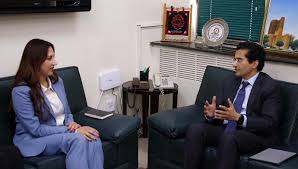
In a meeting in Islamabad on Wednesday, Pakistan’s Minister for Petroleum Ali Pervaiz Malik urged US companies to seize opportunities in the country’s struggling energy sector. “This bidding round is a great opportunity for international partners to invest,” Malik told US Chargé d’Affaires Natalie A. Baker, according to state broadcaster Radio Pakistan. The minister highlighted the government’s ongoing auction of onshore and offshore exploration blocks, part of a bid to revive domestic oil and gas production.
Baker, in turn, signaled Washington’s enthusiasm. “American firms are showing keen interest in Pakistan’s oil, gas, and mineral sectors, in line with President Donald Trump’s vision,” she said, adding that the US embassy would “facilitate direct connections between American and Pakistani companies in the exploration and production sectors,” Radio Pakistan reported.
The overture comes as Pakistan seeks to bolster its $400 billion economy, which has been battered by dwindling foreign exchange reserves and heavy reliance on imported liquefied natural gas. Local oil and gas production has stagnated for years, exacerbating energy shortages and straining state finances. Islamabad hopes foreign investment, particularly from the US, will help unlock its untapped hydrocarbon and mineral wealth.
The invitation to US firms marks a shift in Pakistan-US ties, which have been rocky for much of the past decade. Under President Joe Biden, relations hit a low point, with Washington accusing Pakistan’s intelligence services of ties to the Afghan Taliban, a charge Islamabad denied. Pakistan, meanwhile, chafed at being sidelined during the US withdrawal from Afghanistan in 2021 and faced criticism over human rights and nuclear security. Limited economic engagement and security downgrades further strained the partnership.
The election of Trump has ushered in a new chapter. Last month, the US granted Pakistan a reduced tariff rate of 19% on exports, one of the lowest in South Asia, paving the way for expanded trade. The US is already Pakistan’s largest market for textiles, with Islamabad posting a $3 billion trade surplus in 2024, largely driven by the sector. A trade deal finalized in Washington last month, which averted a potential 29% tariff, also opened the door to deeper investment in energy, mining, IT, and cryptocurrency.
“From our perspective, it was always going beyond the immediate trade imperative, and its whole purpose was, and is, that trade and investment have to go hand in hand,” Finance Minister Muhammad Aurangzeb said in video-taped remarks following the Washington talks. The agreement, he added, laid the foundation for a broader economic and strategic partnership.
Pakistan’s energy sector, long plagued by inefficiencies and underinvestment, is a key focus of the renewed partnership. In July, Trump took to social media to announce a deal to develop Pakistan’s “massive oil reserves,” stating, “We are in the process of choosing the Oil Company that will lead this Partnership.” While details remain sparse, the agreement underscores Washington’s interest in Pakistan’s hydrocarbon potential.
The push extends beyond oil and gas. In a message marking Pakistan’s Independence Day on August 14, US Secretary of State Marco Rubio highlighted opportunities for cooperation in critical minerals and hydrocarbons. Pakistan’s southwestern Balochistan province, home to the Reko Diq project,one of the world’s largest undeveloped gold and copper mines, operated by Barrick Gold Corp., is a focal point. Commerce Minister Jam Kamal has said Islamabad will offer US firms concessions, such as lease grants, to invest in mining projects through joint ventures with local companies.
Pakistan’s outreach to the US aligns with its broader goal of diversifying foreign investment to stabilize its economy. The country’s dependence on imported LNG has strained its foreign exchange reserves, while chronic energy shortages have hampered industrial growth. Unlocking domestic resources, particularly in Balochistan, could ease these pressures and bolster Islamabad’s fiscal position.
The warming of ties also reflects geopolitical shifts. In May, Trump claimed credit for brokering a ceasefire between Pakistan and India after hostilities flared in May, triggered by an attack in Indian occupied Kashmir. The détente has created space for Pakistan to focus on economic priorities, including its energy and mining sectors.
For US firms, Pakistan’s untapped resources and strategic location offer significant upside, though challenges remain. The country’s bureaucratic red tape, security concerns in regions like Balochistan, and history of political instability could deter investors. Still, the prospect of accessing one of South Asia’s largest markets, coupled with Washington’s backing, may prove compelling.
Copyright © 2021 Independent Pakistan | All rights reserved