By Staff Reporter
ISLAMABAD: Pakistan has encouraged its refineries to explore buying Libyan crude and is pressing ahead with strategic petroleum reserves and bonded storage, seeking to loosen its dependence on Middle East supplies that pass through the Strait of Hormuz, Petroleum Minister Ali Pervaiz Malik said on Monday.
Malik told Libya’s oil and gas minister, Khalifa Rajab Abdulsadek, on the sidelines of the International Energy Forum in Riyadh that Pakistan wants alternative supply options if key sea lanes are disrupted, including Hormuz and the Bab al-Mandab Strait. Abdulsadek called Pakistan an important country for Libya and said he would urge the national oil company to allocate larger volumes to Pakistani buyers. He added that Libya plans to upgrade its refineries and is interested in Pakistan’s experience in that area.
The push reflects a structural weakness. Pakistan sources most of its crude and refined fuel from the Middle East and has no fully operational strategic reserve system, relying largely on storage held by private importers. Officials have said the country depends on Hormuz for as much as 90% of its oil and liquefied natural gas imports. The conflict involving the U.S., Israel and Iran, and the attacks in the Gulf that followed, have disrupted shipping and renewed concern over the strait, which carries about a fifth of global oil and gas.
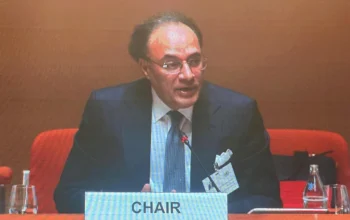
Speaking at a plenary session at the forum, Malik said the 2026 supply shock had been “unprecedented both in terms of its depth as well as its breadth.” He said Pakistan is trying to meet immediate needs while rethinking its energy security architecture. He outlined a bonded reserve scheme offering full tax neutrality and assured repatriation of funds, more onshore and offshore exploration, and new refineries and tank farms. He also pointed to competitive electricity and gas markets and targeted relief mechanisms, and called for investment in renewables, hydrocarbons, critical minerals, grids and pipelines.
Pakistan needs about $550 million of crude a month, officials say, and roughly $300 million would be needed to maintain strategic reserves. Funding is a constraint. In May, a ministry document reviewed by Reuters proposed financing state reserves from a ring-fenced fund of 10 rupees per liter drawn from the existing petroleum levy, with allocations starting July 1. Malik has acknowledged that building reserves is “easier said than done” for a country under an IMF program. A committee he formed in April was tasked with developing a buffer of up to 90 days, in line with International Energy Agency members.
Malik said Pakistan avoided rationing of major energy sources during the crisis, helped by government measures and support from Saudi Arabia, Qatar and Kuwait. The disruption, he said, extended beyond oil and gas to shipping and insurance.
Turkish Energy Minister Alparslan Bayraktar told Malik he plans to visit Pakistan next month to hand over a Turkish Petroleum Corp. seismic vessel, which is due to begin collecting data in the Indus Basin. Malik also held a breakfast meeting with Qatari Energy Minister Saad Sherida Al-Kaabi to discuss possible cooperation in liquefied natural gas.
Malik attended at the invitation of Saudi Energy Minister Prince Abdulaziz bin Salman. He said his presence reflected Pakistan’s solidarity with the kingdom, in line with instructions from Prime Minister Shehbaz Sharif and Field Marshal Asim Munir, chief of defence forces, and he condemned Houthi attacks on Saudi territory. The forum, hosted by Saudi Arabia with Italy and Nigeria, drew officials from major producing and consuming nations and executives from companies including Saudi Aramco, ExxonMobil, Shell and BP.
The security backdrop remains unsettled. Saudi civil aviation authorities said three Saudi citizens were killed in two attacks on Thursday targeting Riyadh’s King Khalid International Airport and a Saudia aircraft; the Houthis claimed a strike on the airport. Two more tankers were attacked near the Strait of Hormuz on Sunday, one in the strait and one off Oman, according to Argus. Brent has held above $100 a barrel in recent weeks, even after Kpler data showed Hormuz flows back above pre-war levels in late September.
Copyright © 2021 Independent Pakistan | All rights reserved