By Staff Reporter
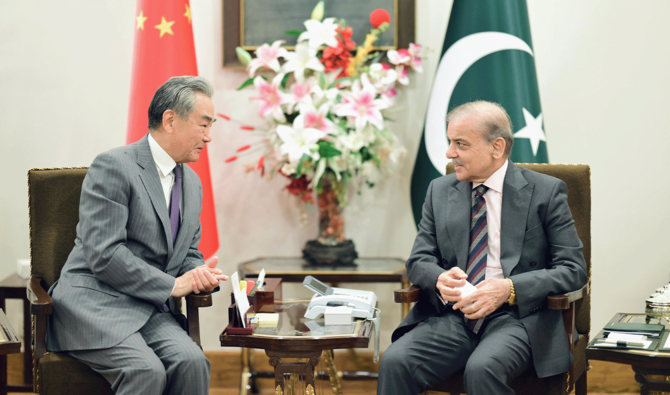
ISLAMABAD: Chinese Foreign Minister Wang Yi held high-level talks with Pakistani civilian and military leaders in Islamabad, pledging to bolster their strategic partnership and advance an upgraded version of the China-Pakistan Economic Corridor (CPEC), officials said on Friday, as both nations navigate regional security challenges.
Wang arrived in the Pakistani capital on Wednesday for a two-day Pakistan-China Foreign Ministers’ Strategic Dialogue, days after engaging with Indian leaders in New Delhi over their disputed Himalayan border. The visit follows a brief but intense military standoff between India and Pakistan in May, during which Islamabad deployed Chinese-made fighter jets and missiles.
In Islamabad, Wang met Prime Minister Shehbaz Sharif, Foreign Minister Ishaq Dar, and Army Chief Field Marshal Asim Munir, with discussions focusing on regional security, counter-terrorism, and deepening bilateral ties, according to Pakistani government and military statements.
“During our most cordial exchange, I reiterated Pakistan’s firm resolve to further strengthen our All-Weather Strategic Cooperative Partnership and underlined the central role of CPEC in driving our socio-economic progress and enhancing regional connectivity,” Sharif said in a post on X after his meeting with Wang.
The CPEC, a cornerstone of China’s Belt and Road initiative, has seen Beijing invest tens of billions of dollars in Pakistan since 2013, funding energy, infrastructure, and transport projects. A flagship component is the deep-sea port at Gwadar in Balochistan, which aims to connect China to the Arabian Sea. The corridor seeks to modernize Pakistan’s economy through a network of roads, railways, pipelines, and ports, largely financed by Chinese loans.
Pakistan also relies heavily on Chinese military hardware, accounting for around 63 percent of China’s arms exports, according to the Stockholm International Peace Research Institute (SIPRI). During the May conflict with India, Pakistan deployed Chinese-made J10-C Vigorous Dragon and JF-17 Thunder jets, armed with air-to-air missiles, alongside HQ-9P long-range surface-to-air missile systems, Chinese radar, and armed and reconnaissance drones.
In a meeting with Field Marshal Munir, Wang reiterated “China’s steadfast support for Pakistan’s sovereignty and development,” the military’s Inter-Services Public Relations (ISPR) said. The army chief expressed gratitude for Beijing’s consistent backing, with both sides committing to “advance peace, stability, and prosperity in the region,” the ISPR added.
On Thursday, Wang and Dar announced plans to prioritize “high-quality” cooperation under an upgraded CPEC, dubbed “CPEC 2.0,” during a joint press conference in Islamabad.
“The two sides agree that the current priority for China-Pakistan cooperation is high-quality CPEC cooperation and build an upgraded version of CPEC,” Wang told reporters. “We will build on our past achievements to build a growth corridor, a livelihood enhancing corridor, an innovation corridor, a green corridor and an open corridor to promote greater synergy between the five corridors with Pakistan’s development planning.”
Dar welcomed China’s vision, emphasizing expanded cooperation in trade, investment, and people-to-people ties, with a focus on industrial zones, green energy, and agricultural modernization. He confirmed that Prime Minister Sharif would attend the Shanghai Cooperation Organization Council of Heads of State Summit in China from Aug. 31 to Sept. 1.
Both sides also vowed to deepen counterterrorism and security cooperation and enhance regional coordination, a commitment underscored by recent tensions with India. New Delhi had claimed Beijing actively supported Pakistan during the May standoff, a charge Islamabad rejected, asserting its “victory” was based on its own capabilities.
Pakistan views China as its top economic and diplomatic ally, with Beijing’s extensive investments in power, infrastructure, telecom, and transport sectors reinforcing their partnership.
Copyright © 2021 Independent Pakistan | All rights reserved