By Staff Reporter
LAHORE: Pakistan mounted a frantic response on Wednesday to confront a swelling flood emergency in its populous Punjab province after India released excess water from dams in the disputed Kashmir region, exacerbating weeks of punishing monsoon rains that have already claimed hundreds of lives and submerged vast swaths of farmland across the nuclear-armed neighbors.
In Sambrial, a town in Punjab’s Sialkot district, five members of one family were among seven people swept away by flood waters in the village of Majra Kalan, Rescue 1122 spokesperson said. “The bodies of a woman and her child have been recovered, while two other children and her husband are still missing.”
The surge of water into three major rivers — the Chenab, Ravi and Sutlej — flowing from India into Pakistan prompted urgent evacuations, army deployments and a deliberate breach of a protective embankment to avert catastrophe at a key barrage. Officials cautioned that “exceptionally high” flood threats could endure for days, evoking memories of the 2022 disaster that killed over 1,700 and wrought more than $30 billion in losses.
An Indian government source told Reuters New Delhi had opened all gates of major dams on rivers in occupied Kashmir following heavy rains, alerting Islamabad to the downstream threat. Pakistan acknowledged the alert — its third since Sunday — and warned of incoming surges. Some 200,000 cusecs of water were expected to be released, though it remained unclear if this would occur in a single burst or stages. A cusec measures one cubic foot, or about 28 liters, per second.
The central Punjab province, the nation’s agricultural heartland and home to roughly half its 240 million people, faced the brunt. “An extremely high flood has been recorded at Qadirabad Headworks on the Chenab River, with water flow measured at 935,000 cusecs,” the Provincial Disaster Management Authority (PDMA) said in a statement.
Authorities carried out an emergency breach on a protective embankment at the Qadirabad Barrage as the Chenab surged overnight, after deploying the army and evacuating 150,000 residents. The move aimed to “help reduce pressure on the structure,” the PDMA added.
A few hours earlier, PDMA Director General Irfan Ali Kathia described the rapid rise. “The water went … to medium and exceptionally high within hours.” “Because of this, we did the evacuations overnight,” he told reporters at a briefing.
Kathia called the river levels “historical peaks” unseen since 2014. Around 100 to 110 relief camps have been established, offering food, medical aid and livestock shelter. He urged immediate evacuations in floodplains. “For the next 48 hours, this is critical for the Ravi River and downstream Khan in Chenab.”
The National Disaster Management Authority (NDMA) echoed the alarm, noting “extraordinary” flows with the Chenab exceeding 900,000 cusecs at Marala Headworks and the Ravi surpassing 200,000 cusecs at Jassar. Low-lying areas near Lahore, including Shahdara, Park View and Motorway-2, were at risk. “The situation in the Chenab and Ravi rivers is extremely dangerous,” the NDMA said, pressing residents along riverbanks to relocate.
The Chenab at Qadirabad and Khanki headworks, the Ravi at Jassar, and the Sutlej at Ganda Singh Wala remained in “exceptionally high flood” conditions, per data from the Meteorological Department’s Flood Forecasting Division (FFD). Outflows at Khanki and Qadirabad topped 1 million cusecs with a rising trend, while Jassar and Ganda Singh Wala exceeded 200,000 cusecs — falling at the former, steady at the latter.
Marala Headworks had eased to “very high” flood with outflows around 500,000 cusecs. Balloki and Shahdara on the Ravi, plus Suleimanki on the Sutlej, faced medium floods with outflows under or just over 100,000 cusecs. Islam Headworks on the Sutlej and several Indus River sites — Chashma, Taunsa, Guddu, Sukkur and Kotri — were in low flood.
At midday, spillways at the Tarbela Dam were opened, with water levels projected to hit 250,000 cusecs. The NDMA urged avoidance of nearby waterways.
The crisis stemmed from intense monsoon rains battering both nuclear-armed rivals since late June, amplified by India’s releases. On Tuesday, the PDMA reported India had opened all gates of its Thein Dam on the Ravi, following a prior alert about the Madhopur Dam. Both sit on the Ravi, which crosses from Indian Punjab into Pakistan.
Seasonal rains have killed 802 across Pakistan since June 26: 479 in Khyber Pakhtunkhwa, 165 in Punjab, 57 in Sindh, 45 in Gilgit-Baltistan, 24 in Balochistan and Azad Kashmir, and eight in Islamabad.
Punjab has emerged as the epicenter, with the government requisitioning army units in eight districts: Lahore, Kasur, Sialkot, Faisalabad, Narowal, Okara, Hafizabad and Sargodha. Troops coordinated with local officials for rescue and relief, including in flooded Kartarpur, site of the Sikh shrine Gurdwara Darbar Sahib, where 200 to 300 were evacuated.
Visuals from the area showed Gurdwara Darbar Sahib in Narowal District completely submerged after the Ravi River overflowed its banks. Officials from the Evacuee Trust Property Board confirmed that floodwater had entered the compound, with levels in some sections of the shrine reaching nearly three feet. The inundation drowned the gurdwara’s courtyard and main staircase, forcing pilgrims to a standstill.
Prime Minister Shehbaz Sharif convened an emergency meeting, where he praised early warnings for saving lives but called for more effective alerts. He directed the NDMA and Punjab PDMA to maintain constant contact, ordered immediate delivery of tents and goods, and sent ministers for energy, communications and planning to Lahore to ensure power continuity and restore infrastructure.
Sharif also mandated preparations for urban flooding in Gujrat, Sialkot and Lahore, plus advance warnings for downstream Sindh. He instructed ministers to monitor relief in affected areas and accelerate operations. “The process of immediately relocating people living along river passages to safe locations should be made more effective and swift.”
Rescue 1122 reported evacuating over 32,500 from river areas, including 5,970 the previous day. Breakdowns included 2,275 from Kasur, 914 from Okara, 846 from Pakpattan, 785 from Bahawalpur, 323 from Vehari, 270 from Bahawalnagar, 259 from Narowal, 74 from Hafizabad, 27 from Lodhran and 15 from Chiniot. Another 987 were rescued Wednesday, chiefly from Nankana Sahib, Hafizabad and Narowal.
Teams in additional districts like Sialkot, Gujranwala, Gujrat and Mandi Bahauddin were on high alert. Some 436 boats were in use, with 400 more as backup. Sialkot District Emergency office appealed for residents near the Tawi and Chenab to relocate immediately.
Inter-Services Public Relations Director General Lt. Gen. Ahmed Sharif Chaudhry told reporters that three rivers were experiencing flooding, with the army conducting rescue operations in affected areas. “Troops and officers were standing with the nation in this difficult time,” Chaudhry said.
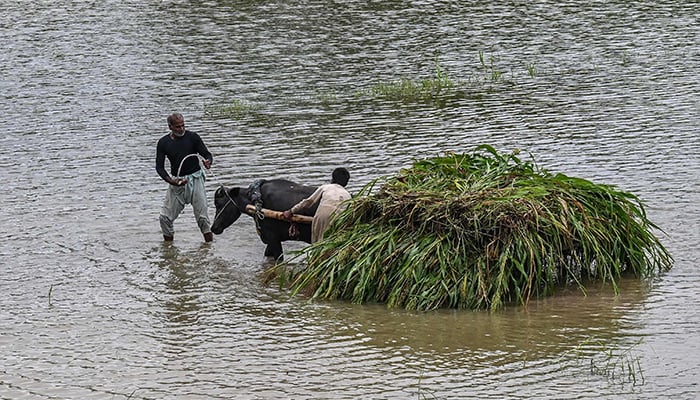
Provincial and federal authorities said nearly 190,000 people have already been evacuated, with the military assisting in rescue operations across dozens of inundated villages. Rescue and relief efforts are underway in Lahore, Faisalabad, Okara, Kasur, Sialkot and Narowal, where several villages and towns, including Kasur and Ganda Singh Wala along the Sutlej River, are submerged in floodwater. Troops have been transporting flood-affected people to safer locations using boats. Children, women and elderly residents are among those relocated, with soldiers also ensuring the safe transfer of victims’ belongings and livestock.
In a weekly outlook, the FFD warned of exceptionally high floods in the Chenab at Trimmu on Aug. 29, at Panjnad on Sept. 2, and in the Indus at Guddu and Sukkur from Sept. 4-5. “Very high to exceptionally high” flows were forecast for the Sutlej at Ganda Singh Wala and Ravi at Jassar, with “high to very high” in Ravi and Chenab nullahs over the next day.
It warned the Ravi’s high flood at Jassar would reach Lahore and Shahdara between 10 p.m. and midnight, then Balloki at 9 a.m. Thursday. It noted 20,000 to 25,000 evacuations from Chenab and Ravi floodplains, calling the flows unseen in 38 to 39 years but manageable at Shahdara, expecting 180,000 to 190,000 cusecs against a 250,000 capacity.
More rain loomed, with the PMD forecasting showers and thunderstorms in Narowal, Sialkot, Lahore, Kasur, Jhelum, Hafizabad, Gujranwala, Gujarat, Sheikhupura and Azad Kashmir. Sialkot broke a 49-year record with 363.5 millimeters in 24 hours, topping 339.7 millimeters from Aug. 6, 1976.
Copyright © 2021 Independent Pakistan | All rights reserved