By Staff Reporter
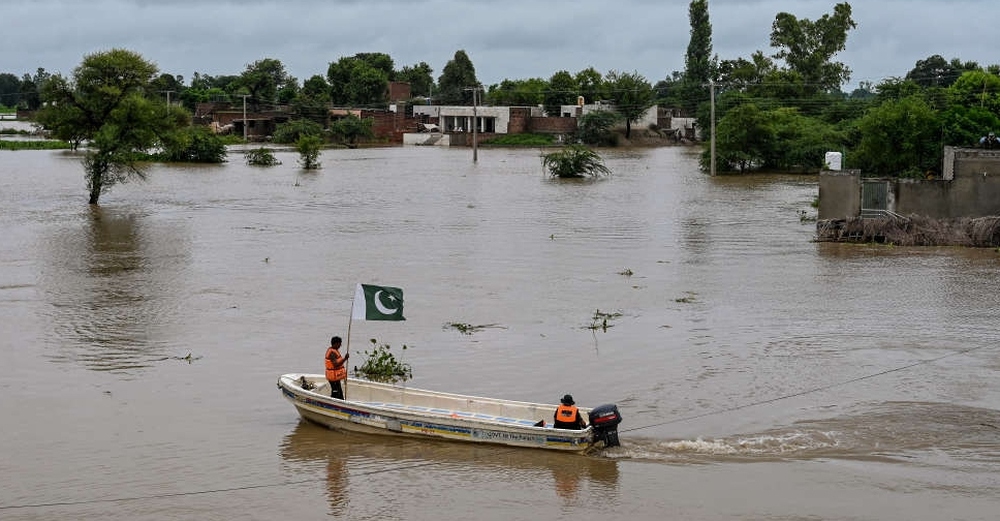
ISLAMABAD: With the Chenab River poised to unleash up to 800,000 cubic feet per second of water in the next two days, Pakistani officials in Punjab have evacuated more than a quarter-million people from flood-stricken areas, where monsoon rains and releases from Indian dams have already devastated farmland, drowned 17 residents, and impacted 1.46 million in the province’s deadliest inundation in decades.
The crisis has wreaked havoc on hundreds of villages and vital grain crops, prompting officials to breach riverbanks in some areas to manage the flow. Authorities have cautioned that between 700,000 and 800,000 cubic feet per second (cusecs) of water could pass through the Chenab River system in the next 48 hours, risking widespread devastation.
Extremely high floods in the Sutlej, Ravi and Chenab rivers have prompted one of the largest relocation efforts in recent years, spanning districts including Jhang, Shorkot, Khanewal, Multan, Muzaffargarh, Shujaabad, Jalalpur Pirwala and Alipur. As of midnight Friday, the Flood Forecasting Division reported normal flow at Trimmu near Jhang at 117,534 cusecs but noted a rising trend.
Upstream, trends were falling: Marala Headworks near Sialkot stood at 106,496 cusecs (low flood), while Khanki and Qadirabad headworks were at 305,436 cusecs. On the Ravi River, Jassar near Narowal had stabilized at 95,580 cusecs, but Shahdara remained in exceptionally high flood at 219,770 cusecs with a steady trend. Head Balloki near Pattoki was in high flood at 114,110 cusecs and rising, while Head Sidhnai near Abdul Hakeem showed a rising trend with an inflow of 25,443 cusecs and outflow of 10,093 cusecs.
The Sutlej River presented similar perils: Ganda Singh Wala near Kasur was in exceptionally high flood at 261,053 cusecs, Sulemanki near Bahawalnagar in medium flood at 113,124 cusecs, and Head Islam in low flood at 52,706 cusecs. The Indus River at Tarbela Dam, by contrast, showed normal flow with an outflow of 155,400 cusecs.
Data from the Provincial Disaster Management Authority (PDMA) detailed the toll: over 1.46 million people in 1,692 mouzas affected by the extreme floods in the three rivers, with 17 deaths reported. The government has evacuated more than 265,000 people, including 1,372 housed in 355 relief camps and 6,656 provided medical aid.
Additionally, 90,348 people and 154,980 cattle have been transported to safety. The Chenab River flooding alone submerged 991 villages: 395 in Sialkot, 127 in Jhang, 124 in Multan, 48 in Chiniot, 66 in Gujrat, 51 in Khanewal, 45 in Hafizabad, 41 in Sargodha, 35 in Mandi Bahauddin and 19 in Wazirabad. Over one million people have been evacuated from these areas, with 73,000 animals relocated and 72 veterinary camps established.
In the Ravi River basin, about 80 villages were inundated — 75 in Narowal, four in Sheikhupura and one in Nankana Sahib — leading to the evacuation of 11,000 people and 4,500 animals, supported by 52 veterinary camps. The Sutlej River floods hit 361 villages: 72 in Kasur, 86 in Okara, 24 in Pakpattan, 27 in Multan, 23 in Vehari, 104 in Bahawalnagar and 25 in Bahawalpur. This prompted the evacuation of nearly 127,000 people and 70,000 animals, with 90 veterinary camps set up.
Information Minister Attaullah Tarar praised the coordination among stakeholders for averting a major disaster in Gujranwala and Wazirabad during a media briefing in Wazirabad on Thursday. He assured that arrangements were in place for relief items, including tents, food and medical supplies. A survey is underway to assess livestock losses, with compensation planned for affected individuals — though none for illegally built structures in high-risk zones.
The floods also halted operations at Sialkot International Airport, suspending services for 24 hours on Thursday. An airport spokesperson confirmed the runway and terminal were safe, with drainage work ongoing. An official told Dawn that the last flight — a Dubai-bound Flydubai service — departed Thursday morning.
Prime Minister Shehbaz Sharif, joined by Punjab Chief Minister Maryam Nawaz Sharif, conducted an aerial survey of the affected areas on Thursday, where National Disaster Management Authority (NDMA) Chairman Lt. Gen. Inam Haider briefed him on the situation. During her visit to the Ravi River areas, Chief Minister Maryam expressed regret that the crisis had been aggravated by the opening of spillways by India but noted that the province’s early warning system was functioning effectively, allowing the timely evacuation of residents.
International support came in a call from Turkish President Recep Tayyip Erdogan to Prime Minister Shehbaz, expressing solidarity and offering aid. “Turkiye stands ready to help in any way possible, including during the rescue and relief efforts,” Erdogan said, according to the Prime Minister’s Office. Shehbaz thanked him, calling it reflective of the “deep-rooted fraternal ties” between the two nations.
As Punjab reels, the threat looms downstream in Sindh, where officials are bracing for spillover from the surging rivers. Sindh Chief Minister Syed Murad Ali Shah said Thursday his government is “well prepared” to tackle the downstream floods, with officials monitoring the River Indus and its embankments. “The government is well prepared to face the situation we are anticipating,” Shah said.
He added that the provincial irrigation department is closely watching the Guddu, Sukkur and Kotri barrages. Emergency mechanisms are activated, including reconstructed headworks and strengthened embankments post-2022 floods, with ongoing projects.
The NDMA has warned of exceptionally high flows in the Chenab, Ravi and Sutlej moving south into Sindh. Senior NDMA official Dr. Tayyab Shah, speaking at the National Emergency Response Center in Islamabad, emphasized the shifting threat. “I would strongly emphasize that this situation would start becoming more imminent in the southern part of Pakistan. Because the flood is now moving toward the southern region of Pakistan.”
Pointing to weather displays, he noted early warnings issued in June for heavier downpours in northeastern Pakistan. He urged vigilance in southern Punjab districts like Mandi Bahauddin, Jhang, Sargodha, Chiniot, Bahawalpur, Bahawalnagar and Rajanpur, and Sindh areas including Ghotki, Kashmore and Sanghar. “All those people who are living near the proximity of the rivers, they should remain vigilant,” Dr. Shah said.
Climate activists and residents voiced concerns amid historical precedents. Sindh writer Manzoor Solangi, recalling the 2010 floods that damaged his home in Naushahro Feroze, warned of potential flows exceeding 1.2 million cusecs — beyond the capacity of Sindh’s barrages. “There are fears the flow this time could exceed 1.2 million cusecs, a level beyond the capacity of the flow of Sindh’s all three barrages, Guddu, Sukkur and Kotri,” Solangi said. He noted possible breaches in dikes could flood settled areas.
Compounding the crisis, the Pakistan Meteorological Department forecasts another monsoon spell from August 29, with heavy to very heavy rainfall through September 2. Strong currents from the Arabian Sea and Bay of Bengal, plus a westerly wave, will bring widespread rain, thunder and lightning.
In Kashmir, areas like Neelum Valley, Muzaffarabad and others face very heavy rain from August 29 to September 2. Gilgit-Baltistan districts expect rain with isolated heavy falls from August 30 to September 1. Khyber Pakhtunkhwa anticipates heavy to very heavy falls in districts including Dir, Chitral and Peshawar from August 29 to September 1. Punjab, already battered, braces for heavy falls in nearly all districts, including Islamabad, Rawalpindi and Lahore, from August 29 to September 2. Sindh expects rain in Mithi, Tharparkar and others on August 30-31. Balochistan faces similar conditions in Barkhan and Zhob from August 30 to September 1. Warnings include flash floods in hilly areas, landslides causing road closures, and urban flooding in cities like Islamabad, Lahore and Peshawar from August 29 night to September 1.
Copyright © 2021 Independent Pakistan | All rights reserved