By Staff Writer
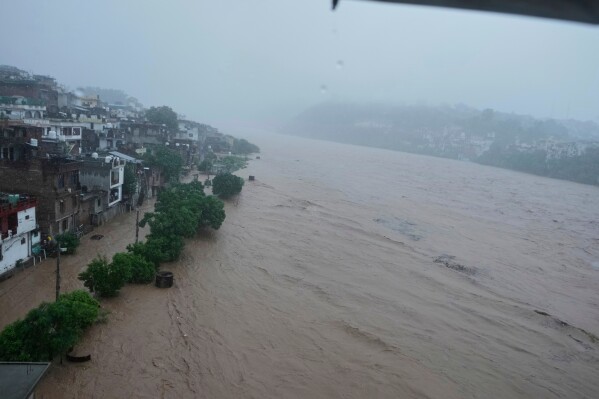
ISLAMABAD: Authorities issued a flood alert for the capital and much of Punjab province on Monday as heavy monsoon rains and water releases from India swelled major rivers, threatening fresh inundations in a region already reeling from weeks of deadly flooding that has killed hundreds and displaced millions.
The National Emergency Operations Centre warned of heavy rainfall from Sept. 1 to 3 that could significantly increase water flows in eastern rivers, including the Sutlej, Ravi and Chenab. The alert followed days of devastation in Punjab, where more than two million people have been affected, with over 2,000 villages inundated. Approximately 760,000 people and 516,000 animals have been evacuated, and at least 41 people have died in less than a week, according to the Provincial Disaster Management Authority.
Nationwide, rains and floods have killed 854 people since June 26, when the monsoon season began. The emergency has revived memories of the catastrophic 2022 deluge, when a third of Pakistan was submerged, more than 1,700 people were killed, 30 million displaced and damages estimated at $35 billion.
The World Health Organization on Monday also warned that Pakistan’s flood-hit Punjab province has been witnessing an increase in vector-borne diseases even though provincial authorities have not yet reported any major outbreak.
Punjab, the country’s most populous and breadbasket province, has been facing a flood emergency fueled by above-normal rains and India’s release of excess water, which has affected more than 2.4 million people and killed 41 people in the last 10 days, according to the provincial disaster management authority.
Authorities have relocated more than 850,000 people to relief camps, where the WHO says unsafe drinking water and mosquitoes pose the main epidemic risks, making displaced people vulnerable to diarrhea, typhoid, malaria, dengue and skin infections.
“Although no major outbreak has been reported so far, an upsurge has been detected for vector-borne diseases such as malaria and dengue, water-borne diseases like acute watery diarrhea, and skin diseases like scabies and eye infections,” Dr. Jose Ignacio Martin Galan, head of communications at the WHO Pakistan Country Office, said.
To reduce these risks, WHO has urged authorities to prioritize access to essential health services, medicines, diagnostic kits and psychosocial support, along with shelters, food, safe drinking water and sanitation facilities.
Monsoon season brings South Asia 70 to 80 percent of its annual rainfall, but increasingly erratic and extreme weather patterns are turning the annual rains, which are vital for agriculture, food security and the livelihoods of millions of farmers, into a destructive force.
In Islamabad, the deputy commissioner issued orders for special monitoring of low-lying areas and drains. “Rain in the federal capital, district administration on high alert,” the deputy commissioner said in a statement.
The Sutlej River is currently experiencing an unusual discharge of 253,068 cusecs, while additional inflows of up to 300,000 cusecs are expected due to upstream rainfall and dam releases, according to the National Emergency Operations Centre. At Jassar, the Ravi River is flowing at 60,094 cusecs under normal conditions, but its level may rise to 150,000 cusecs in the coming days. The center also cautioned about potential flooding in connected drains and tributaries.
Meanwhile, the Chenab River is flowing at 94,728 cusecs at Marala, but further heavy inflows are anticipated due to rainfall in Indian Illegally Occupied Jammu and Kashmir and releases from upstream reservoirs. Tributaries including Jammu Tawi, Manawar Tawi and Palkhu may face severe flooding.
The center warned that low-lying and riverbank settlements are at risk of inundation, with possible breaches of embankments and damage to crops and villages.
A Provincial Disaster Management Authority update issued on Monday reported the Chenab flowing at 91,940 cusecs at Marala Headworks, 136,039 at Khanki and 159,940 at Qadirabad, with Trimmu recording 550,965 cusecs and steady. At Chiniot Bridge, water was at 132,675 cusecs and rising.
On the Ravi, Balloki registered 152,415 cusecs and steady, while Sidhnai recorded 99,250 cusecs and rising. The Sutlej was flowing at 253,068 cusecs at Ganda Singh Wala, 124,274 at Sulemanki and 121,013 at Panjnad.
“All relevant departments are on alert due to water being released into the Chenab by India,” Irfan Ali Kathia, director general of the Provincial Disaster Management Authority Punjab, told reporters. “Punjab is monitoring the situation in the rivers round the clock.”
Kathia warned of an “extremely high flood level” at Balloki on the Ravi, while Panjnad, the confluence of Punjab’s five rivers, was expected to swell to nearly one million cusecs between Sept. 2 and 3.
Separately, Pakistan’s commissioner for Indus Waters circulated a letter to government departments citing an Indian High Commission warning of possible “high flood” levels at Harike and Ferozepur on the Sutlej. India routinely releases excess water from its reservoirs when they reach capacity, under arrangements governed by the Indus Waters Treaty.
Copyright © 2021 Independent Pakistan | All rights reserved