By Staff Reporter
LAHORE: Authorities issued fresh warnings Wednesday of potential flooding along key rivers in Punjab province after India alerted Islamabad to high water levels in the Sutlej and Tawi, even as a surge on the Chenab River threatened to inundate downstream districts already battered by weeks of monsoon deluges.
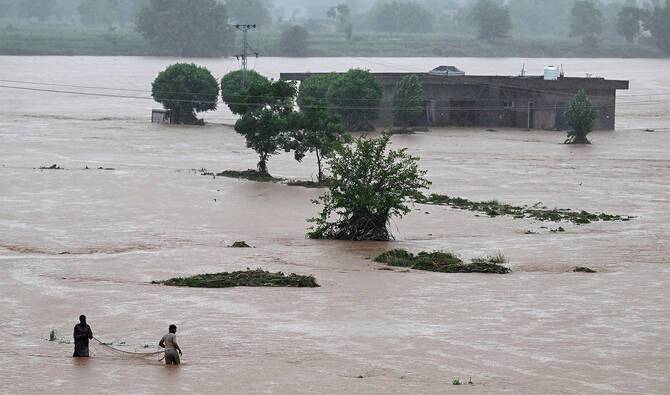
The alerts compounded a crisis that has left Punjab, the country’s most populous and agriculturally vital province, grappling with widespread destruction. At least 43 people have been killed in the province over the past 10 days, with more than 3.6 million affected across 3,363 villages, according to the Provincial Disaster Management Authority (PDMA). Nationwide, rains, floods and landslides have claimed 881 lives since June 26, evoking grim parallels to the 2022 catastrophe that submerged a third of Pakistan, displaced 30 million people, killed more than 1,700 and inflicted economic damages exceeding $35 billion.
With water levels rising rapidly, officials urged residents in riverside areas of districts including Kasur, Okara, Vehari, Bahawalnagar, Gujrat, Sialkot and Jhang to brace for possible evacuations. The warnings followed a notification from India under the terms of the 1960 Indus Waters Treaty, which governs the sharing of cross-border rivers and requires advance notice of releases that could trigger downstream flooding.
“The High Commission of India to Pakistan has conveyed the following information … Flood Data: High Flood, Sutlej (Harike below, Ferozepur below) and Tawi, Jammu, at 0800 hrs on 3rd September 2025,” Pakistan’s Office of the Commissioner for Indus Waters said in a statement.
The PDMA interpreted the message to mean that “Sutlej, Harike and Ferozepur below, and Tawi, Jammu is at high flood level … which will affect the water levels in downstream respective districts.”
Much of the flooding stems from unusually intense monsoon rains, which deliver 70 to 80 percent of South Asia’s annual precipitation between June and September and are essential for farming but increasingly erratic amid climate change. Water levels also spike when India, which controls the eastern rivers Ravi, Beas and Sutlej under the treaty, releases excess flows from its upstream dams and barrages as reservoirs reach capacity.
The latest PDMA update showed the Chenab River continuing to swell, with flows surpassing 468,000 cubic feet per second (cusecs) at Marala Headworks, 367,000 cusecs at Khanki and 253,000 cusecs at Qadirabad. On the Ravi, levels were climbing at Jassar, Ravi Siphon and Shahdara, while the Sutlej held steady but carried more than 269,000 cusecs at G.S. Wala.
PDMA chief Irfan Ali Kathia said civil authorities, the army and other agencies had been placed on high alert, vowing that “citizens’ lives and property would be protected.”
District administrations have been ordered to reinforce embankments, position heavy machinery at vulnerable points and stockpile food, medicines and drinking water. Evacuation teams and Rescue 1122 units are already in place.
The National Disaster Management Authority (NDMA) reported a second flood surge moving through the Chenab, with peak flows of 548,237 cusecs recorded at Marala Headworks at noon Wednesday. “The wave is expected to reach Khanki at 20:00 hours with 558,237 cusecs, and Qadirabad at 03:00 hours on Sept. 4 with 550,237 cusecs,” the NDMA’s National Emergencies Operations Center said.
The surge is projected to hit Trimmu by Sept. 8 at 330,226 cusecs, Panjnad by Sept. 11 at 264,980 cusecs and Guddu Barrage by Sept. 13 at 217,283 cusecs. Punjab’s disaster authority noted the Chenab had risen by more than 400,000 cusecs in the past eight hours, with flows in the Ravi, Chenab and Sutlej expected to climb further through Sept. 5 due to ongoing rainfall in upstream areas.
“Severe flooding in the Ravi, Sutlej and Chenab rivers has affected more than 3.63 million people across 3,363 villages,” Punjab Relief Commissioner Nabeel Javed said in a statement. “Lives and livelihoods are being protected through timely evacuations and relief efforts, but the situation remains critical.”
More than 1.29 million people have been relocated to safer ground, with 655 relief camps established in Punjab sheltering over 11,000 residents. Additionally, 404 medical camps have treated 26,441 patients.
Floodwaters have crippled electricity networks in several regions. A federal Power Division report indicated that tens of thousands of households in districts like Jhang and Toba Tek Singh were still without power as of Wednesday. In Jhang, only about 5 percent of more than 81,000 affected customers had service restored, while Chiniot had reconnected nearly 95 percent of 72,000 impacted consumers. Faisalabad reported more than 90 percent restoration.
The ministry said most repairs were slated for completion between Sept. 4 and 5, provided waters subside. “Restoration of electricity in affected areas is the top priority,” the Power Division said.
In Sialkot, a key export center, the international airport resumed all flights after implementing safety measures. “The airport is fully operational, and a new shuttle service has been launched for passengers,” spokesperson Muhammad Umair Khan said.
The NDMA said it was operating “round the clock under the prime minister’s instructions” in coordination with civil and military entities, with its operations center fully mobilized. Approximately 5,700 tonnes of relief goods have been distributed to flood-hit communities nationwide.
Looking ahead, the NDMA forecast that the current monsoon spell — the ninth this season — would linger for another one to two days, with rain persisting in upper Pakistan over the next 24 to 48 hours. Precipitation is also expected in southern areas, including South Punjab and South Sindh, starting Sept. 6, with heavy downpours anticipated in coastal districts like Badin, Sujawal and Tharparkar.
The authority cautioned that torrents from the Ravi, Chenab and Sutlej are set to converge at Panjnad, heightening flood risks there from Sept. 4 to 5.
Pakistan ranks among the nations most susceptible to climate change, where scientists attribute heavier and more unpredictable monsoon patterns to rising temperatures. While these seasonal rains are vital, they frequently bring ruin.
Copyright © 2021 Independent Pakistan | All rights reserved