By Staff Reporter
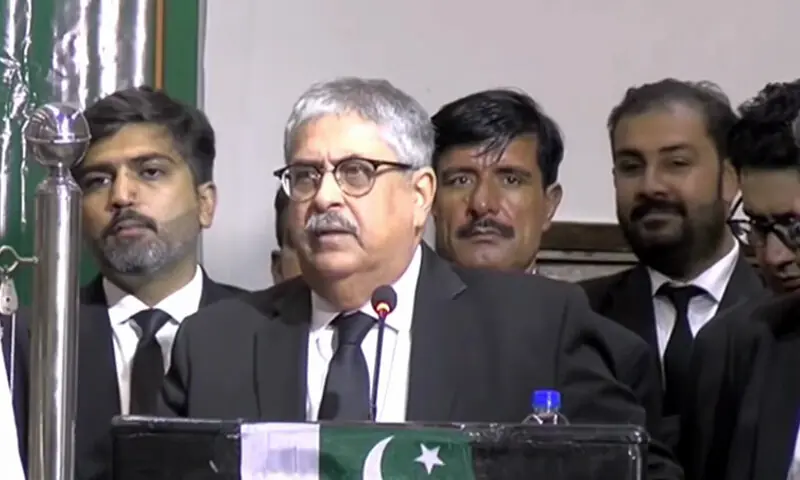
KARACHI: Supreme Court Justice Athar Minallah said Thursday that widespread references to a “hybrid system” in Pakistan amount to an admission of dictatorship, blaming a lack of constitutional governance for enabling elite capture to eclipse the rule of law.
Addressing the Karachi Bar Association, Minallah offered a blunt critique of the nation’s judicial and political history, cautioning that societies that forsake truth invite destruction. His comments highlighted tensions over the informal power-sharing between civilian authorities and the military, a setup that Defence Minister Khawaja Asif praised in July as a “hybrid regime.”
“It is something to accept that people today say there is a hybrid system, that [actually] means there is dictatorship and there is no constitutional governance,” Minallah said.
Analysts have long used the term to denote the military’s outsized role in influencing civilian governance and state affairs.
Minallah linked the problem to systemic shortcomings. “I had to write in many high court orders that there is no rule of law or Constitution in the country; there is elite capture,” he said.
He called Pakistan’s 77-year judicial record “not something to be proud of for me,” saying his generation had inflicted damage on the country and must own it, without shifting blame. This pattern, he added, has persisted throughout the nation’s history.
Minallah stressed that judges’ oaths require impartial rulings under the law and defence of the Constitution, without fear or favor. “The judiciary at all levels was bound to the oath and answerable to God and the people.”
Failure to confront the absence of constitutional rule, he argued, breaches both the Constitution and the oath. “As a judge, if I am not ensuring constitutional rule, then I am violating my oath,” he said.
The justice decried distortions in historical teaching. “Unfortunately, we are taught distorted history, and no one tells us the truth. Our generation did whatever it could do; the most we can do now is to hand over the baton to you and at least tell you the truth,” he told the gathering. “The societies in which the truth is eliminated and truth ceases to be spoken are destroyed.”
Minallah said history’s lessons remain unheeded. “The root of the country’s split in 1971 was laid down in the dissolution of the constituent assembly by the civil-military bureaucracy,” he said, alluding to the secession of East Pakistan, now Bangladesh.
Though independent judges have emerged, “the judiciary has never played the role that it ought to have”. Over 77 years, he noted, the system has left people unable to name five exemplary judges. He saluted those who rejected oaths under the Provisional Constitutional Order in dictatorial eras, many from Sindh, including would-be chief justices who valued principles over position.
He noted the Karachi Bar’s backing of Fatima Jinnah against authoritarianism and voiced regret over judicial susceptibility to influence, recalling Gen. Zia-ul-Haq’s denial of pressure in Zulfikar Ali Bhutto’s trial — despite later revelations that it contributed to Bhutto’s hanging. “Even then, three judges opposed it, two of them from here – Justice Haleem and Justice Turab Patel,” he said.
Copyright © 2021 Independent Pakistan | All rights reserved