By Staff Reporter
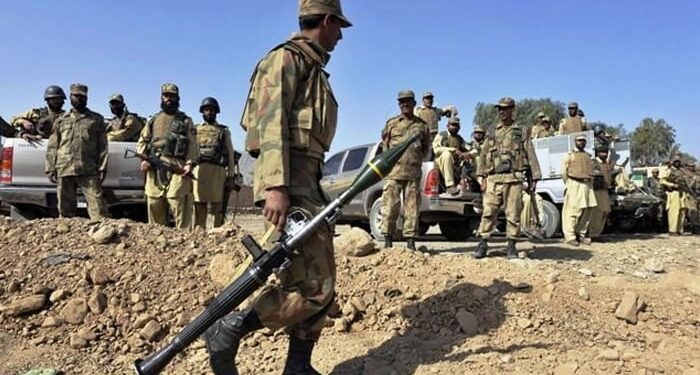
ISLAMABAD: Pakistan’s military said on Sunday that security forces killed at least 36 militants in a series of operations along the Afghan border over three days, as the government renewed its demand that the Taliban administration in Kabul curb cross-border attacks it blames on Afghan soil.
The Inter-Services Public Relations, the military’s media wing, said the operations took place between September 3 and 5 in Khyber Pakhtunkhwa province, the latest in a string of clashes the government has tied to the Tehreek-i-Taliban Pakistan, a militant group Islamabad refers to in official statements as “Fitna al-Khawarij.” Pakistani officials allege the group receives backing from India.
The bulk of the killings, according to the ISPR, followed a border clash the night of August 31 into September 1 in North Waziristan district, where security forces said they stopped a group of militants attempting to cross from Afghanistan and killed 15 of them. In the days that followed, the military said, additional forces killed 10 more militants who had remained in the area, bringing the toll from that single episode to 25.
A second, separate clash in North Waziristan accounted for seven more deaths. The ISPR said troops detected movement of another group near the border and “effectively engaged” them. Four additional militants were killed in two other operations, conducted jointly with law enforcement, in the districts of Kohat and Dera Ismail Khan.
The military’s statement placed the operations within a broader argument Pakistan has made for years: that the Taliban government in Afghanistan, in power since 2021, has failed to prevent militants from using Afghan territory to stage attacks across the border. “The Afghan Taliban regime has consistently failed to ensure effective border management and honor its international counterterrorism obligations,” the ISPR said, adding that “repeated incidents” of this kind had reinforced that position.
The military said it would continue “sanitization operations” in the area to locate any remaining militants, describing the broader effort as part of a campaign called “Azm-i-Istehkam,” a counterterrorism framework approved by Pakistan’s Federal Apex Committee on the National Action Plan. Security forces, the statement said, remained “resolute and unwavering” in defending the country’s borders.
President Asif Ali Zardari commended the armed forces for the operations in a statement issued separately by his office, citing what he called their “professional capabilities” in stopping militants from crossing the border. He described securing Pakistan’s frontiers and eliminating terrorism as top government priorities and again called on Taliban authorities in Kabul to deny militants the use of Afghan territory.
The operations come as Khyber Pakhtunkhwa continues to register a sharp rise in militant violence. Data compiled by the Pakistan Institute for Conflict and Security Studies showed that the province’s mainland districts recorded 54 attacks in August, a 50 percent increase over July, while the province’s merged tribal districts logged a separate 54 attacks, up 126 percent from the previous month.
A separate analysis by the Centre for Research and Security Studies found that Khyber Pakhtunkhwa and Balochistan province together accounted for nearly 96 percent of the country’s violence-related deaths in the second quarter of 2026. Khyber Pakhtunkhwa alone recorded 475 deaths, or 61 percent of the national total, and 151 violent incidents, more than half of all such incidents nationwide. Balochistan accounted for 265 deaths and 94 incidents over the same period, the report found.
Pakistan’s government has repeatedly pressed the Taliban administration to act against the TTP, whose attacks have intensified since Afghanistan’s Taliban government took power in 2021. At a briefing Wednesday, a Foreign Office spokesperson said that any improvement in relations between the two countries would depend on the Taliban taking “concrete and verifiable action” against the TTP and other militant groups based in Afghanistan, according to Pakistani officials.
The comments came amid a period of renewed diplomatic contact between the two governments. Chinese special envoy Yue Xiaoyong visited Islamabad as part of an effort to revive the so-called Urumqi process, a trilateral framework involving China, Pakistan and Afghanistan aimed at preventing further deterioration in relations. Separately, Afghanistan’s ambassador to Pakistan, Sardar Ahmad Shakib, was invited to speak at Pakistan’s National Defence University.
Despite that outreach, Pakistani officials say they see limited evidence that the Taliban have moved beyond containing the TTP’s activity to dismantling it. A recent report from the United Nations Analytical Support and Sanctions Monitoring Team found that the Taliban had relocated roughly 2,000 TTP fighters and their families away from areas near the Pakistani border, and that Taliban supreme leader Hibatullah Akhundzada had warned the group against carrying out attacks inside Pakistan. But the same report found that Taliban support for the TTP had continued even as the group expanded its ranks and stepped up attacks.
Copyright © 2021 Independent Pakistan | All rights reserved