By Staff Reporter
DUBAI: India powered to a seven-wicket rout of Pakistan in a politically charged Asia Cup 2025 group match on Sunday, capping a one-sided affair with a controversial post-match speech from captain Suryakumar Yadav that invoked a deadly Kashmir attack and a recent border skirmish.
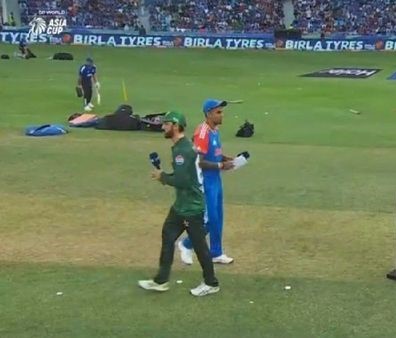
The victory at Dubai Sports City Stadium — played out before a half-empty crowd — came against a backdrop of boycott calls from across the border, which appeared to seep into the action as Indian players skipped the traditional handshakes at the toss and after the match.
Yadav’s remarks at the presentation ceremony, dedicating the win to victims of the May Pahalgam attack in occupied Kashmir — which sparked a four-day military clash between the nuclear-armed rivals — drew sharp rebukes for blending sport and politics. “We stand with the victim’s families of the Pahalgam terror attack, and we express our solidarity, and we want to dedicate today’s win to the armed forces,” Yadav told the ceremony.
Pakistan skipper Salman Ali Agha was absent from the post-match formalities, leaving his counterpart to dominate the spotlight.
India overhauled Pakistan’s modest 127 for nine in just 16 overs, with Yadav unbeaten on 47 and Abhishek Sharma blasting 31 off 13 balls to set the tone. The chase ended in style, Yadav clearing the ropes for six to seal the result. “It was a delight to close the game in style. We played to our strengths and executed the plan exactly as needed,” Yadav said later, comments that further stirred the pot with their nod to national sentiment.
At a press conference, he doubled down. “Our government and the BCCI were aligned. We took a call and came here just to play the game and gave them (Pakistan) a proper reply.”
The lopsided result exposed Pakistan’s frailties from the outset, starting with a baffling toss call. Opting to bat first on a pitch known to favour chasers, Pakistan’s decision drew instant flak from former express quick Shoaib Akhtar, who dissected it live on air. “I don’t agree with the decision to bat first on a track that traditionally suits the chasing team. It was like handing the initiative back to India before the game even started,” Akhtar said.
Team selection compounded the woes, with the management sticking to left-arm wrist-spinner Sufiyan Muqeem over a second frontline seamer.
India’s top order feasted, dispatching him to all corners and laying bare the tactical oversight. But it was the batting implosion that proved most damning. On a true-bouncing surface offering full value for strokes, Pakistan’s top order crumbled spectacularly. Opener Saim Ayub fell for a golden duck — his third in five T20 internationals — in a reckless start that has now become a red flag for selectors.
Mohammad Haris (3), skipper Agha (3), Hasan Nawaz (5) and Mohammad Nawaz (0) followed suit, with five of the top seven failing to reach double figures. The collapse left the lower order to salvage something, and a defiant Shaheen Shah Afridi unbeaten on 33 off 16 balls dragged them to 127 for nine — a total that never looked defendable against India’s firepower.
Enter India’s spin duo, who tore through the middle order. Player of the Match Kuldeep Yadav spearheaded the demolition with 3-18, his left-arm wizardry exploiting familiar weaknesses. “I knew where Pakistan batters were vulnerable. My plan was simple: bowl tight lines and lengths, avoid unnecessary variations, and build pressure. It worked perfectly,” Kuldeep said.
Fellow left-armer Axar Patel chimed in with key strikes, maintaining his strong record against Pakistan by sticking to the basics. Kuldeep’s haul lifted his T20I tally against the neighbours to 18 wickets in eight matches at a stingy economy of around four an over — figures that should haunt Pakistan’s think-tank.
In the field, Pakistan’s attack lacked menace, with part-timer Ayub improbably topping the charts at 3-35 — a damning indictment of the strategy.
The post-mortem was merciless from Pakistan’s ex-stars. Akhtar pulled no punches on the batting mindset: “Our batsmen are simply not built for the demands of modern T20 cricket. We lack the professional mindset and quality required at this level.”
Misbah-ul-Haq pinned it on technique and temperament. “Once Pakistan lost two quick wickets, the batting went into its shell. The shot selection was poor, and there was no visible game plan against the spinners. On this pitch, 180 should have been the minimum target.”
Umar Gul zeroed in on the strike rotation failures, with Pakistan labouring through near 10 overs’ worth of dots. “This is T20 cricket. If boundaries are hard to come by, rotation of strike is the key. Singles and doubles were available, yet Pakistan played as if they were stuck. It was poor planning, plain and simple.”
Axar, at times unplayable, added to the spin stranglehold. As another India-Pakistan showdown looms on September 21, Pakistan’s hierarchy confronts uncomfortable truths: the dismissal of historical data on threats like Kuldeep, a top order that buckles under the spotlight, and reliance on tailenders like Afridi for aggression.
Copyright © 2021 Independent Pakistan | All rights reserved