By Staff Reporter
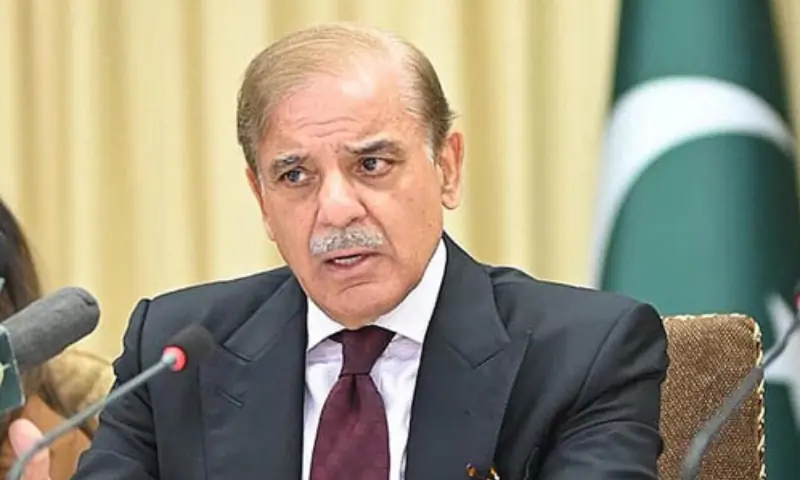
ISLAMABAD: Prime Minister Shehbaz Sharif appealed to world leaders to fulfil promises on climate financing, warning that mounting loans are no substitute for grants to help vulnerable nations like his cope with escalating disasters fuelled by global warming.
Speaking at a special climate event convened by United Nations Secretary General António Guterres alongside the president of Brazil, the host of next year’s COP30 climate summit, Sharif highlighted Pakistan’s ongoing struggles with floods and landslides.
The country, which contributes minimally to global greenhouse gas emissions, has been battered by record monsoon rains this year, killing more than 1,000 people and injuring nearly 1,100 since late June, according to Pakistan’s National Disaster Management Authority.
“Loans over loans, [and] adding to loans is not a solution,” Sharif said, emphasising that debt-driven aid falls short in addressing the climate catastrophe facing nations like Pakistan. The remarks came as member states presented updated Nationally Determined Contributions, or NDCs, outlining emissions targets for 2035.
Sharif reiterated Pakistan’s commitment to tackling the crisis, expressing hope that the international community would honour its pledges for the sake of future generations. He recalled the devastating 2022 floods that killed 1,700 people, displaced millions, destroyed vast agricultural lands and caused $30 billion in losses, based on government estimates.
In response, Pakistan convened an international donors’ conference in Geneva to seek recovery funds. But earlier this year, the Senate Standing Committee on Economic Affairs learned that of the $10 billion pledged by various countries, only $500 million arrived as grants, with the rest provided as loans.
Sharif told delegates that Pakistan remains scarred from those events. “This year, intense monsoon rains, cloudbursts, flash floods and devastating urban flooding have impacted more than five million people, destroyed 4,100 villages, and claimed over 1,000 precious lives,” he added. Despite its negligible role in global emissions, Pakistan “bear[s] impacts far beyond our share,” Sharif said.
Still, he affirmed the country’s “steadfast and unwavering” dedication to its climate agenda. In 2022, Pakistan ranked among the world’s most vulnerable countries to climate change.
Sharif noted that in its 2021 NDC, Pakistan pledged an unconditional 15 percent reduction in projected greenhouse gas emissions by 2030. As part of an overall target to cut emissions by 50 percent, the country has already met that unconditional goal. “Renewables are presently providing over 32pc of Pakistan’s power mix. Solar energy has grown sevenfold since 2021,” the prime minister said.
He also pointed to the restoration of 23,000 hectares of mangrove forests. But Sharif lamented that executing Pakistan’s national adaptation plan has been “hampered, and hampered severely, due to inadequate international climate finance.”
Looking ahead, he announced ambitious steps: boosting renewables and hydropower to 62 percent of the energy mix by 2035, adding 1,200 megawatts of nuclear capacity by 2030, shifting 30 percent of transport to cleaner options by 2030, and installing 3,000 charging stations nationwide. Pakistan also plans to expand climate-smart agriculture, secure water resources and plant 1 billion trees.
In a separate Security Council debate on artificial intelligence, Pakistan warned that unregulated AI, especially in military uses, threatens global stability and must adhere to the U.N. Charter and international law.
Defence Minister Khawaja Muhammad Asif told the gathering that AI applications lacking “meaningful human control” should be banned. While AI could spur socio-economic advances, it risks widening inequalities and upending the international order, he said.
Asif cited the deployment of autonomous munitions and high-speed cruise missiles in a recent India-Pakistan military exchange as illustrating the perils. “AI must not become a tool of coercion or technological monopoly,” he said, according to the Associated Press of Pakistan news agency, adding that it “lowers the threshold for use of force, making wars more politically and operationally feasible.”
He called on nations to adopt measures curbing destabilising AI applications, insisting that “human judgment must remain central in matters of war and peace.” “We must ensure that AI is harnessed to promote peace and development, not conflict and instability,” Asif added.
Copyright © 2021 Independent Pakistan | All rights reserved