By Staff Reporter
KARACHI: Pakistan’s ruling coalition partners escalated their public feud over flood relief on Thursday, with the chairman of the Pakistan Peoples Party insisting that a federal cash assistance program was the only effective way to deliver immediate aid to victims, while Punjab’s chief minister accused his party of politicising the disaster and vowed to provide more substantial support directly.
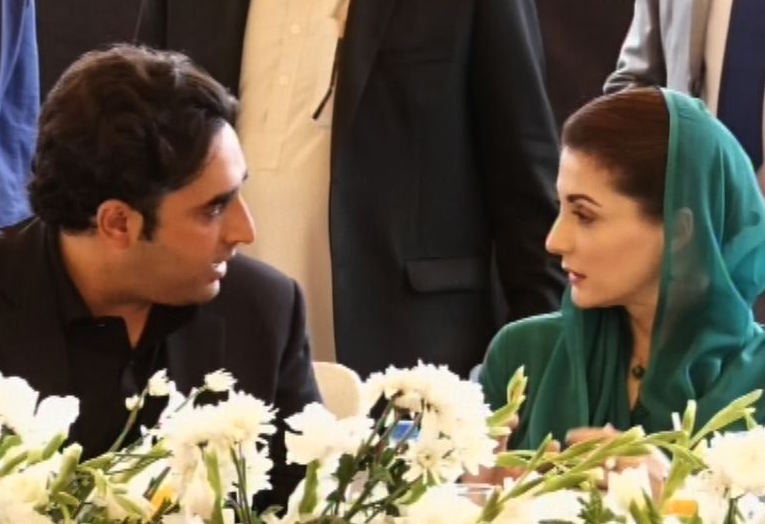
The exchange between Bilawal Bhutto-Zardari of the PPP and Maryam Nawaz Sharif of the Pakistan Muslim League-Nawaz highlighted growing tensions within the alliance that holds power at the national level, even as the country grapples with the aftermath of devastating floods that have ravaged agriculture and displaced thousands.
The two parties have clashed in recent days over the best mechanism for distributing relief, with the PPP pushing for the use of the Benazir Income Support Programme (BISP) — a national safety net that provides cash to poor and vulnerable families, particularly women, and the PML-N questioning its transparency and adequacy.
At a news conference in Karachi, Bhutto-Zardari emphasised the floods’ severe impact on farming and food security, urging swift federal action. “Across the country, the agriculture sector was already struggling but after the floods, it has been badly affected. Our national food security may also be at risk,” he said.
Bhutto-Zardari recalled his earlier appeals to the government, led by Prime Minister Shehbaz Sharif, to declare climate and agricultural emergencies and waive power bills for farmers in affected districts. He praised the government for heeding those calls but stressed the need for more coordinated efforts.
Turning to his home province of Sindh, where the PPP holds power, he detailed plans to aid small farmers through the Benazir Hari Card, targeting those with one to 25 acres of land, along with fertilizer subsidies. “Our effort is to support the wheat crop so that we do not need to import wheat.”
Bhutto-Zardari argued that timely interventions by both provincial and federal authorities could turn the crisis into an opportunity for economic resilience. “If provincial and federal governments take timely action, we can not only mitigate the losses from this flood but also avoid a heavy import bill. It is better to spend our resources on our own farmers and agriculture sector so that Pakistan’s economy can reach a position where we export instead of importing.”
He described the floods’ effects as ongoing, with low-lying areas of Sindh still inundated and historic damage in Punjab, particularly its southern regions. Bhutto-Zardari also noted losses in Gilgit-Baltistan and Khyber Pakhtunkhwa, insisting that federal leadership was essential. “A natural calamity is not the responsibility of any one province; across the world, the federal government plays the leading role. It is also the responsibility of the federal government to deliver relief to the affected people through BISP,” he said.
Reiterating his stance amid the coalition’s disputes, he called BISP “the sole method” for immediate federal relief, citing its use in past disasters and during the Covid-19 pandemic. “If we don’t do this today, I must ask: what is the fault of the people of South Punjab when they face such devastating floods, their homes are destroyed, and they are living on the road?” Bhutto-Zardari said, urging the federal government to “review its policy.”
He also criticised the delay in seeking international aid. “When the floods began, the federal government should not have waited for any provincial help. It should have issued an international appeal immediately. I am not criticising […] but if you are spending Rs100 rupees, you could have spent Rs200; if you were helping 100 people, you could have helped 200.”
Bhutto-Zardari added that engaging the global community and pushing for a review of International Monetary Fund restrictions earlier could have bolstered resources. “By talking to the international community, by seeking a review of International Monetary Fund (IMF) restrictions, your hand would have been stronger, if you had made a timely global appeal as you did previously. This time it should have happened, and it did not.”
Later in the day, Maryam Nawaz Sharif, Punjab’s chief minister and daughter of former prime minister Nawaz Sharif, fired back during a ceremony in Dera Ghazi Khan, a flood-hit area in southern Punjab. She accused the PPP of exploiting the crisis for political gain. “The PPP is our ally and I respect them, but unfortunately, they have been politicising the floods in Punjab,” she said.
Addressing PPP leaders directly, she added, “I don’t know their agenda, but I want to tell [President] Asif Zardari and [PPP Chairman] Bilawal … please help your party’s spokesperson understand that if, God forbid, there is a disaster in Sindh, Punjab would stand with it.”
Sharif dismissed the idea of relying on BISP for relief, calling it insufficient. “Nowadays, people are talking about distributing aid through BISP. I do not want to criticise them … but they only give Rs10,000 [under this programme]. On the other hand, I will give them (flood victims) Rs1 million.”
She described BISP’s approach as a “very simplistic solution,” questioning its value for those who had lost homes, livestock and crops. “What will people who have lost their homes, cattle and crops do with just Rs10,000?” Sharif said, adding that Punjab aimed to rebuild houses and compensate for agricultural losses, which BISP “does not provide enough money” to achieve.
Responding to calls for international assistance, Sharif rejected the notion of seeking foreign aid. “The thing is, I am Nawaz Sharif’s daughter, and I will not beg for aid,” she said. “How long will Pakistan continue to beg the international community for aid? The NFC (National Finance Commission) gives billions to the provinces. What is this money being used for?”
The back-and-forth comes a day after the PML-N raised doubts about BISP’s transparency, prompting the PPP to accuse its coalition partner of an “irresponsible attitude” for rejecting the program’s data to aid flood victims in Punjab.
Copyright © 2021 Independent Pakistan | All rights reserved