By Staff Reporter
MUZAFFARABAD: The government has reached a deal with protesters in Azad Jammu and Kashmir to end weeks of unrest that turned deadly, reopening roads and restoring calm to the territory after clashes left at least 10 people dead and scores injured, officials announced on Saturday.
The agreement, signed after two days of intense negotiations, addresses a broad range of grievances, from compensation for victims of the violence to reforms in education, health care and governance. It marks a breakthrough in a standoff that began over demands to abolish elite privileges and reserved seats for refugees from Indian-occupied Kashmir, escalating into widespread protests and a shutter-down strike that paralysed the region under a communications blackout.
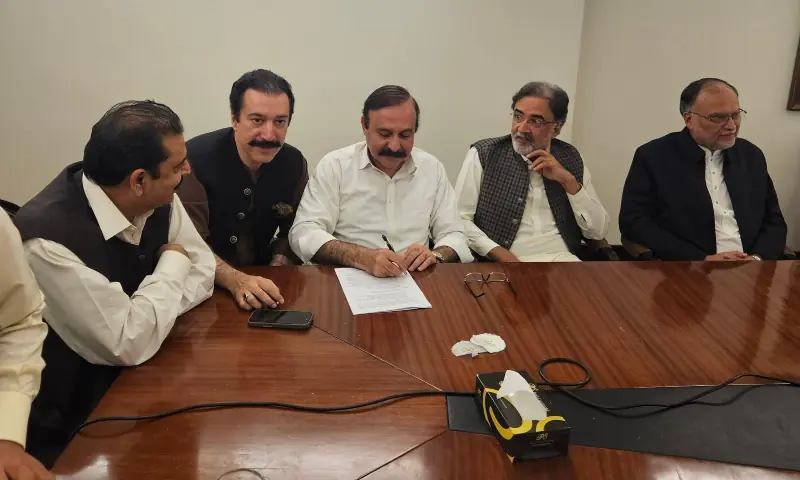
“Our negotiation delegation has signed a final agreement with the AJK Joint Action Committee. The protesters are returning to their homes. All roads have reopened,” Parliamentary Affairs Minister Tariq Fazal Chaudhry said in a post on X in the early hours of Saturday. “This is a victory of peace. Long live Azad Kashmir.”
Chaudhry shared a copy of the pact, which outlined 12 “decisions” and 13 “additional points” aimed at resolving the crisis. Among the key provisions: Cases under anti-terrorism laws will be filed for deaths in violent incidents; compensation will be given to the families of those who died on 1st and 2nd October; families of protesters will receive the same compensation as the families of officials; injured individuals will receive Rs 1 million each; and one member of the family of a deceased protester will be given a 20-day government job.The deal also includes structural changes, such as establishing two additional Secondary Education Boards in Muzaffarabad and Poonch within 30 days, with all three AJK Secondary Boards linked to the Federal Board.
The existing Local Government Act will be restored within 90 days in accordance with judicial rulings. The AJK government will release funds for the health card within 15 days, and MRI and CT scan machines will be provided in all districts of AJK with federal funding.
On infrastructure and governance, the Pakistan government will provide Rs10 billion to improve the electricity system in AJK. The size of the AJK cabinet will be reduced to 20 ministers and advisers, and the number of administrative secretaries will not exceed 20. Civil defence departments will be merged into the SDMA, and the Accountability Bureau and Anti-Corruption Establishment will be merged. AJK’s Accountability Act will be aligned with Pakistan’s NAB laws.
Feasibility reports for two tunnels in AJK will be prepared by the Pakistan government, with the project prioritised under the Saudi Development Fund as per PC-1 guidelines. A high-powered committee of legal and constitutional experts will be formed to consult on members selected from outside AJK. Until the committee submits its final report, the privileges of these members will remain suspended, and funding, ministry status, and other perks for these members will remain on hold until the final report is submitted.
To ensure compliance, a Monitoring and Implementation Committee will be established, comprising representatives from the federal government, the AJK administration and the Joint Awami Action Committee (JAAC). Besides Chaudhry and Kashmir Affairs Minister Amir Muqam from the federal side, the panel will include two nominated representatives from the AJK administration and two members of the JAAC. The committee will handle dispute resolution, formulate rules and regulations for its working methodology, and define timelines for implementing each decision “in the light of budgetary allocation and other constraints.” It will also “review existing perks and privileges/fringe benefits authorised to [the] judiciary, government officials and ministers in order to rationalise it,” according to the agreement.
The government’s negotiating team included Chaudhry, Muqam, Interprovincial Coordination Minister Rana Sanaullah, Planning Minister Ahsan Iqbal, Religious Affairs Minister Sardar Yousaf, former adviser to the prime minister on Kashmir affairs Qamar Zaman Kaira, ex-AJK president Masood Ahmed Khan and PPP leader and former prime minister Raja Pervez Ashraf. From the AJK government, Education Minister Diwan Ali Chugtai and Local Government Minister Faisal Rathore participated. Raja Amjad, Shaukat Nawaz Mir and Anjum Zaman Awan represented the JAAC.
The unrest traces back to Sept. 25, when talks between the JAAC, the AJK government and federal ministers broke down over elite privileges and reserved seats for refugees. Rival groups staged protests, trading blame for violence that marred what began as a largely peaceful movement. Fierce clashes between protesters and law enforcers ensued, resulting in deaths and injuries. On Thursday, Prime Minister Shehbaz Sharif expressed deep concern over the situation, directing the negotiation committee to proceed immediately to Muzaffarabad and find an immediate and lasting solution.
Sharif welcomed the agreement on Saturday, calling the restoration of peace and return to normalcy a positive development. He praised the efforts of the government’s negotiation committee, commending its members for their dedication and hard work in resolving the crisis through dialogue. “The government stands fully prepared to address the issues faced by our Kashmiri brothers,” the prime minister said. “Public interest and peace are our top priorities, and we will continue to serve the people of Azad Kashmir with full commitment.”
“We have always been and will continue to be staunch defenders of the rights of our Kashmiri brothers and sisters,” Sharif added. “The concerns of Azad Kashmir have always remained a key focus for our government.”
Minister of Planning, Development, and Special Initiatives Ahsan Iqbal also hailed the outcome, describing it as a win for Pakistan, Azad Kashmir and democracy. “The people of Azad Jammu & Kashmir have always stood at the frontlines of Pakistan’s national cause, and their voice carries immense weight,” Iqbal said. “Over the past weeks, we saw a difficult situation emerge due to legitimate public concerns,” he added. “It was the wisdom of local and national leadership and the spirit of dialogue that enabled us to resolve this stand-off peacefully, without violence, without division, and with mutual respect.”
Iqbal emphasised that the resolution was not a victory of one side over the other. “It is a victory of the people of AJK, Pakistan & Democracy. It shows that when the government listens, and when the people engage constructively, we can find solutions together.”
Copyright © 2021 Independent Pakistan | All rights reserved