By Staff Reporter
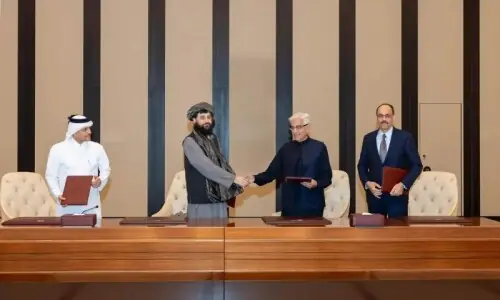
ISLAMABAD: Pakistan and Afghanistan agreed on Sunday to an immediate ceasefire along their volatile border after high-level negotiations in Doha, pledging also to create a permanent mechanism to foster lasting peace and stability between the two nations, state-run PTV News reported.
The accord, reached after 13 hours of talks facilitated by Qatar with Turkey serving as mediator, came amid a recent surge in cross-border clashes that have claimed dozens of lives on both sides and heightened regional tensions.
Officials from both countries expressed cautious optimism that the deal could halt the violence, though deep-seated security concerns persist. “During the negotiations held in Doha between Pakistan and Afghanistan, both countries agreed on an immediate ceasefire,” PTV News reported in a post on the social media platform X, citing the Qatar Ministry of Foreign Affairs. “During the talks, both countries not only agreed on an immediate ceasefire but also decided to establish a permanent mechanism for bilateral peace and stability.”
The agreement includes plans for follow-up meetings in the coming days to oversee the implementation and continuity of the ceasefire. “These measures will prove beneficial in promoting security and stability in both Pakistan and Afghanistan,” the post said.
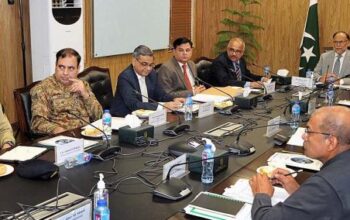
A high-level Pakistani delegation, led by Defence Minister Khawaja Asif and including senior intelligence officials, reached Doha on Saturday for the discussions. The Afghan side was headed by Defence Minister Maulvi Sahib Muhammad Yaqub Mujahid, with intelligence chief Mullah Wasiq also in attendance, according to reports from Afghanistan.
Zabiullah Mujahid, the spokesman for the Taliban government in Kabul, confirmed the Afghan delegation’s departure in a post on X. “As it was promised that negotiations would be held with the Pakistani side, a high-level delegation of the Islamic Emirate, led by the Minister of Defence Maulvi Sahib Muhammad Yaqub Mujahid, left for Doha today,” he wrote.
The talks followed a temporary 48-hour cease-fire announced by Pakistan’s Foreign Office on Wednesday, which was extended on Friday to allow for the negotiations. Even as the discussions proceeded, Pakistan reiterated its stance against escalation while pressing Afghanistan to address militant activities originating from its territory.
“Pakistan does not seek escalation but urges the Afghan Taliban authorities to honour their commitments to the international community and address Pakistan’s legitimate security concerns by taking verifiable action against terrorist entities,” a Foreign Office statement said on Saturday. “Pakistan appreciates the mediation efforts of Qatar and hopes these discussions contribute to peace and stability in the region.”
The ceasefire comes after a week of intense hostilities that began on the night of Oct. 11, when Afghan forces launched what Pakistan described as an unprovoked attack on its border posts. The clashes resulted in the deaths of 23 Pakistani soldiers and more than 200 Taliban and affiliated militants, according to the Inter-Services Public Relations, the Pakistani military’s media wing. In response, Pakistan conducted precision strikes inside Afghanistan’s Kandahar Province and near Kabul, targeting militant camps and border positions. Afghanistan characterized its initial assault as retaliatory, accusing Pakistan of carrying out airstrikes on its territory the previous Thursday — an allegation that Islamabad has neither confirmed nor denied.
Fighting erupted again on Tuesday, Oct. 14, with exchanges of fire between Afghan Taliban forces, militants from the group known as Fitna al Khawarij — a term used by Pakistani authorities for terrorists affiliated with the banned Tehreek-i-Taliban Pakistan (TTP) — and Pakistani troops at the Kurram border.
On Wednesday, Pakistan launched additional precision strikes in Kandahar and Kabul. Then, on Friday, even as the cease-fire extension was in place, Pakistan targeted hideouts of the outlawed Hafiz Gul Bahadur group in the Angoor Adda region and across Afghanistan’s Urgun and Barmal districts in Paktika Province. These strikes followed an audacious gun-and-bomb attack on a military installation in North Waziristan, which occurred just hours after the cease-fire extension.
Information Minister Attaullah Tarar of Pakistan detailed the operations in a post on X, saying that Pakistan had struck verified camps of the Gul Bahadur group in border areas of North and South Waziristan districts along the Pak-Afghan border. “During the 48-hour ceasefire, terrorists operating from Afghanistan attempted to launch multiple terrorist attacks inside Pakistan, which were effectively countered by security forces,” Tarar wrote. “During the effective responses by security forces, more than 100 kharjis were sent to hell.”
He added that terrorists had carried out an improvised explosive device attack in North Waziristan, in which civilians and a soldier were killed, and multiple others were injured. “Against kharjis of Gul Bahadur Group, precision strikes were undertaken last night. In these precision strikes, [a] minimum [of] 60-70 kharjis and their leadership have been sent to hell based on confirmed intelligence reports,” the minister said. “All speculations and assertions being made regarding targeting of civilians are false and meant to generate support for terrorist groups operating from inside Afghanistan.”
“Pakistan sincerely believes that [the] path forward lies in resolving this complex issue of Indian-sponsored terrorism emanating from Afghan soil through talks and control of non-state actors by Afghan authorities. However, Pakistan has all the rights to safeguard its territorial integrity and the lives of the people of Pakistan, and we shall not allow terrorists operating from inside Afghanistan to live in peace,” Tarar added.
The broader context of these events is a longstanding strain in relations between Islamabad and Kabul, which has intensified since 2023. Pakistan has repeatedly accused Afghanistan of allowing its soil to be used by militants for cross-border attacks, particularly after the TTP ended its own ceasefire with Islamabad in November 2022. This has led to a deterioration in security in Pakistan’s Khyber Pakhtunkhwa and Balochistan provinces. Kabul has maintained that it does not permit its territory to be used against any country, but Islamabad continues to criticise the Taliban authorities for failing to curb TTP-led assaults.
Copyright © 2021 Independent Pakistan | All rights reserved