By Staff Reporter
ISLAMABAD: The Pakistan Navy anticipates that its first Chinese-designed submarine will enter active service next year, a development that underscores the deepening military collaboration between Islamabad and Beijing amid regional tensions.
In an interview with the Global Times, a Chinese state media outlet, published on Sunday, Chief of Naval Staff Admiral Naveed Ashraf said a deal for eight Hangor-class submarines, slated for delivery by 2028, was “progressing smoothly.”
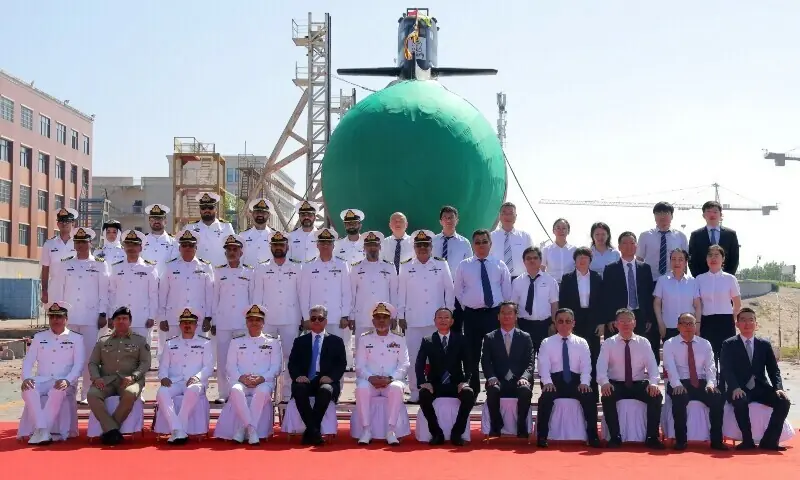
He described the successful launch of the second and third submarines in China earlier this year as a major milestone for naval cooperation between the two countries. The project, Admiral Ashraf said, was not only significant for advancing the Pakistan Navy’s submarine force capabilities but would also contribute toward self-reliance through the transfer of technology and skill development at Karachi Shipyard and Engineering Works.
The submarine agreement, reportedly worth up to $5 billion, calls for the first four diesel-electric attack submarines to be built in China, with the remaining vessels assembled in Pakistan to enhance the nation’s technical capabilities. Pakistan has already launched three of the submarines into China’s Yangtze River from a shipyard in the central province of Hubei.
“Chinese-origin platforms and equipment have been reliable, technologically advanced and well-suited to Pakistan Navy’s operational requirements,” Admiral Ashraf told the Global Times, adding that the navy’s experience with them had been positive, both in terms of performance and technical support.
The admiral also highlighted the Type 054A/P frigates as another major achievement in China-Pakistan naval cooperation. Such multirole frigates were already in service with the Pakistan Navy, he said, describing them as “among the most advanced surface combatants.” These Chinese-made frigates had greatly strengthened the navy’s multi-mission capability, particularly in air defence, anti-submarine warfare and maritime surveillance, Admiral Ashraf said.
“These platforms are playing a key role in ensuring maritime security in the North Arabian Sea and the broader Indian Ocean region, which is critical for global economy,” he was quoted as saying.
The update on the submarine deal comes months after the Pakistan Air Force used Chinese-made J-10 fighter jets in May to shoot down an Indian Air Force Rafale aircraft, made by France. The altercation between the nuclear-armed neighbours surprised many in the military community and raised questions over the superiority of Western hardware over Chinese alternatives.
Islamabad has long been Beijing’s top arms customer. Over the 2020-2024 period, Pakistan bought over 60 percent of China’s weapons exports, according to data from the Stockholm International Peace Research Institute.
Looking ahead, Admiral Ashraf emphasised that the Pakistan Navy’s partnership with China was built on deep-rooted friendship, mutual respect, trust and shared strategic interests. “In the coming decade, we expect this relationship to grow, encompassing not only shipbuilding and training, but also enhanced interoperability, research, technology sharing and industrial collaboration,” he was quoted as saying.
“There is immense potential for cooperation in advanced technologies, unmanned systems, marine scientific research and maritime industry development. Together, we aim to ensure a secure and stable maritime environment that supports regional peace and prosperity,” he added, noting that China has been a “trusted partner in the Pakistan Navy’s modernisation journey.”
Admiral Ashraf further said that the introduction of advanced frigates and submarines had significantly enhanced the Pakistan Navy’s operational reach, multi-domain war-fighting capabilities, and deterrence posture.
He added that these platforms, along with joint training and exercises with China, had deepened the two sides’ professional synergy and strengthened interoperability at sea, noting that “this cooperation goes beyond hardware; it reflects a shared strategic outlook, mutual trust, and a long-standing partnership.” “As modern warfare evolves, emerging technologies such as unmanned systems, artificial intelligence and advanced electronic warfare systems are becoming increasingly important. The Pakistan Navy is focusing on these technologies and exploring collaboration with China,” Admiral Ashraf said.
Copyright © 2021 Independent Pakistan | All rights reserved