
By Staff Reporter
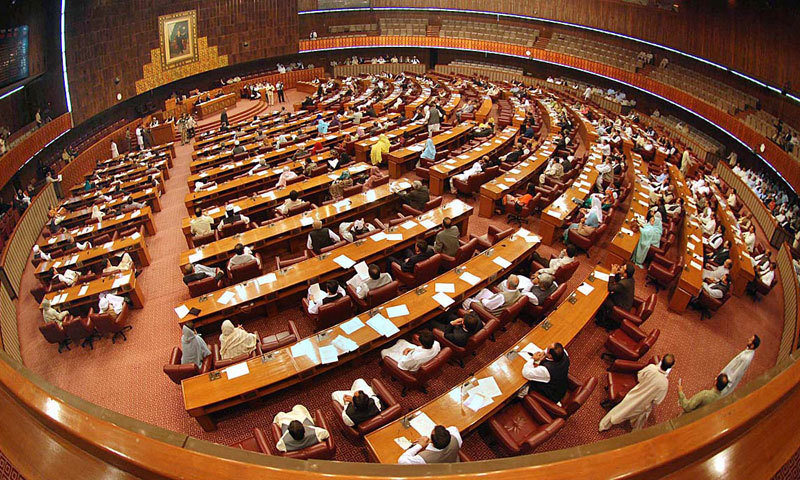
ISLAMABAD: The National Assembly appeared poised on Wednesday to approve a sweeping constitutional overhaul that would reshape the country’s judiciary and military institutions, after the lower house took up the measure amid fierce opposition protests and a boycott by critics who decried it as an assault on democratic principles.
The 27th Constitutional Amendment Bill, a 59-clause proposal introduced by Law Minister Azam Nazeer Tarar in the National Assembly on Tuesday, had already cleared the Senate a day earlier with 64 votes in the 96-member upper house and none against, as opposition lawmakers walked out and tore up copies of the legislation in a show of defiance.
Supporters included members of the treasury benches, senators from the Awami National Party, the Jamiat Ulema-e-Islam-Fazl’s Ahmed Khan and, in a notable departure, the Pakistan Tehreek-e-Insaf-backed Saifullah Abro, who later announced his resignation from the Senate.
With the PML-N-led coalition commanding a solid two-thirds majority in the 336-member National Assembly — including 125 seats for the PML-N, 74 for the Pakistan Peoples Party, 22 for the Muttahida Qaumi Movement-Pakistan, four each for the Pakistan Muslim League-Quaid and the Istehkam-e-Pakistan Party, and one apiece for the Pakistan Muslim League-Zia, the Balochistan Awami Party and the National Peoples Party — the bill’s passage seemed all but assured. The opposition, by contrast, holds a collective 103 seats.
Speaking on the floor of the National Assembly on Tuesday, Tarar urged bipartisan engagement, noting that the Senate had passed the measure with the required two-thirds majority. “In the joint parliamentary committee, the opposition should also have attended the session,” he said. His remarks were interrupted by a strong protest from the opposition benches, with lawmakers raising slogans against the amendments. Undeterred, Tarar outlined the bill’s key provisions, emphasising reforms to judicial processes. “World over, constitutional benches handle matters related to the Constitution… judicial appointments are made through judicial commissions,” he said. “In Pakistan, we have established a proper procedure and removed the powers of suo motu action in this bill.”
He said the amendments would create a Federal Constitutional Court to handle provincial matters and constitutional cases, while the Supreme Court would focus on more than 62,000 pending civil and other cases.
Tarar also addressed the bill’s implications for the military, praising its role in national defence. “The military played a crucial role when India attacked, and the entire House witnessed unity against the threat,” he said. “After our victory, the Organisation of Islamic Cooperation (OIC) and Arab countries praised and supported us.”
Regarding military ranks, he clarified: “The appointment of the army chief is made under the Army Act. A Field Marshal is a rank held in many countries and remains a lifetime honour. Appointments in the armed forces are based on rank, and the Field Marshal distinction continues to be a lifelong title.”
He stressed the need to align such honors with constitutional boundaries: “After a Field Marshal receives the rank, it is necessary to bring it within constitutional limits. We were part of the war committee and observed the army chief demonstrating exceptional performance and skill.” The law minister touched on a proposed exemption for the president, saying: “A special exemption has been proposed for the president… if the president returns to public office, the exemption will end. We request that this matter be debated and then put to a vote.”
Opposition leaders, however, lambasted the amendments as self-serving and undemocratic. Barrister Gohar, chairman of the Pakistan Tehreek-e-Insaf, dubbed them the “Baku Amendments,” a pointed reference to Prime Minister Shehbaz Sharif’s approval of the draft while on an official visit to Azerbaijan. “Buildings constructed for personal gain are considered monuments of slavery,” Gohar said. He accused the government of sidelining and closing cases to advance certain interests, calling the process deeply flawed. “Amending the constitution is a sensitive matter,” he said. “Today is a day of mourning for democracy, and steps are being taken to bury it. We do not accept these Baku Amendments.”
Copyright © 2021 Independent Pakistan | All rights reserved