By Staff Reporter
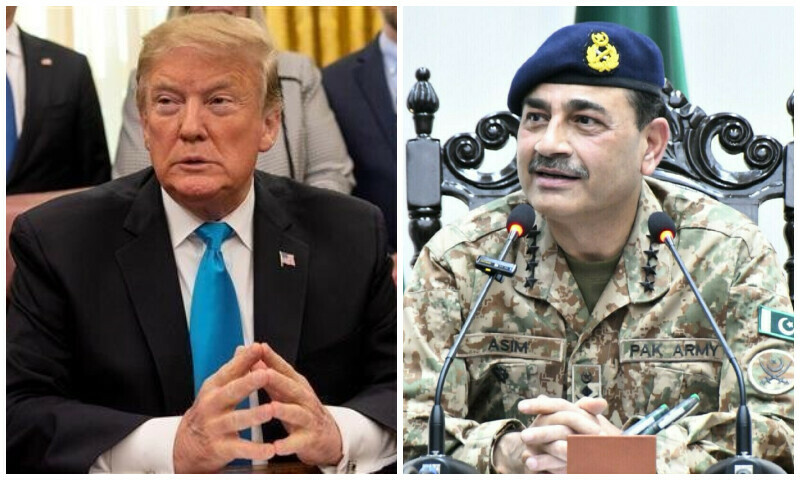
ISLAMABAD: Barely a year ago, American diplomats spoke of India as the indispensable counterweight to China in the Indo-Pacific, while Pakistan was often felt like a reluctant, troublesome partner kept at arm’s length. That calculus has been dramatically upended under President Donald Trump, who has showered praise on Pakistan’s powerful army chief, Air Marshal Asim Munir, calling him a “great guy” and crediting himself with averting nuclear catastrophe between the two rivals, even as he has slapped some of the world’s highest tariffs on India.
A Bloomberg News report published Friday, has thrilled officials in Islamabad, who now describe the brief but intense military confrontation with India in May as an unambiguous Pakistani triumph. It has also unsettled the bipartisan foreign-policy establishment in Washington, which for two decades nurtured ever-closer ties with New Delhi. “Almost all of our strategic interests lie with India,” Kurt Campbell, who served as deputy secretary of state in the Biden administration, told Bloomberg Television. A “wholesale collapse” in relations between Trump and Prime Minister Narendra Modi of India, he warned, would likely “lead to some lasting damage.”
A US Congress report says “a year ago, India was a central piece of the US’s strategy to work with allies and partners to pressure China, with Pakistan largely an afterthought. Now US-Pakistan relations are on the rise as Trump hits India with high tariffs, upending more than two decades of US policy aimed at improving relations with the world’s biggest democracy.”
Trump has made no secret of his admiration for General Munir, the once-obscure officer who has emerged as a national hero in Pakistan since the May clash. The president now routinely places the Pakistani general on the same plane as Modi when discussing the region’s volatile nuclear standoff. The shift has revived Pakistan’s standing as a geopolitical player at a moment when Islamabad is moving swiftly to align itself with Trump’s stated priorities, cryptocurrency regulation, counterterrorism cooperation and trade, while deepening defence and economic ties with Saudi Arabia and courting American investment in its vast mineral reserves.
In Islamabad, the mood is buoyant. “We defended ourselves and we won,” State Minister for Finance Bilal Azhar Kayani told Bloomberg. “But in addition to that, the way we have conducted ourselves diplomatically in a changing and fluid global landscape has been commendable.” The May confrontation, which brought the nuclear-armed neighbors to the brink of broader war, has been recast inside Pakistan as proof of both military prowess and diplomatic finesse.
Jay Truesdale, a former chief of staff at the United States Embassy in Islamabad and now chief executive of the geopolitical risk firm TDI, said the episode had produced a “firmer alignment between Pakistan’s military and civilian leaders.” “The way the Americans intervened and the outcome that took place, the Pakistanis can claim that they had a victory, and this has further galvanized the unity of effort,” Truesdale said.
American tariffs tell the story in numbers: Pakistani exports to the United States now face a 19 percent rate, far lower than the levies imposed on most South Asian nations and dramatically below the punishing duties on Indian goods. Some former officials see opportunity in the recalibration. Nisha Biswal, who served as assistant secretary of state for South and Central Asian affairs in the Obama administration, argued that a robust relationship with Pakistan could give Washington “leverage over India.” “The extent to which the US can exert leverage and pressure on Pakistan, and has the relationship to do so in times of crisis, is an important aspect,” Biswal said. “You don’t want a Pakistan that is impervious to US influence.”
Pakistan has wasted no time capitalising on the opening. Last month it signed an economic pact with Saudi Arabia shortly after concluding a mutual-defence agreement with the kingdom. American companies, meanwhile, are exploring Pakistan’s rare-earth deposits; in September, US Strategic Metals signed a memorandum of understanding to develop those resources after General Munir met executives in Florida. “We’d like this to become a political win for America,” said Mike Hollomon, commercial director at U.S. Strategic Metals.
Yet the sudden warmth carries risks. Pakistan’s military spokesman, Maj. Gen. Ahmed Sharif Chaudhry, struck a confident note in an interview. “Not only the Americans, but the world everywhere, they find in Pakistan right now a leadership that, despite all the challenges, is handling the affairs in a great manner,” he said. Finance Minister Muhammad Aurangzeb was more circumspect about navigating relations with both Washington and Beijing, Pakistan’s largest arms supplier and infrastructure financier. “China has been a longstanding partner, so has the US,” Aurangzeb said. “They both know that we are well engaged on both ends.”
However, Bloomberg says “a challenge for Pakistan is whether it can trust Trump and balance relations with the US and China, Islamabad’s top supplier of weapons, infrastructure and aid”.
Copyright © 2021 Independent Pakistan | All rights reserved