By Staff Reporter
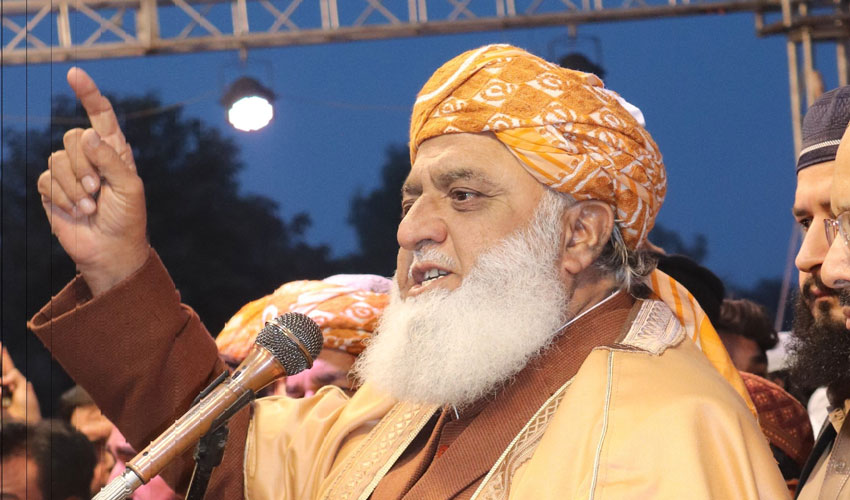
ISLAMABAD: Maulana Fazlur Rehman, the influential leader of the conservative and pro-Taliban Jamiat Ulema-i-Islam-Fazl party, on Tuesday criticised a series of recent legislative measures in Pakistan aimed at curbing domestic violence, prohibiting child marriages and advancing transgender rights, framing them as departures from Islamic principles and undue influences from international bodies.
Speaking to reporters in the capital, Rehman, a veteran politician and religious scholar known for his staunch opposition to secular reforms, described the laws as creating “hindrances” in traditional marital practices and questioned their alignment with religious jurisprudence. “Some legislation has been enacted regarding the marriage of children below the age of 18 years, regarding transgenders, and regarding domestic violence,” he said.
The remarks come amid a push by provincial and federal lawmakers to strengthen protections for vulnerable groups, including women, children and transgender individuals, in a country where rights advocates have long highlighted pervasive issues like early marriages and gender-based violence. Pakistan has more than 19 million child brides, with nearly one in six young women married before age 18, according to data from the United Nations International Children’s Emergency Fund.
On Nov. 13, the National Assembly passed the Domestic Violence (Prevention and Protection) Bill 2025, which awaits Senate approval and seeks to create a framework for safeguarding women, men, transgender people, children and other vulnerable individuals from abuse in the home. The measure includes penalties of up to three years in prison and fines as high as Rs100,000 for offences not covered under the existing penal code.
The following day, the Balochistan Assembly approved a bill banning child marriages, despite protests from opposition members, including Younis Zehri of Rehman’s party. In September, the Balochistan cabinet had endorsed the province’s inaugural transgender policy, designed to promote social and economic inclusion for the community.
Rehman took particular issue with the classification of those under 18 as minors in the context of marriage, challenging the religious basis for such a threshold. “Strengthening the law to the point that if a marriage or nikkah is done before 18, it will be called sexual abuse and will be interpreted as rape, and a punishment will be given accordingly,” he said, asking which Islamic sect’s laws defined 18 as the age of maturity.
He termed it a “weird point” and a “joke” that a child born from such a union would be considered legitimate, with the father obligated to provide financial support. While it remains unclear if the recent bills explicitly address this scenario, a March ruling by the Lahore High Court held that a biological father must maintain a child even if conceived through rape. Sindh province and the Islamabad Capital Territory already set 18 as the minimum marriage age for girls, and Punjab is preparing to introduce similar legislation under the Child Marriage Restraint Act.
Drawing historical parallels, Rehman invoked the Protection of Women Bill of 2006, enacted during the military rule of Gen. Pervez Musharraf to revise the controversial Hudood ordinances despite resistance from religious groups. He noted that the Pakistan People’s Party, now governing Balochistan where the child marriage ban and transgender policy originated, had supported that earlier measure. “Today as well, hindrances were being created in the way of permitted nikkah,” he said.
On transgender rights, Rehman demanded justification for allowing those born as “a complete male or a complete female” to alter their gender. “Perhaps, they do not even have as much freedom there in the West as we have given them here in the Islamic Republic of Pakistan,” he claimed.
He expressed disappointment in the government of Prime Minister Shehbaz Sharif and his Pakistan Muslim League-Nawaz party, saying he had not anticipated such policies from them. Accusing the measures of advancing a United Nations “agenda,” Rehman labeled international rights conventions as forms of “slavery.” In the same briefing, Rehman broadened his critique to the newly passed 27th Amendment to the Constitution, which has drawn fire from opposition factions for granting enhanced privileges to senior military officials. While commending the armed forces for their valor in the May conflict with India, he decried the “lifetime perks” as unnecessary in a democratic society. “These are perhaps such unique perks that Pakistan’s democratic society does not require them at all,” he said.
Urging President Asif Ali Zardari and the chiefs of the army, navy and air force to renounce the lifetime immunity provided under the amendment, Rehman faulted the Pakistan People’s Party for undermining democracy rather than championing it, especially after failing to thwart elements of the prior 26th Amendment. He further argued that the amendment overlooked the roles of the Federal Shariat Court and the Supreme Court’s Shariat Appellate Bench, potentially sowing confusion over appeals, which might fall to either the Supreme Court or a new Federal Constitutional Court.
Copyright © 2021 Independent Pakistan | All rights reserved