By Staff Reporter
ISLAMABAD: Iran’s top security official called on Wednesday for bolstering military cooperation with Pakistan to confront cross-border terrorism, emphasising the shared threats facing the two nations amid persistent regional instability.
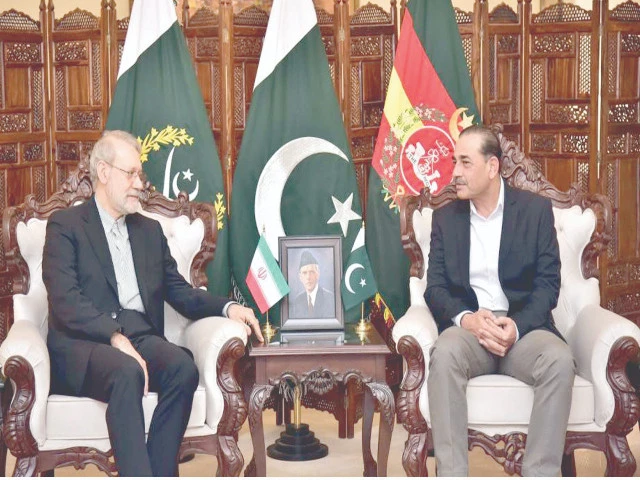
Ali Larijani, secretary of Iran’s Supreme National Security Council and an adviser to the country’s supreme leader, made the appeal during a news conference in the Pakistani capital, where he wrapped up a two-day visit aimed at deepening bilateral ties.
His remarks came against a backdrop of heightened concerns over militant activity along the porous border shared by Iran, Pakistan and Afghanistan. “The joint mechanism between the militaries of the two countries would enable more effective operations against cross-border terrorism,” Larijani said, praising Pakistan’s existing efforts to curb extremist groups. He added that both Tehran and Islamabad remained “committed to taking joint action against terrorism.”
Larijani’s trip, which began on Monday, included high-level discussions with Pakistan’s leadership. On Tuesday, he met with Prime Minister Shehbaz Sharif and Deputy Prime Minister and Foreign Minister Ishaq Dar, where the two sides reaffirmed their dedication to expanding cooperation on regional and international matters.
Earlier on Wednesday, Larijani conferred with Pakistan’s chief of army staff, Field Marshal Syed Asim Munir, at the military’s General Headquarters. There, the Iranian official commended Pakistan’s contributions to regional peace and security.
Beyond counterterrorism, Larijani signaled Iran’s willingness to assist in easing frictions between Pakistan and Afghanistan, a longstanding source of tension involving border disputes and militant incursions. “Tehran stood ready to play its part in resolving the ongoing tensions between Pakistan and Afghanistan,” he said, noting that Iran would “respond positively whenever Pakistan asks for its role.”
He acknowledged Pakistan’s past solidarity with Iran during challenging periods, saying, “Pakistan stood by Iran in difficult times, and we deeply value the cooperation of both the Pakistani government and its people.” Larijani described the differences between Pakistan and Afghanistan as “a significant challenge for regional stability,” and reiterated Iran’s commitment to exploring avenues for resolution while working closely with Islamabad.
The Iranian leader also addressed the conflict in Gaza, stressing the need for Palestinian self-determination. “The Palestinian people should have the right to elect their own government through open elections,” he said.
He dismissed American proposals for peace in the region as inadequate, arguing that they provided only “temporary solutions” while “creating larger problems.” International peacekeeping forces, he cautioned, often served as short-term measures that could lead to further complications.
Larijani clarified that any Pakistani involvement in a Gaza peacekeeping force would be “entirely its decision.” On the sensitive issue of Iran-United States relations, Larijani welcomed potential Pakistani mediation. “Pakistan has repeatedly offered joint meetings, which Iran respects,” he said, adding that Tehran would embrace “any positive and constructive initiative.” He described Pakistan’s role in such efforts as “positive” and expressed readiness for “constructive dialogue,” concluding that “our bilateral cooperation is moving in the right direction, and both our nations are united in the fight against terrorism.”
A key economic thread in Larijani’s comments centered on the long-stalled Iran-Pakistan gas pipeline project, intended to supply natural gas from Iran to energy-starved Pakistan. He asserted that Iran had met its commitments, with the pipeline “completed up to the border.” “If there had been no obstacles, Pakistani households would already be using Iranian gas,” Larijani said, expressing hope for a swift resolution.
He reiterated, “The pipeline is ready up to the border, and if there were no disruptions, Pakistani citizens would be benefiting from Iranian gas today.” The project has been hampered by international sanctions on Iran, financing hurdles and geopolitical pressures, though neither side elaborated on specific barriers during the news conference.
Copyright © 2021 Independent Pakistan | All rights reserved