By Staff Reporter
ISLAMABAD: Prime Minister Shehbaz Sharif said the country has emerged from a near-default economic crisis, crediting government efforts for stabilising key indicators and securing a fresh $1.2 billion disbursement from the International Monetary Fund.
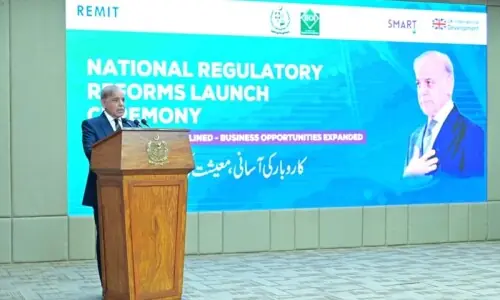
Speaking at the launch of national regulatory reforms in Islamabad on Saturday, Sharif said the economy was in dire straits when his administration took power, with inflation surging, interest rates stifling growth and business confidence in tatters. “We were at the verge of financial default. Our inflation was galloping and policy rate was crippling. So, one could not imagine any kind of investment in Pakistan, let alone foreign direct investments. And the business in the country was in turmoil. But we did not lose hope,” he said.
The premier highlighted how the government confronted “very scary challenges” through teamwork and planning, emphasising the need to “spill blood and sweat” to meet targets. “And this was the commitment, unwavering determination to walk in that very difficult path in the last one and a half year. And here we are. And today, Alhamdulillah, we are now discussing how to now move forward and grow our economy,” Sharif added.
The event included the unveiling of Regimeter, a portal to monitor reforms approved by a cabinet committee and gather private-sector feedback. Sharif called the framework a “quantum jump” that would ease burdens on industrialists and businesses plagued by cumbersome rules, paving the way for foreign investment in agriculture, information technology, mines and minerals.
He also stressed opportunities for Pakistan’s young population through vocational training with international certification, enabling jobs at home and abroad to boost prosperity. Sharif commended federal and provincial teams for their coordination and thanked the UK government and its international development arm for support, describing Britain as a key partner alongside allies in the Middle East, Saudi Arabia and the US. “Pakistan had a wonderful relation with United Kingdom and they were looking forward to a wonderful time of mutual cooperation,” he said.
Haroon Akhtar Khan, special assistant to the prime minister for industry and production, framed the reforms as part of a broader shift from a regulatory to a developmental state, anchored by tariff rationalization, modernization and export-driven revival. “Under the new national tariff policy, we are moving towards predictability, competitiveness and phasing out of arbitrary duties,” Khan said.
UK Minister of State for International Development Jenny Chapman praised Pakistan’s entrepreneurial potential, natural resources and strategic trade position, labeling the reforms a shared ambition. “The links between our people play a huge part in the flow of trade and investment between our two countries as well. Trade is now at 5.5 billion pounds a year. We’ve got a new trade dialogue and we’re supporting Pakistan’s efforts to work with the 1.6 million strong Pakistani diaspora in the UK to unlock private capital,” she said.
The IMF’s latest outlook, released alongside the tranche approval, projects Pakistan’s growth rising modestly to 3.2% by fiscal 2026 from 2.6% this year, though the Fund warns of persistent debt burdens, subdued expansion and scant household relief amid a fragile stabilization.
Copyright © 2021 Independent Pakistan | All rights reserved