By Staff Reporter
RAWALPINDI: Pakistan’s military on Tuesday delivered a blistering indictment of the Afghan Taliban government, accusing it of turning Afghanistan into a breeding ground for terrorists who carried out thousands of attacks inside Pakistan last year, many with alleged financial and logistical support from India.
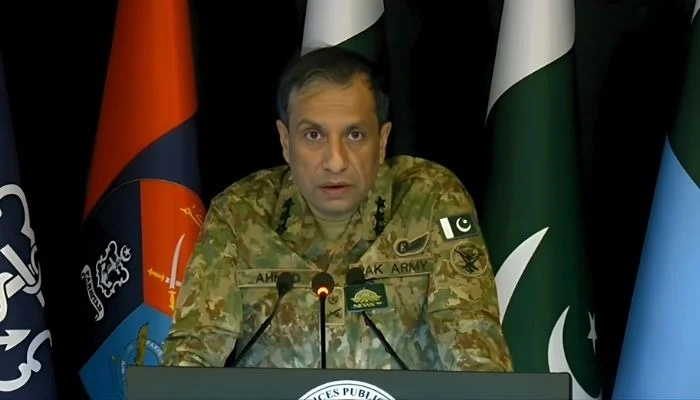
In a rare, hours long news conference at army headquarters, Lt. Gen. Ahmed Sharif Chaudhry, the chief military spokesman, detailed the toll of what he called a “landmark” year in the country’s fight against militancy: more than 5,000 terrorist incidents, 27 suicide bombings and the deaths of 1,235 civilians and security personnel. Security forces, in turn, conducted over 75,000 operations, killing 2,597 militants — a reversal from earlier years when losses tilted heavily against Pakistani troops.
The briefing, held on the first Tuesday of the new year, reflected growing frustration in Islamabad over cross-border threats, even as independent monitors reported a late-2025 dip in violence after Pakistan sealed parts of its frontier with Afghanistan.
General Chaudhry reserved some of his sharpest criticism for the Taliban rulers in Kabul, saying they had reneged on promises made in the 2020 Doha agreement with the United States to prevent their soil from being used for attacks abroad, to form an inclusive government and to safeguard women’s rights. “Were the commitments fulfilled?” he asked. “They were not. Is there a government there? There is no government there. They just call themselves interim Afghan government. Is there an inclusive government there? No, there is not. Has terrorism been eradicated from Afghanistan? Contrarily, Afghanistan has become a hub of terrorists and non-state actors.”
Pakistan has long viewed the Taliban’s 2021 takeover as a catalyst for renewed instability, with groups like the Tehreek-i-Taliban Pakistan — which the military now terms Fitna-al-Khawarij, invoking a historical Islamic reference to rebels — finding safe haven across the border.
General Chaudhry said the Taliban had restructured the TTP to mirror its own organization, providing training, direction and a false narrative of heroism in ousting American forces to lure recruits. But the real drivers of the US withdrawal, he argued, lay elsewhere: a failed reconstruction effort that poured $144 billion into Afghanistan, according to a report by the Special Inspector General for Afghanistan Reconstruction, only to sustain a “war economy” that the Taliban now perpetuated by fanning regional unrest. Left-behind American weaponry valued at $7.2 billion — from night-vision gear to M-4 rifles — had flooded black markets, arming insurgents.
The general said the Taliban has propagated a fake narrative, boasting that it forced the United States and international coalition forces to withdraw from Afghanistan “On the basis of that, they start further polluting the minds of youngsters, the youth and religious-minded people… They present themselves as the flag-bearers of Islam and increase their recruitment.”
Complicating matters, General Chaudhry said, was India’s role as the “biggest patron” for these groups, channeling funds and support through Afghan proxies. He pointed to a surge in attacks after Pakistan’s forces repelled an Indian incursion in a brief May 2025 clash, suggesting New Delhi had turned to nonstate actors for retaliation. “After its defeat, Indians immediately sought to influence non-state actors.” When foreign funding dried up after the US withdrawal, the Taliban sustained its “war economy” by exporting terrorism across the region, seeking new patrons and sponsors — with India emerging as the primary backer for attacks in Pakistan”. “Their patron — India — provides them with funds, technical inventory and other assistance,” General Chaudhry said. “So they have now started going into this armed quadcopter business. They also have a special wing for quadcopters in their organizations. They also use mosques, public places and houses as human shields.”
Tensions boiled over in October, when Pakistani strikes targeted TTP camps inside Afghanistan, prompting Taliban forces to fire on border posts. Pakistan responded forcefully. “Dozens of Afghan posts were obliterated within hours, and a hard message was sent,” General Chaudhry recounted, emphasising that the strikes hit only Pakistani militants operating there, not Afghan Taliban units or civilians. “We targeted our own citizens who were present there and involved in terrorism in Pakistan. They have training centers there. We knew TTP was present there. Did we target TTA? No, we did not.”
The border closure that followed curbed infiltration, he said, with militant deaths averaging 276 per month in the final quarter — “signs here for those who can understand.” He dismissed any equivalence with India’s actions. “Who is India to cause harm to any Pakistani citizen? Whoever tried to point out similarities between the two developments was lying.”
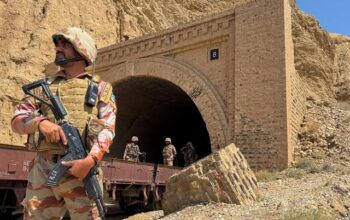
Inside Pakistan, the violence centered on two provinces. Khyber Pakhtunkhwa, which saw 71 percent of incidents (3,811 total), and Balochistan, with 29 percent (1,557). Operations mirrored that focus, with 14,658 in the northwest and 58,778 in the southwest, averaging 206 daily nationwide. All 10 major attacks last year — including bombings of the Jaffar Express train (21 civilians killed), a bus in Noshki, Frontier Corps bases in Quetta and Peshawar, and an attempted assault on Cadet College Wana echoing the 2014 Peshawar school massacre — involved Afghans, General Chaudhry said. Security forces killed all 78 perpetrators; none escaped.
The ISPR chief played video confessions from detainees and named high-value kills, like the TTP’s No. 2, Amjad Ali. At one point, he paused to honor the dead, asking the room to stand and salute the “martyrs.” “This is the fight of the people,” he said. “The narrative they create that it is the military’s fight is false. If we and you did not stand up against them, they would blow themselves up in your homes, markets, offices, schools and streets until you adopt their perverted ideology.”
Domestically, General Chaudhry faulted “internal facilitators,” particularly in politics, for enabling the threat. Without naming former prime minister Imran Khan’s Pakistan Tehreek-e-Insaf party, which controls Khyber Pakhtunkhwa, he lambasted its opposition to operations and calls for talks with militants. He screened a clip of Khyber Pakhtunkhwa Chief Minister Sohail Afridi questioning why only Pakistan faced Afghan-based terrorism, then rebutted it with reports of similar complaints from other neighbours. “The primary reason for this is the politically conducive environment provided to terrorists, and the political-terror nexus that is flourishing in the province,” he said. “What policy of appeasement is this in which you are begging Kabul?”
He questioned why militants had spared the jailed Khan’s party. “It is because they want to become the favorites of Fitna-al-Khawarij.” A PTI leader and former speaker of the National Assembly, Asad Qaiser, had rejected operations, drawing a sarcastic riposte. “If you do not want a military operation, then what should be done — sit at the feet of khawarij? Should khawarij leader Noor Wali Mehsud be made the province’s chief minister and allegiance pledged to him?”
General Chaudhry contrasted this with the nationalist Awami National Party, targeted after opposing terrorism, implying the current leadership shied from confrontation. “They are saying that they are not ready to die. That they will not stand up. That they will join them.”
Broader issues like low convictions in terror cases, rampant illegal weapons and narcotics — “it has a direct bearing on our counter-terrorism efforts” — and sluggish Afghan repatriation in Khyber Pakhtunkhwa compounded the problem. Only five of 43 refugee camps there had been cleared, versus all in Punjab and Balochistan; of 150,000 returnees, just 1.2 percent were deported, hinting at political interference.
Balochistan, however, offered a brighter spot under the revived National Action Plan, the framework for the Azm-i-Istehkam campaign. District committees integrating local officials, military and intelligence had convened 472 times since February, deploying Rs31 billion for 127 completed projects, 949 planned and 54,000 community engagements. Police now held sway provincewide, with Rs5 billion for training and curbs on Iranian oil smuggling to sever terror-crime links.
General Chaudhry addressed militant tactics, like 405 quadcopter strikes in Khyber Pakhtunkhwa using Indian-supplied gear, and clarified Pakistani drone use: surveillance only, with no collateral damage. “We use it with care, and your army does not cause any collateral damage. We hit only terrorists and their facilitators.” He also called out “promoters of terrorism under the guise of human rights,” citing a Balochistan professor’s confession to terror ties, defended by some journalists, the Baloch Yakjehti Committee and a human right activist. And also social media’s role in spreading terror demanded action. “There are a few things in life worth fighting for, where fighting is not only justified but necessary, and there is no alternative. We have to win this fight, not by appeasement, but by force and strength. No power in the world can stop us from winning this fight,” the military spokesman said.
Copyright © 2021 Independent Pakistan | All rights reserved