By Staff Reporter
ISLAMABAD: Pakistan is holding off on a decision to contribute troops to an international stabilization force in Gaza until the United States provides clear answers on its mandate and funding, a Foreign Office spokesman said on Thursday, as the country grapples with persistent cross-border terrorism from Afghanistan that has strained relations with its neighbour.
The announcement shows Islamabad’s cautious approach to regional engagements, balancing potential involvement in Middle East peacekeeping with demands for concrete commitments from Kabul to curb militant activities. Tensions with Afghanistan have intensified in recent months, culminating in military strikes and border closures last year, even as Pakistan explores deeper defence ties with Saudi Arabia.
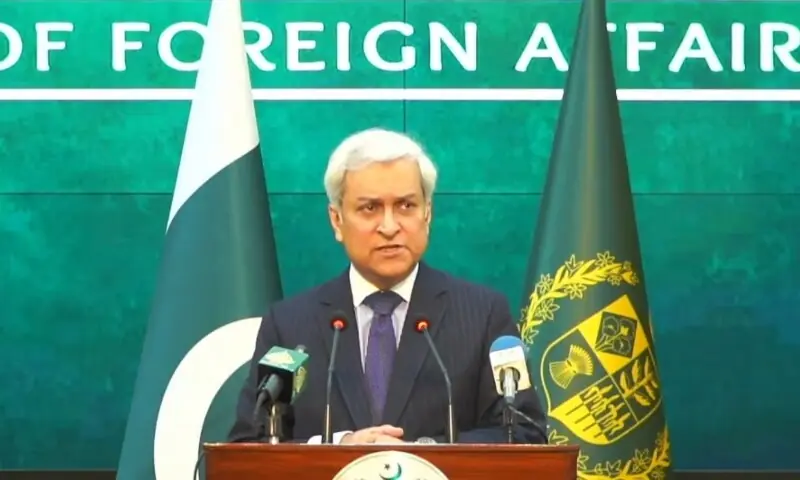
Foreign Office spokesman Tahir Andrabi, addressing reporters at a weekly briefing, said Pakistan’s participation in the Gaza force hinges on specifics from Washington. “As regard to the International Stabilization Force [in Gaza], as I said, in a number of my replies, that, and in fact, what the deputy prime minister also said here, that that it depends on the mandate, and in regards to the balance of that force,” he said.
Andrabi was responding to comments last month by US Secretary of State Marco Rubio, who acknowledged that potential contributors, including Pakistan, were seeking details on the force’s scope and financing. “We still wait for answers with respect to those questions,” the spokesman added.
Pakistan’s Deputy Prime Minister Ishaq Dar had signaled interest in the force last month, clarifying that any contribution would not involve disarming Hamas. International reports have highlighted Washington’s view of Pakistan’s military as a valuable asset for such missions, given its experience in counterinsurgency operations.
Andrabi noted recent phone calls between Dar and Saudi Foreign Minister Faisal bin Farhan, welcoming Riyadh’s statements on Yemen and praising efforts to resolve regional conflicts peacefully. On defence cooperation with Saudi Arabia, the spokesman described it as “robust,” but demurred on a Reuters report suggesting talks to convert $2 billion in Saudi loans into a deal for JF-17 fighter jets. “I am not aware of any particular deal, regarding any platform or any systems and its financial adjustment. But this is a development that we would confirm upon materialisation.”
He similarly had no details on potential deployments of Pakistani troops to support Saudi operations in Yemen. “We have, as I said, robust defence cooperation, many of these projects remain in the pipeline, but as regards the number of troops or an added number of troops, I do not have any information.”
Much of Thursday’s briefing focused on Afghanistan, where Pakistan insists the only major bilateral issue is terrorism originating from across the border. “We do not have any bilateral dispute with Afghanistan except for this one issue. Terrorism emanating from Afghanistan is a major issue. So we need verifiable assurances, commitments that these acts will be stopped,” Andrabi said. He reiterated demands for “concrete, verifiable, written assurances” from the Afghan Taliban that their territory would not be used by the banned Tehreek-i-Taliban Pakistan, which Islamabad refers to as Fitna-al-Khawarij.
“And this demand will stand unless we get concrete, verifiable, written assurances from the Afghan side that their soil will not be used,” he said, adding that resolving the issue could unlock Afghanistan’s potential as a regional connectivity hub. “Such commitments from Afghanistan are in the interest of its own country. This is a legal demand and could be fulfilled. This could lead to improvement in all bilateral relations.”
Pakistan has accused the Afghan Taliban of sheltering militants since 2021, despite assurances in the 2020 Doha agreement with the United States that terrorism would be eradicated from Afghan soil. Tensions boiled over in October 2025, when Pakistan conducted cross-border strikes targeting Tehreek-i-Taliban Pakistan and Gul Bahadur group camps after attacks on its security forces. The strikes led to skirmishes along the border, prompting Pakistan to close major crossings. A ceasefire was declared on Oct. 19, but trade has not resumed. Mediation by Qatar and Turkey failed to yield results.
In a press conference on Jan. 6, Lt. Gen. Ahmed Sharif Chaudhry, director general of the military’s Inter-Services Public Relations, described the Afghan Taliban as “the mother organisation” harboring such groups. “Afghanistan has become the centre of terrorist operations in the region,” he said. General Chaudhry also alleged a nexus between the militants, the Afghan Taliban and India, calling Indian Prime Minister Narendra Modi a “new hero” for the regime. “The nexus between Fitna Al-Khawarij, TTP, and India became fully exposed in 2025, posing a serious threat to regional peace and security,” he said.
Despite the strains, Andrabi stressed that diplomatic channels remain open, with embassies and consulates functioning. Pakistan continues to engage through the China-Afghanistan-Pakistan trilateral dialogue, though progress is tied to assurances on terrorism. The Afghan side, he said, has been unwilling to provide those commitments, but Islamabad “does not wish to be hostile to Afghanistan” and does not interfere in its internal affairs. “Incidents of terrorism emanating from Afghanistan are a primary concern for Pakistan. Our demand is that Afghan territory should not be used against Pakistan,” the spokesman said.
Copyright © 2021 Independent Pakistan | All rights reserved