By Staff Reporter
ISLAMABAD: Facing mounting criticism over the removal of thousands of mature trees across the capital, minister for climate change and environmental coordination on Friday defended the action as a necessary step to combat a public health threat, saying that nearly 29,000 invasive paper mulberry trees had been felled in compliance with a Supreme Court order.
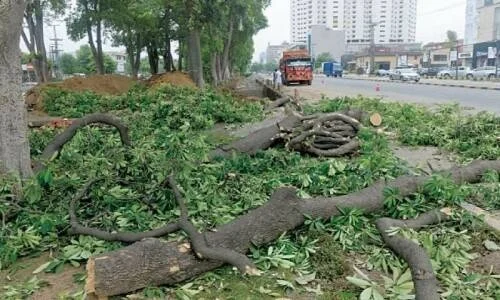
The trees, which officials say exacerbate allergies and have contributed to deaths among chronic asthma patients, were targeted in a campaign that has drawn sharp rebukes from residents and environmental advocates who argue that the cuts have gone too far, stripping away vital green cover in areas like Shakarparian and leaving patches of land barren.
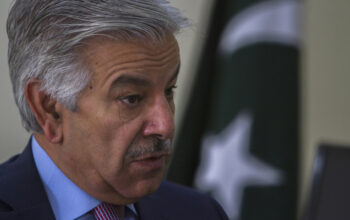
“Paper mulberry trees, which are a major cause of allergies and have caused deaths among chronic asthma patients, have been chopped following Supreme Court’s orders which were issued in 2023. In 2025, the order was again implemented to rid the city of this invasive species which is not indigenous and is life threatening,” Dr. Musadiq Malik, the minister, said during an appearance on a television talk show after chairing a high-level meeting on the issue. “It is planned not to plant non-indigenous species,” saying that for every tree removed, three new saplings or trees would be planted in its place.
The controversy erupted in recent weeks as crews from the Capital Development Authority cleared trees in several key locations, including Shakarparian, where at least four large patches have been reduced to near-desert conditions. Residents have reported that not only paper mulberry trees but also other species were cut down, though CDA officials have insisted that the removals were limited to the invasive mulberry.
In the H-8 sector, trees were felled as part of an upgrade to a local park, while in Chak Shahzad, decades-old growth was cleared to make way for a dual carriageway linking to a housing society developed jointly by the CDA and military’s Defence Housing Authority. Dr. Malik, in his remarks, traced the problem back to the 1960s, when the non-native paper mulberry trees were first introduced to Islamabad. He said the felling was undertaken only after consultations with the Ministry of Health confirmed the trees’ role as a significant health hazard.
A statement released by the Ministry of Climate Change after the meeting provided further details, noting that Dr. Malik had been briefed on the campaign’s progress in reducing the presence of the allergenic species, which it described as “a major contributor to severe allergies and asthma-related health issues among residents of the federal capital.” The effort, according to the statement, focused on selective removals in areas where paper mulberry concentrations exceeded 90 percent, such as Shakarparian, F-9 Park, and along the H-8 and H-9 sectors. These would be replaced with native, fruit-bearing trees and pine species.
“To safeguard Islamabad’s green cover, plans were underway to plant more trees against every tree removed under the campaign, ensuring that the city’s overall tree cover was not reduced,” the statement said. It highlighted intentions to install mature native trees to speed up ecological recovery and called for better coordination among agencies like the Environmental Protection Agency, the CDA, and the ministry to align plantation efforts with the upcoming spring season.
The meeting, convened amid widespread media scrutiny, was attended by prominent figures including Talal Chaudhry, the minister of state for interior; Mohammad Ali Randhawa, the CDA chairman; Aisha Moriana, the secretary for climate change; and senior representatives from the EPA, the Islamabad Wildlife Management Board and other bodies. Dr. Malik directed the development of “a transparent, well-defined and streamlined mechanism” to ensure compliance with laws governing environmental permissions and licensing.
Notably absent from the ministry’s official handout was any reference to tree cutting along Park Road in Chak Shahzad, one of the sites that has fueled public anger. In what appeared to be a response to the backlash, the CDA has launched a tree-planting drive this month — unusually early, as January typically brings frost and dew that make it less than ideal for such activities. In past years, the authority began its plantations around mid-February.
The campaign, centered initially in Shakarparian, has drawn fresh criticism on social media, with users questioning the timing and viability of planting in winter conditions. CDA officials have countered that only hardy species, like Chir pine, are being used — varieties they say can withstand the cold. They added that the effort, aiming to plant 30,000 trees, would ramp up next month.
The tree removals have a debate in Islamabad about balancing urban development and environmental health. While supporters of the campaign point to the Supreme Court’s directives and the documented risks from paper mulberry pollen, critics contend that the scale of the cuts risks undermining the city’s reputation as one of South Asia’s greenest capitals, potentially worsening air quality and heat in the long term.
Copyright © 2021 Independent Pakistan | All rights reserved